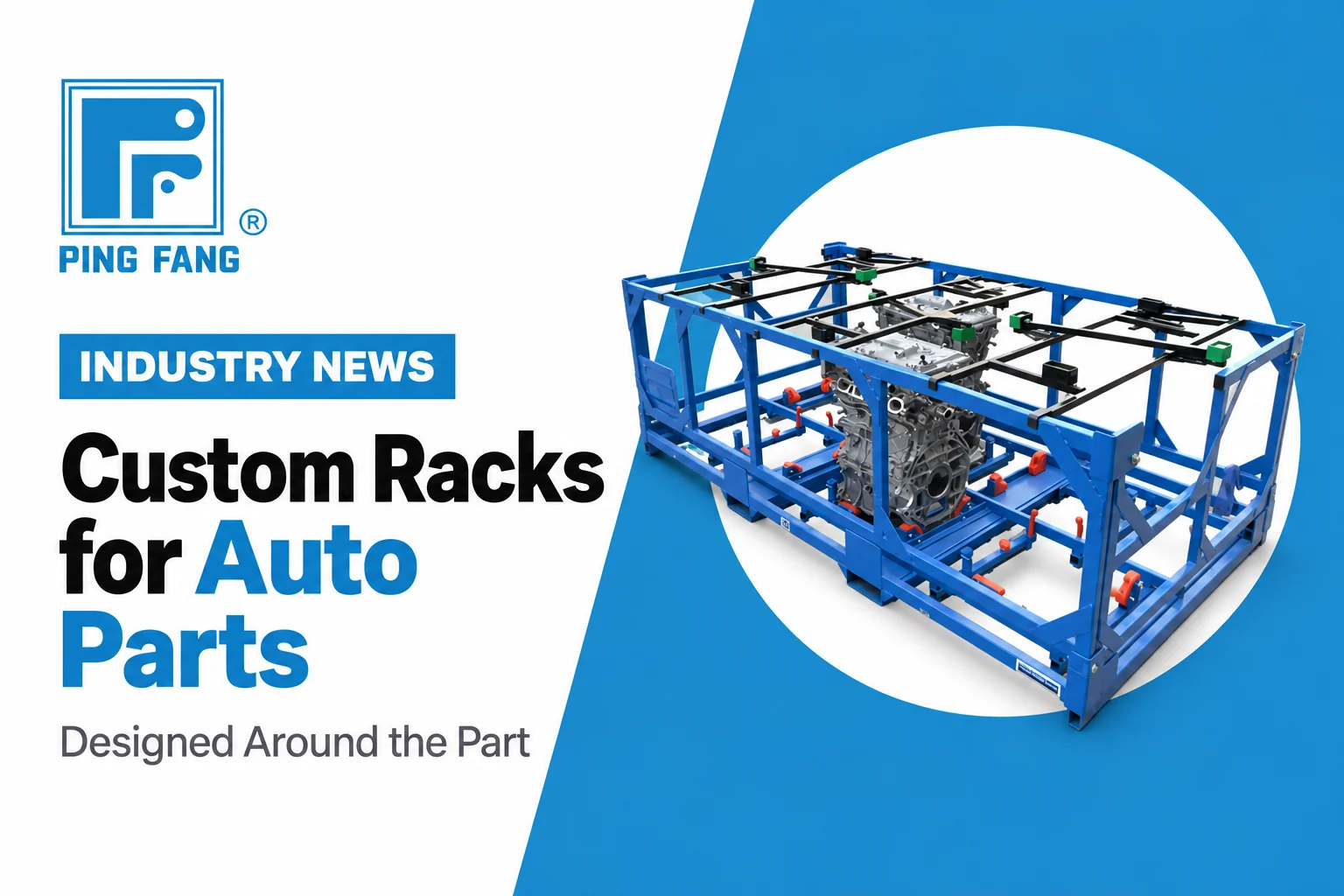
Buyers in the car industry say automotive racking, returnable racks, dunnage racks or custom metal racks, and they all mean much the same thing. Here they are called custom racks, meaning racks that carry a part from one stage of production to the next and go back for more. This article works from the part outward. It shows how real builds hold an engine, a gearbox, a battery and a lamp, what the load and size figures look like, and how to brief a factory so the first drawing is close to the last one.
A Rack Is Packaging That Knows One Part
A standard roll cage will carry almost anything because it knows nothing about its contents. Custom racks are the opposite, and an auto parts rack is the clearest case. It knows exactly one part, and in automotive racking it is made to hold that part in one position, with no contact on the surfaces that must stay clean and no movement along the route.
Three things shape every such rack. The part sets the holder, which is the saddle, pin or clamp that touches the part, and every custom rack starts there. The line sets the rhythm, meaning how many parts arrive per hour and how many racks must be waiting. The route sets the handling, which decides whether the rack needs fork pockets, casters, a tow coupler or a stacking foot. Get these three right and the frame almost designs itself. Get one wrong and the rack looks fine in a photo and fails on the line.
Field Guide, How Custom Racks Hold Real Parts
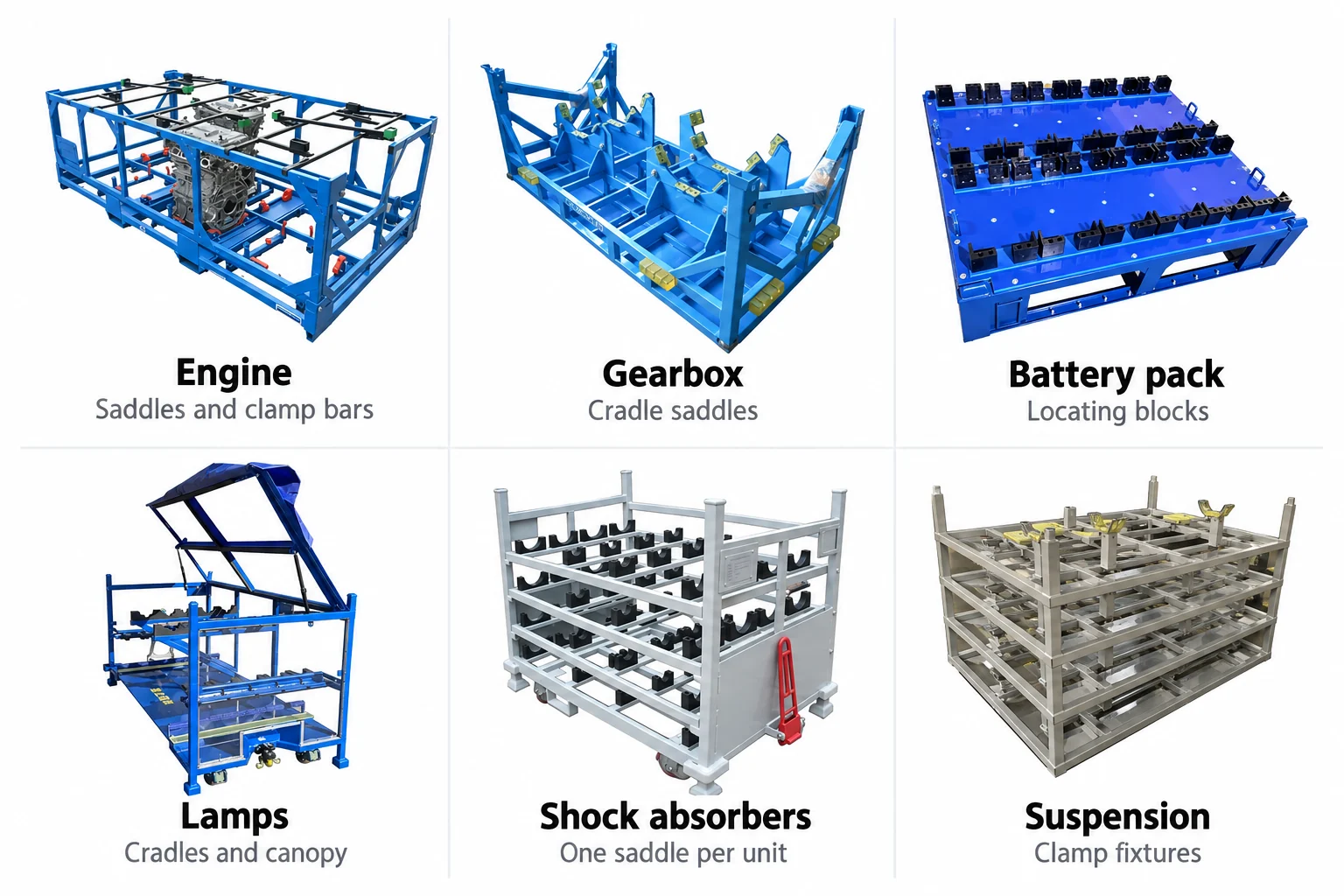
The custom racks below are builds from our custom line. Each was made for one part, from a customer drawing or a sample, and the figures are the ones recorded on the build sheets. They show how far the holder changes the rack, even before size and load are considered.
One engine, two ways to hold it
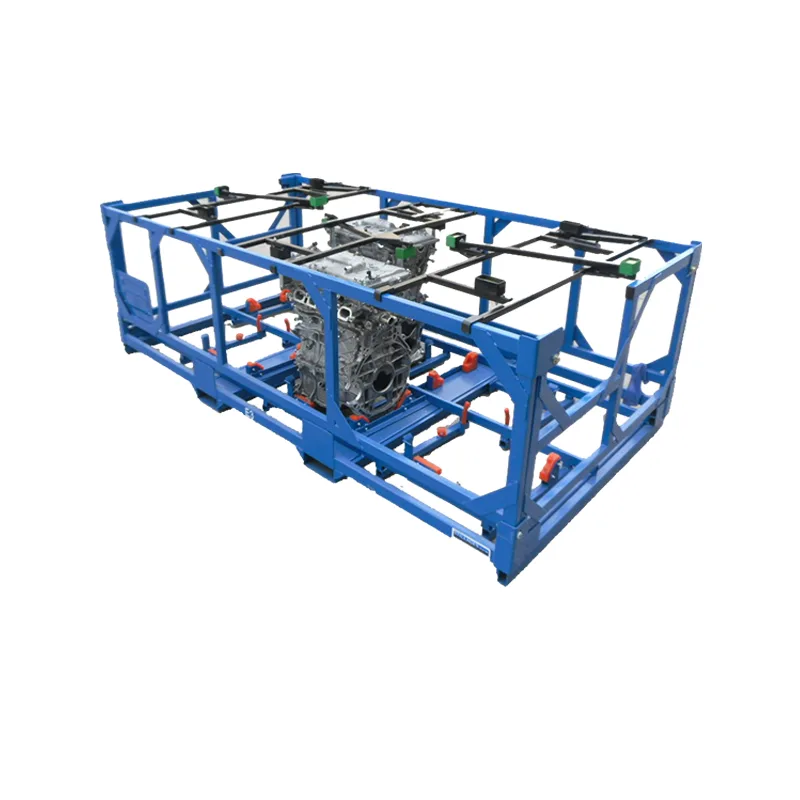
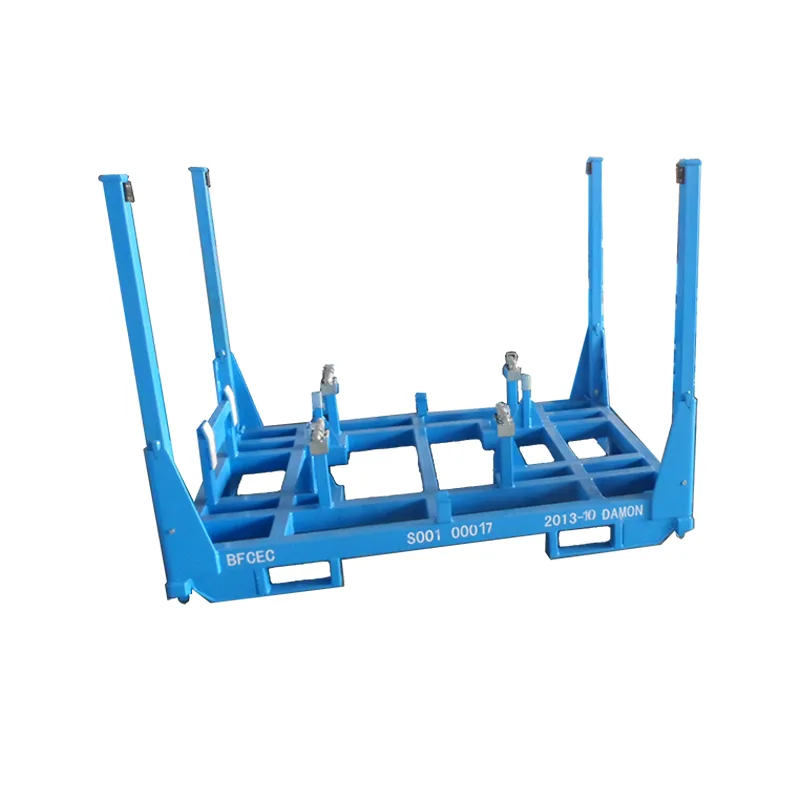
The engine rack seats each engine block in a shaped saddle and closes clamp bars across the top frame. It measures 2243 × 1191 × 760 mm, carries up to 1,800 kg and has the highest rating in the line. The engine pallet takes a different approach. The engine sits on locating pins secured with retaining clips, inside four corner posts, and the base has fork pockets. It measures 1726 × 1126 × 1300 mm and carries up to 1,500 kg.
The same part, two racks, and two different logics. The saddle rack is low at 760 mm, and the pin pallet stands 1300 mm tall inside its corner posts. Neither is better in the abstract. Which one suits a plant depends on how the engine is loaded and lifted at its own station.
Gearboxes in cradles that close
The gearbox pallet rack rests each gearbox in a curved cradle saddle, and a hinged retaining bracket closes over it. A welded base frame with a corner structure sits under the saddles, and the rack stands 1280 mm high on a 1650 × 1130 mm footprint. It carries up to 1,500 kg. The hinged bracket swings closed over the housing and swings open again to release it.
Shock absorbers, one saddle per unit
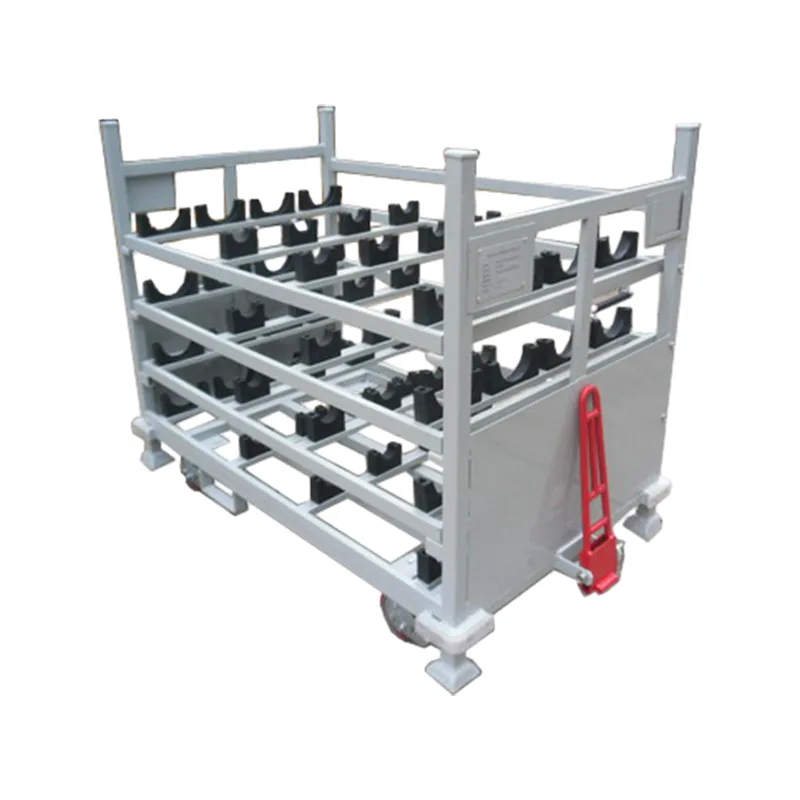
The shock absorbers rack gives every unit its own shaped saddle, with the saddle rows set in tiers. It is rated at 800 kg, the lowest rating listed in the line. It runs on casters and has a red tow handle that folds away, so a loaded rack can be towed and the handle put out of the way. The size is 1733 × 916 × 1251 mm.
Suspension parts on layers that stack four high
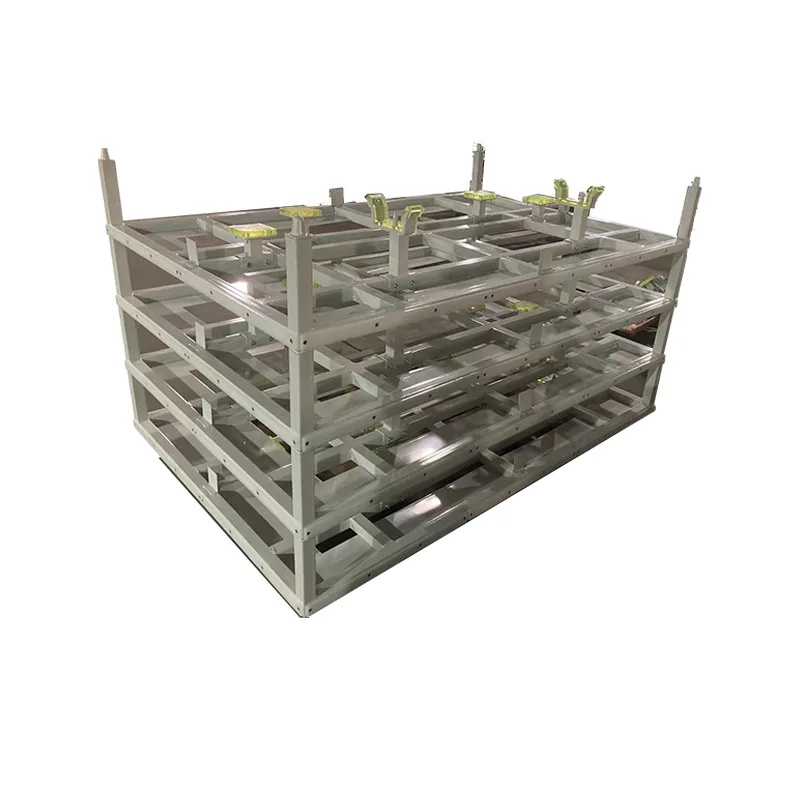
Each layer of the suspension pallet rack carries clamp fixtures that hold the parts, and loaded layers stack on each other. The photos show four tiers. A layer measures 1800 × 1200 × 283 mm, the lowest build in the line, and carries up to 1,000 kg. Stacking the layers four high, as the photos show, is how the build saves floor space.
Battery packs between locating blocks
The power batteries pallet positions each battery between rows of locating blocks on a steel deck. The deck stands only 318 mm high on a frame with fork openings, and the whole pallet measures 1200 × 1000 mm, so it fits the standard pallet footprint that forklifts and trucks already handle. It carries up to 1,000 kg. The block layout follows the drawing of the battery, so each pack sits in a fixed position.
Lamps, three builds for one family of parts
Lamp assemblies have delicate lenses, so racks for them keep them side by side and covered. The three lamp racks in our line show three answers. The canopy rack has shaped cradles for each lamp, a canopy frame that closes over the load, gas struts that hold the canopy up while the rack is loaded, casters and a tow coupling. It measures 2350 × 1150 × 1200 mm and carries up to 1,000 kg. The tilting frame rack has one solid deck under a top frame that tilts up on a gas strut and closes over the load, on a forklift base. The multi-tier rack stores lamps on several sloped tiers, stands 1763 mm high and takes only 2.11 m² of floor, against 2.70 m² for the canopy build and 2.24 m² for the tilting frame.
Tires and general parts
The tire storage rack lays tires in rows across longitudinal support tubes between two end frames, on a base that forks can reach. It measures 2280 × 1200 × 1050 mm. The car parts rack sets mixed parts on mushroom-head locators on a base grid, and removable top rails let loaded racks stack on their corner posts. It carries up to 1,500 kg, and the locator layout is set on the drawing to match the parts it carries.
| Build | How it holds the part | Size (mm) | Load |
|---|---|---|---|
| Engine rack | Saddles and clamp bars | 2243 × 1191 × 760 | 1,800 kg |
| Engine pallet | Locating pins and corner posts | 1726 × 1126 × 1300 | 1,500 kg |
| Gearbox rack | Cradle saddles, hinged brackets | 1650 × 1130 × 1280 | 1,500 kg |
| Shock absorbers rack | Saddle per unit, in tiers | 1733 × 916 × 1251 | 800 kg |
| Suspension pallet rack | Clamp fixtures per layer | 1800 × 1200 × 283 | 1,000 kg |
| Battery pallet | Locating blocks on a deck | 1200 × 1000 × 318 | 1,000 kg |
| Canopy lamp rack | Shaped cradles, closing canopy | 2350 × 1150 × 1200 | 1,000 kg |
Three builds, the tilting frame lamp rack, the multi-tier lamp rack and the tire rack, record only a size and a finish on their build sheets. Their load is set on the project drawing, as for every custom rack we make. That is how a line of custom racks works, since a catalog rating for a rack made around one part would mean little for the next part.
What a Holder Cannot Do Alone
Once the part is held, three more choices decide whether custom racks work in a real plant. They are how the rack stacks, how it moves and what it protects against.
Stacking saves floor space between uses. The suspension layers stack four high, and the car parts rack stacks on its corner posts once the top rails are fitted. A stacking rack needs feet that seat into the rack below, and the holder layout must leave those feet clear. Moving is the second choice. Some racks are handled by a forklift, with fork pockets or runners under the base, like the engine pallet, the battery pallet and the tire rack. Others are towed, with casters and a tow handle or coupler, like the shock absorbers rack, the canopy lamp rack and the multi-tier lamp rack. A rack that must do both carries both features, and the cost rises with each one.
Protection is the third. Auto parts have surfaces that cannot be scratched, so racks add soft contact where the part touches steel. The accessories we build to order include a clear PVC cover that keeps dust off the parts in transit, EVA pads that absorb shock and fabric bags that hold special parts away from bare metal. Racks that run in trains carry front and rear tow couplers, so several racks link and are towed as one train and stored in a line. A four-caster base uses two fixed and two swivel casters, with brakes on the swivel pair to hold the rack when it is parked.
Why Every Rack in This Line Is Powder Coated
Every build in our custom line is powder coated, and the coat covers the frame, the saddles and the clamp bars that carry the rating. Powder coating suits this work for practical reasons. A powder coat can be applied in a color chosen for each order, which lets one department run its racks in its own color and spot them at a glance. It also gives a smooth, even surface where the part rests.
The trade-off is that the coat can chip where a part is dragged across it, so racks that take rough loading benefit from the pads described above. Galvanizing appears elsewhere in our range, mostly on cages and trolleys that work in wet places, and it can be specified for custom steel racks if the route is outdoors or wet. Tell the factory where the rack will spend most of its life, and the finish is chosen to match.
Reading the Load Rating of a Part Rack
The rating on a custom rack answers a narrower question than the rating on a standard one. It says how much weight this frame carries when these parts sit in these holders, and it assumes the load is spread the way the drawing spreads it. A saddle passes the weight of its part into the frame at the points where it is fixed, and a layout with more saddles spreads the same weight differently. So the figure always belongs to the drawing it was set on.
Ask three things about any custom metal rack. Is the rating for the loaded rack standing still, or for the rack being lifted and moved, since moving adds shocks. Is the figure for one rack or for a stack, because a stacking rack carries the racks above it through its posts, and the bottom rack of a stack of four carries far more than the figure for a single one. And is the part weight counted separately from the rack weight, because a heavy frame can use up a forklift's capacity before the parts do. A supplier who answers all three with numbers has done the sum.
Choosing How the Rack Is Handled
Handling looks like a detail, but it changes the frame more than any other decision after the holder. Fork pockets in a welded base suit plants where every move is by forklift, as on the engine pallet and the battery pallet. Runners that leave fork clearance, as on the tire rack, make a simpler base. Casters and a tow coupler suit plants where racks travel between stations on a line, as on the shock absorbers rack and the canopy lamp rack, and a loaded rack can then be pushed or towed without a forklift.
Some plants want both, and then the frame carries both sets of features. Each one adds cost and weight, so choose the handling from the route and not from habit. Walk the route first, and write down every curb, ramp, lift and door a loaded rack will pass. A rack that cannot clear a threshold is a rack that gets lifted by hand, and that defeats the purpose.
Height at the Line, Where the Worker Meets the Rack
The height of a rack decides how easily a worker reaches the part. The engine rack stands only 760 mm high, so an operator or a hoist can drop an engine into its saddle from above. The engine pallet is 1300 mm tall, so its corner posts rise well above the base. A part picked by hand all day wants a rack that presents it at hip to chest height, without a stoop or a long reach. A part lifted by a hoist wants clear space above.
Tell the factory how the part is loaded and unloaded, and by whom. A drawing that shows the rack from the side with the worker beside it often reveals a problem that a part drawing cannot, such as a top rail in the way of the arm or a tier too low to see into.
How Many Racks Does a Line Need?
Buyers of custom racks often ask how many to order, and the answer comes from the loop, not from the line alone. A returnable rack is only useful while it circulates, so the fleet has to cover every rack that is full, empty, in transit or waiting.
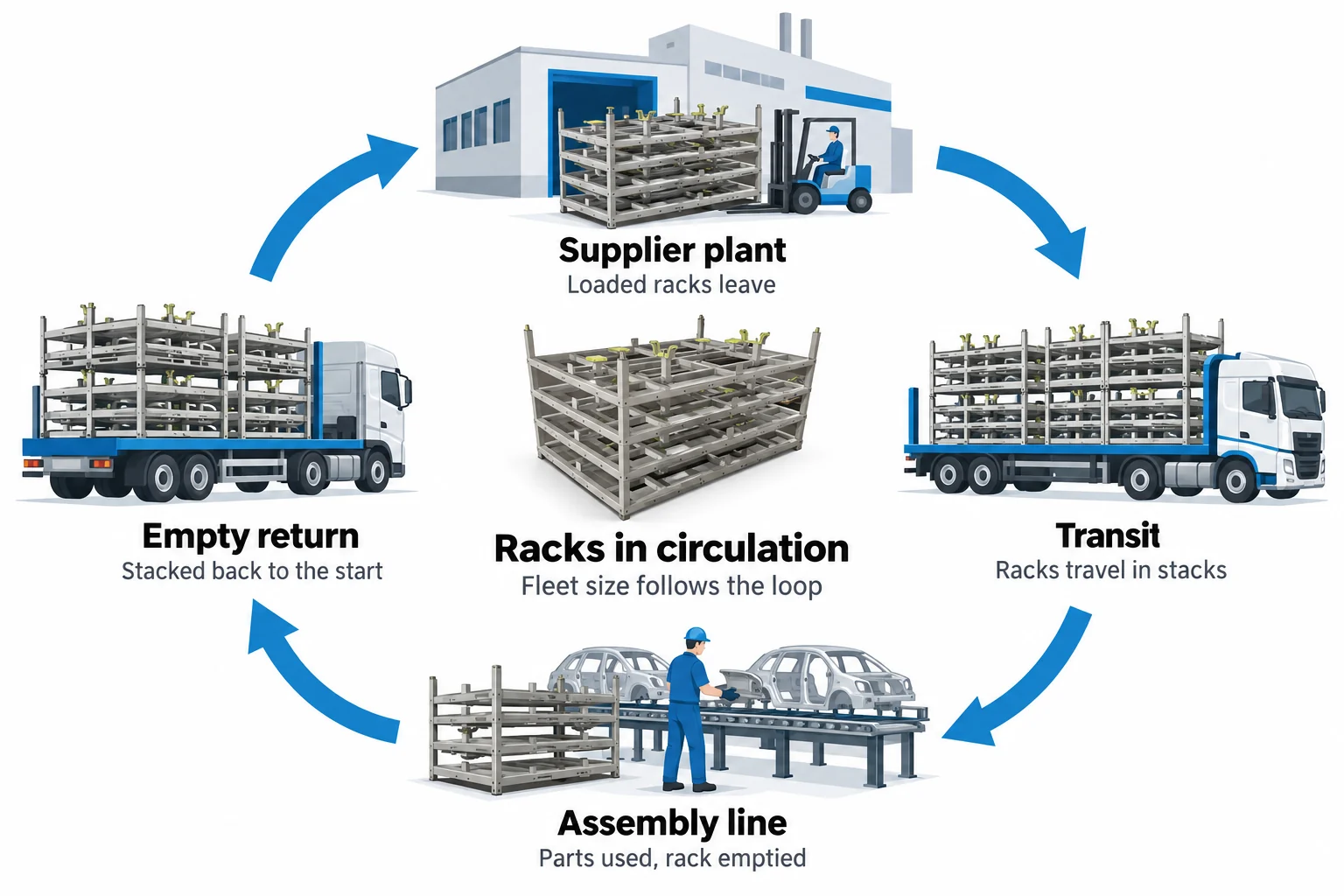
The sum is short. Divide the parts the line uses per day by the parts one rack carries, which gives the racks used per day. Multiply by the days one full round trip takes, covering loading, transit, use on the line and the empty return. Then add a spare margin for repair and delays. As an example, a line that uses 400 parts a day from racks of 20 parts needs 20 racks a day. If a round trip takes 12 days, 240 racks are in circulation, and a 10 percent margin brings the order to about 265. The figures are only an illustration, but the shape of the sum holds, and it shows why a shorter round trip saves money as surely as a cheaper rack does.
This is also why stacking and folding features pay off on the return leg. Empty racks that stack take a fraction of the truck space of loaded ones, and the saving repeats on every loop.
From Drawing to Custom Racks in Production, Nine Steps
Our process for custom racks has nine steps, and each step asks something specific from you. Knowing the steps before you send an inquiry saves a round of questions.
| Step | What happens | What we need from you |
|---|---|---|
| 1 Parts measurement | Volume, weight and shape of the part are taken | Drawing or a sample |
| 2 Data analysis | In and out frequency and peaks are analyzed | Parts per hour or per day |
| 3 Supply chain analysis | Vehicles, transport and storage are checked | Truck sizes, ceiling heights |
| 4 Solution | Drawings, bill of materials, process, quality standard and capacity quote | Target quantity and budget |
| 5 Drawing audit | You review and revise the drawing with us | Comments in writing |
| 6 Sample | A sample rack is made and improved | Your approval of the changes |
| 7 Sample testing | A full working cycle is simulated | Access to a real part |
| 8 Modification | Changes follow the test results | Final sign-off |
| 9 Manufacture | Production to the agreed quality standard | Order and schedule |
Two things stand out. The steps before the sample are about information, not steel, which is why a thin brief slows the early steps. And the sample test runs a full working cycle with your real part, because a rack that holds a part on a bench can still fail when it is lifted, towed and stacked.
Briefing Mistakes That Cost a Round
Most projects for custom racks slow down for the same few reasons, and all of them are cheap to avoid.
- Sending a photo of the part and no drawing. A photo shows the shape and hides the tolerances. A drawing or a sample gives the factory the real dimensions.
- Forgetting the empty return. A rack that is right when full may be awkward empty. Say how the empty racks travel back.
- Leaving out the tallest stack. The highest stack you plan sets the posts and the feet. If it changes later, the rack changes too.
- Hiding the environment. A rack that spends time outdoors, in a washdown area or beside a coating line needs a different finish and different pads.
- Changing the part mid-project. A small change to a casting can move a saddle by several millimeters. Tell the factory as soon as a revision is likely.
- Asking for a price before the brief is complete. A figure given on half the facts is a guess, and one of you pays for it later.
What to Send With Your Inquiry
Drawings and requirements are answered within 24 hours on working days. If the part is new and still being designed, send what you have, because the early sizes are enough to start the first drawing. Our engineering team makes up more than 28 percent of the staff, and steel parts for these racks are cut on a 6,000 W plate laser and a 3,000 W tube laser.
Who Owns the Design
Settle ownership in writing before the drawing is approved. A rack drawn around your part reveals the shape of your part, and you may want to keep that private or move the design to a second factory later. Say in the brief who owns the drawing, whether it may be reused and who may make more racks from it. Some of our own fixture designs are patented, among them an engine parts storage rack and an auto parts transfer box, and the certificates page lists both by number. The same page shows that a patent number can be checked at its source, which is the standard to hold any supplier to.
The full line of custom racks sits on our OEM page, and you can send your part through the contact page. For standard equipment, see our checklist for choosing a stillage manufacturer and our guide to post pallets.
 Related Questions