
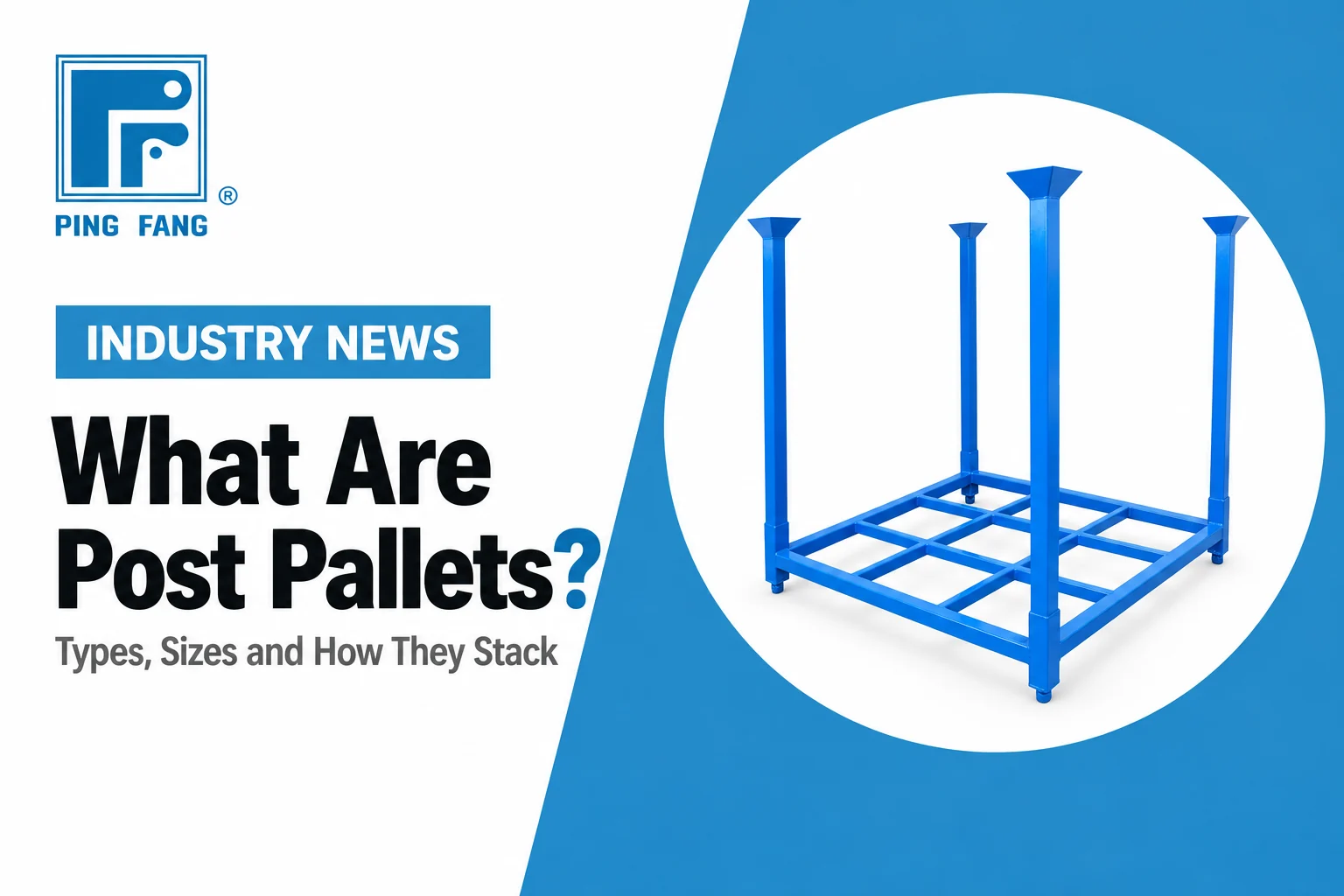
Post pallets go by different names depending on where you buy them. Buyers in the UK, Ireland, Australia and New Zealand say post pallets or demountable post pallets, while in the United States and Canada the same steel units are usually called stack racks, stackable racks or portable stack racks. This guide explains how post pallets work, how they differ from stacking frames and other stillages, the sizes and ratings on a real range, and what to settle before you order.
What Are Post Pallets? Meaning and Definition
Post pallets are steel pallets with four corner posts that carry another loaded unit above them. The base is welded and takes the forks, the posts are removable, and each post is capped with a cup that holds the base of the next unit. Together they turn floor space into stacked storage without any fixed racking. The posts and cups are what separate them from a plain pallet.
The same product has several names, and the mix of names is the main reason people search for it in different ways. It is also sold as a corner post pallet, a demountable post pallet or a post pallet stillage. In the United States the usual names are stack racks and stackable pallet racks, and the matching frames are called pallet stacking frames. Knowing the alternatives helps when you compare suppliers, because a quote for a stack rack and a quote for a post pallet may describe the same unit.
Post Pallets, Stack Racks, Stacking Frames and Stillages Compared
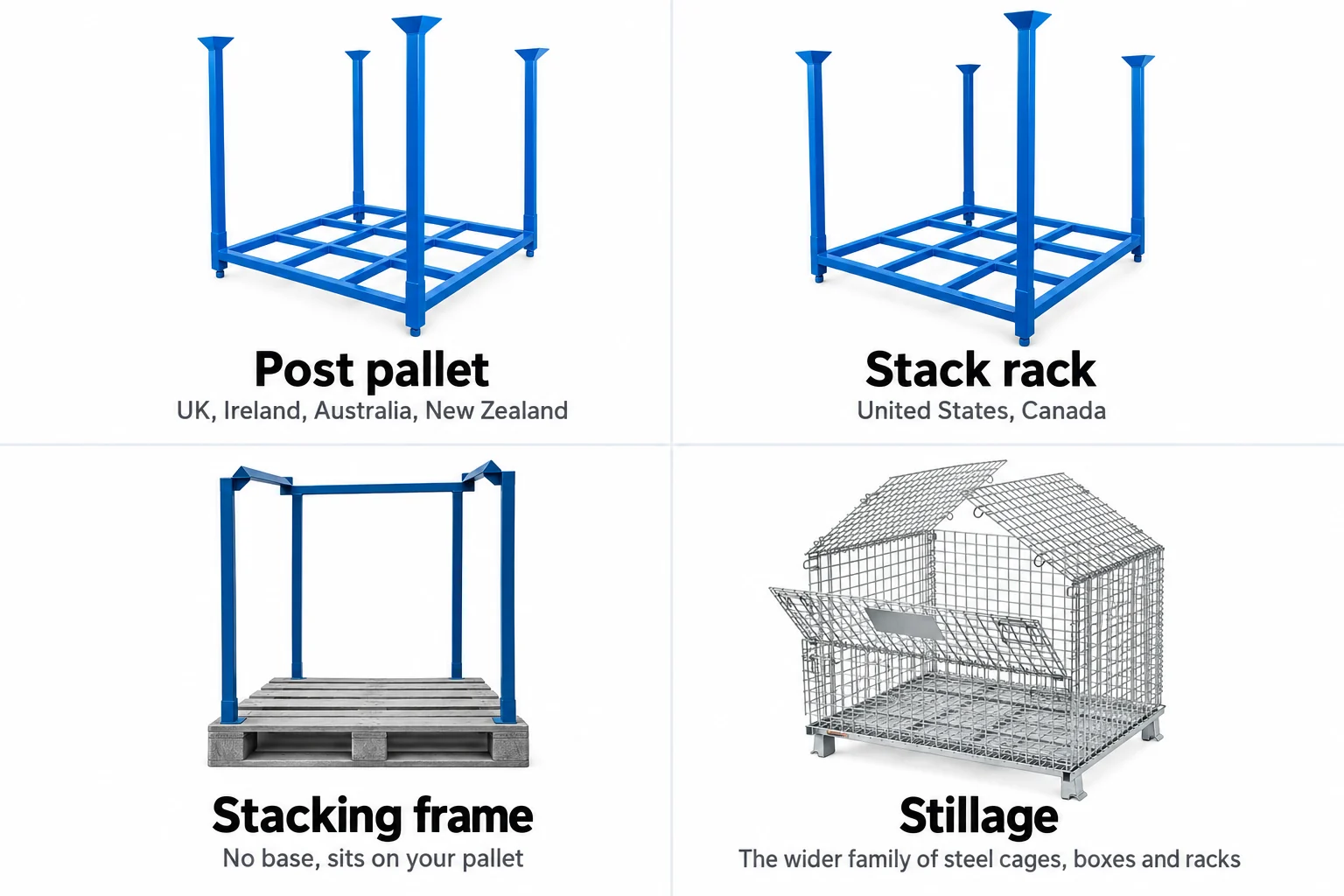
Four names cover most of what buyers are comparing. Two of them are the same product under different regional names, and the other two are different products with a different job.
| Name | What it is | Where the name is common | Has its own base |
|---|---|---|---|
| Post pallet, demountable post pallet | Welded base with four removable corner posts | UK, Ireland, Australia, New Zealand | Yes |
| Stack rack, stackable rack, stackable pallet rack, portable stack rack | The same design, sold under the US name | United States, Canada | Yes |
| Stacking frame, pallet stacking frames | Four posts and top frame that sit on a loaded pallet | India, United States, New Zealand | No, it uses your pallet |
| Stillage | The wider family of steel cages, boxes, frames and racks that a forklift lifts | UK, Ireland, Australia, New Zealand | Yes |
It is a kind of stillage, and some suppliers list it as a post pallet stillage. Our guide to what a stillage is covers the full family, including wire mesh cages and solid steel boxes. This guide stays with the post pallet and its closest relative, the stacking frame. These units sit under the turnover rack solution and the Stillage and Turnover Material Rack range on our site.
The Parts of a Post Pallet
Every post pallet is built from five parts, and knowing them makes a data sheet easier to read. The base takes the lift, the posts carry the stack, the sockets hold the posts, the cups guide the next unit into place and the deck holds the goods.
- Base. A welded steel frame with fork entries, built so the tines of a forklift or a pallet truck can enter without catching. Short feet keep it off the floor, and the same feet are what locate the unit when it sits on another one.
- Posts. Four steel posts, one at each corner, carry the weight of the units stacked above. Their height sets how tall a load the unit can take, so it should always be read against the load height.
- Sockets. Collars at the corners of the base hold each post. They are what makes the posts removable, because a post lifts straight out of its socket and drops back in.
- Cups. The funnel-shaped caps at the top of each post. The feet of the base above sit into the cups, which guides the unit into position and keeps the stack square.
- Deck. Open frame, wire mesh or solid steel, chosen to suit the goods. The deck is the part that differs most between models.
Welds join the base and sockets, and the quality of those welds sets how many trips a unit survives. Cracks start at joints, which is why a supplier's welding method is a fair question to ask.
How Post Pallets Stack
The units stack through their posts, not through their goods. The load of every unit above travels down the four posts into the base below. Goods inside can be soft, fragile or oddly shaped and still sit in the middle of a stack without being crushed.
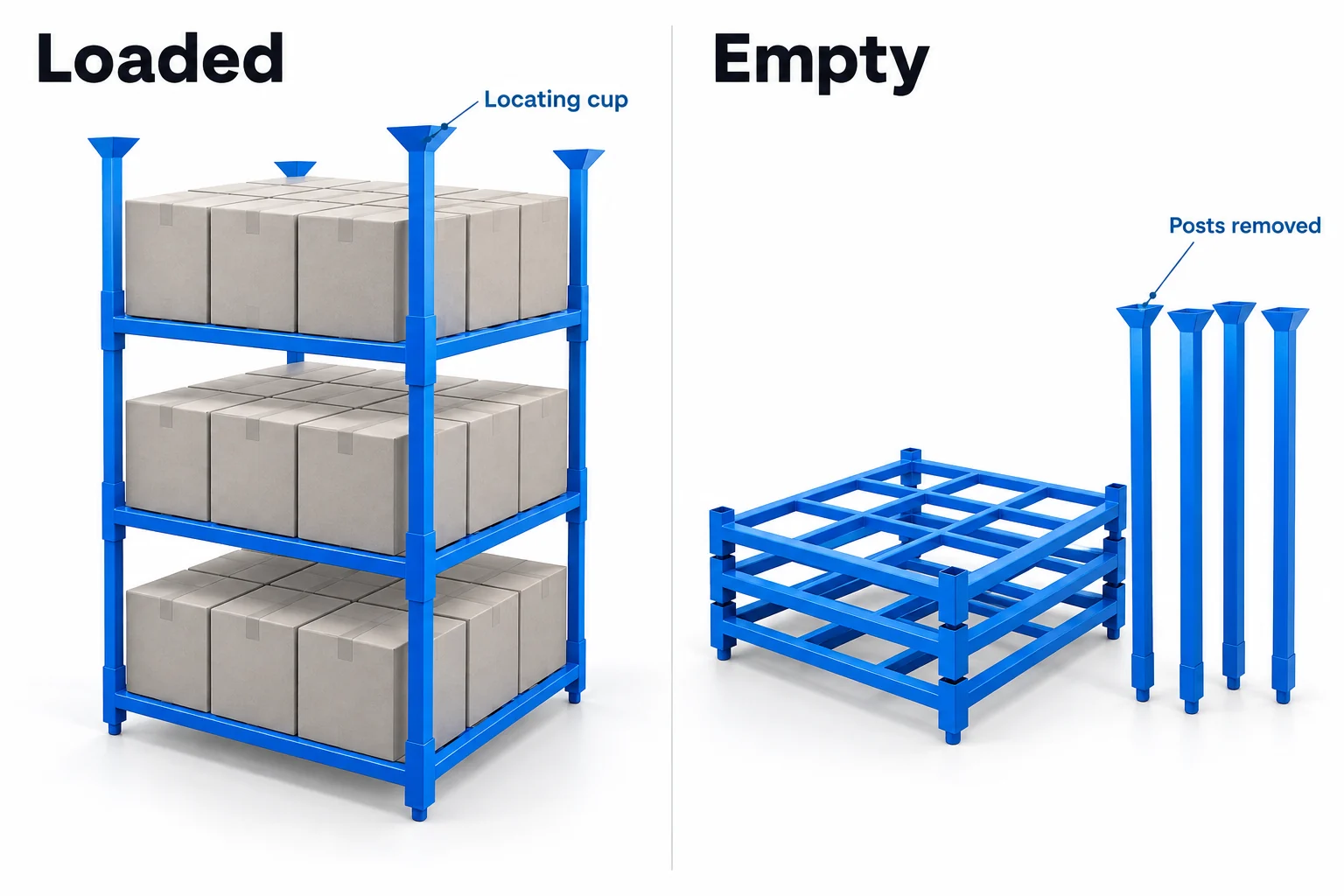
The cups do the guiding and keep the stack square without any strapping. Because the posts are removable, the same unit works as a tall stackable rack when loaded and as a flat base when empty.
Two points matter for any post pallet. The rating is for one unit, and the bottom unit carries everything above it. For how to read a rating, including static and dynamic figures, see the section on load ratings in our stillage guide.
The Main Types of Post Pallets
The types differ in three things, the deck, the finish and the height of the posts. The six standard models in our range cover the common combinations, and other sizes are made to your drawings.
Demountable post pallets with open frame decks
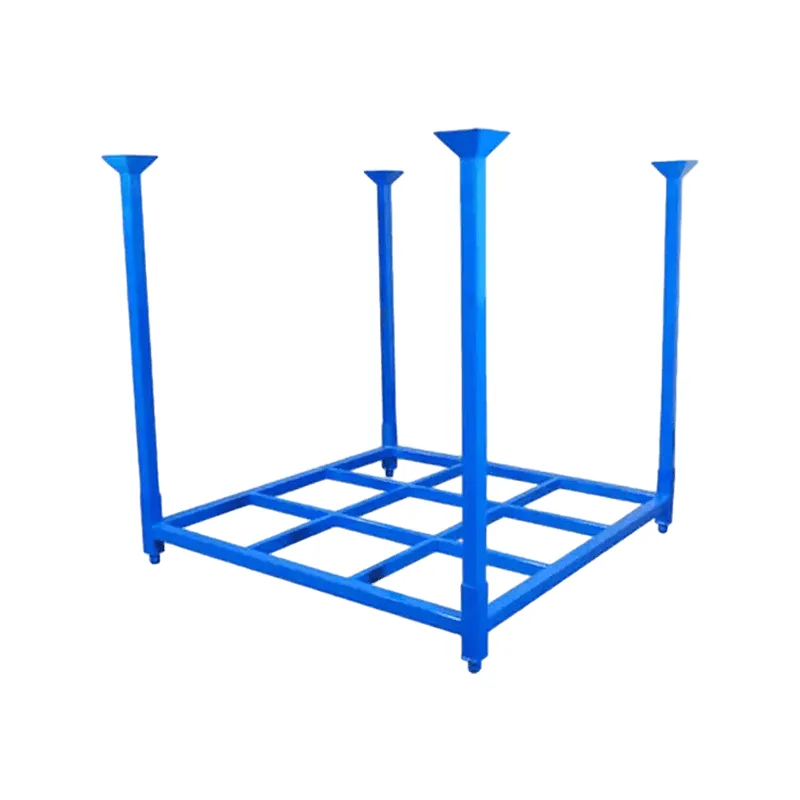
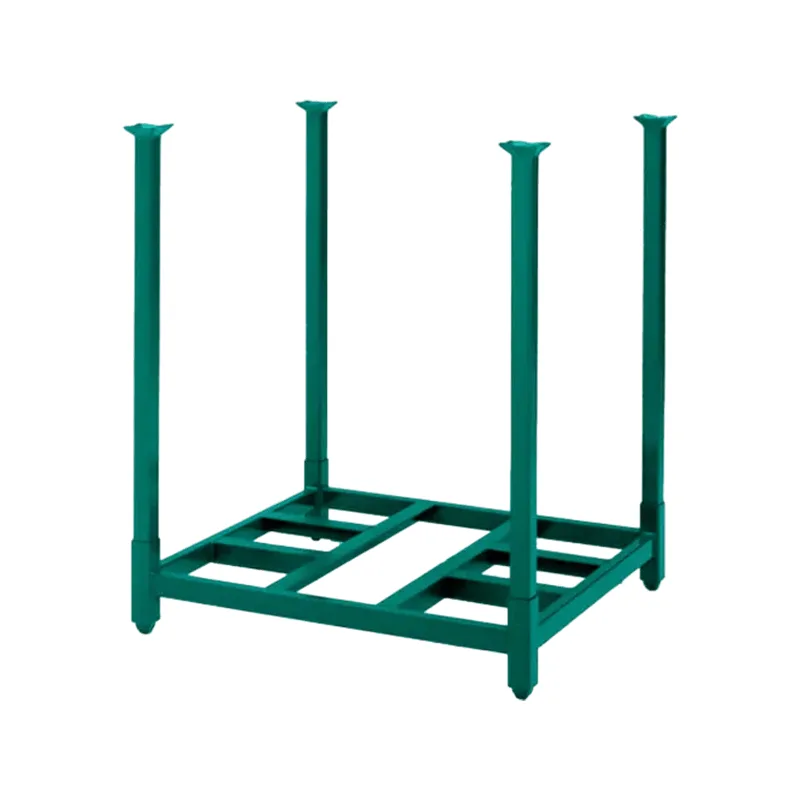
Many post pallets have an open welded grid as the deck. The grid keeps weight low, lets dirt fall through and suits pallets and boxes that have their own solid base. Four of our six models use this layout, from the 1830 × 1220 mm PFMPR001 to the square 1524 × 1524 mm PFMPR004, which is a 60 inch square base.
Corner post pallets with mesh or solid decks
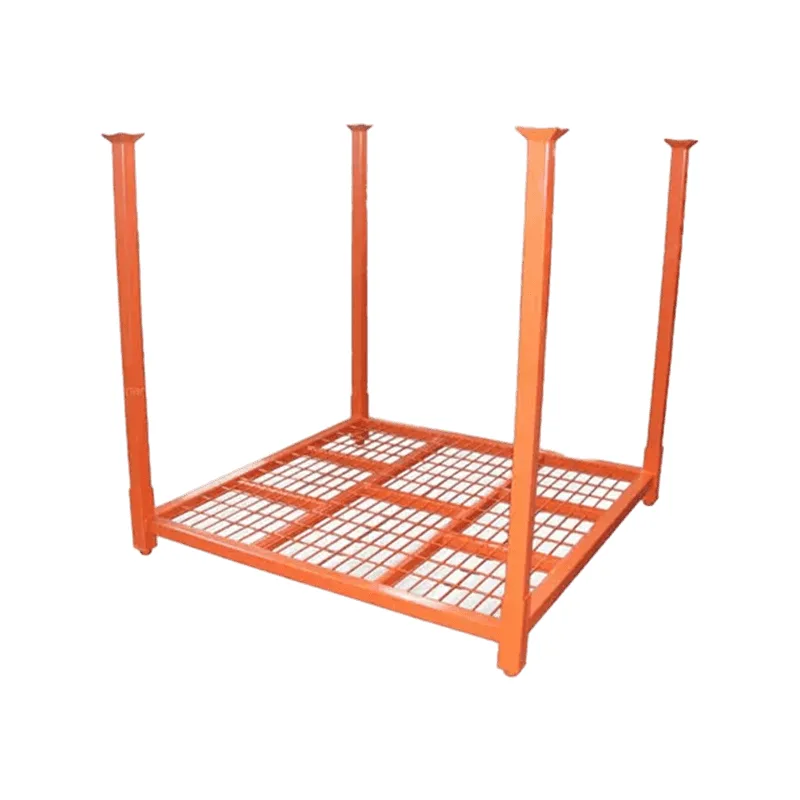
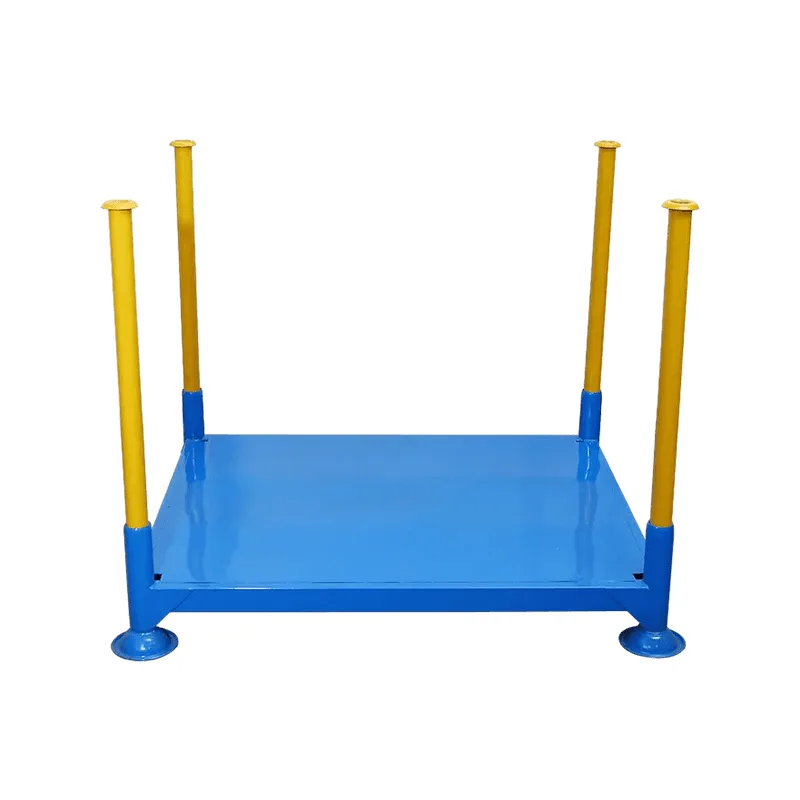
When the goods are small, round or awkward, the deck changes. PFMPR005 keeps the 1524 mm square base of PFMPR004, raises it to 1730 mm overall and decks it in wire mesh. Tires ride on the mesh without pressing on the tier below. PFMPR006 has a solid steel deck on a 1250 × 1200 mm base. Loose parts and in-process stock sit on a closed floor instead of an open grid. These are the corner post pallets that workshops and tire stores ask for most. For tire storage on its own, see our guide to foldable tire racks.
Metal post pallets in galvanized and powder coated finishes
Five of the six models are powder coated, a finish that takes the abrasion of forks and steel-on-steel stacking indoors. PFMPR002 is hot-dip galvanized and rated 1,500 kg, which is the choice for outdoor yards, humid stores and corrosive materials. Steel post pallets in both finishes come from the same welded design. The choice comes down to where the unit will stand. Our stillage guide explains the two finishes in more detail.
Post Pallet Sizes, Dimensions and Capacity
Sizes follow the pallets and the floors the units work with. The table lists the six standard models, with the overall size including posts.
| Model | Overall size (mm) | Rated load | Deck | Finish |
|---|---|---|---|---|
| PFMPR001 | 1830 × 1220 × 1520 | 1,000 kg | Open frame | Powder coated |
| PFMPR002 | 1395 × 1060 × 1500 | 1,500 kg | Open frame | Hot-dip galvanized |
| PFMPR003 | 1250 × 1100 × 1350 | 1,000 kg | Open frame | Powder coated |
| PFMPR004 | 1524 × 1524 × 1524 | 1,000 kg | Open frame | Powder coated |
| PFMPR005 | 1524 × 1524 × 1730 | 1,000 kg | Wire mesh | Powder coated |
| PFMPR006 | 1250 × 1200 × 1500 | 1,000 kg | Solid steel | Powder coated |
PFMPR003 is the compact model, sized for smaller pallets and tighter floors, and it still carries 1,000 kg. PFMPR002 carries 1,500 kg on a 1395 × 1060 mm base, which suits dense goods in a small space. Dimensions in the table are overall sizes. Check the posts against the height of your load, not only the footprint.
Stacking frame sizes for comparison
A stacking frame has no base of its own, and the pallet it sits on sets its size. Our 12 stacking frames are all rated 1,000 kg per frame and powder coated, in four footprints and three heights.
| Footprint (mm) | Models | Heights (mm) |
|---|---|---|
| 1400 × 1165 | PFSF001, PFSF002, PFSF003 | 1235, 1435, 1535 |
| 1470 × 1200 | PFSF007, PFSF008, PFSF009 | 1235, 1435, 1535 |
| 1500 × 1265 | PFSF004, PFSF005, PFSF006 | 1235, 1435, 1535 |
| 1570 × 1320 | PFSF010, PFSF011, PFSF012 | 1235, 1435, 1535 |
The frames are sized for 1210 and 1310 pallet footprints. Give us the pallet size in millimeters and we match the frame to it. The full range is on the stacking frames pages.
How to Choose Between Post Pallets and Stacking Frames
Choose by what you already own, because that decides if you need a base. A post pallet comes with its own deck. A stacking frame reuses the pallet you already run. Both stack loaded and both save return space when empty, so the decision comes down to the goods and the loop.
- Choose a post pallet when the goods have no base. Loose parts, tires and irregular loads sit on the deck, and the deck can be open, mesh or solid.
- Choose a stacking frame when the goods are already on pallets. The frame turns each loaded pallet into a stackable unit and the pallet stays in the loop.
- Choose a post pallet when the pallet will not come back. A frame depends on a pallet that returns with it, and a post pallet does not.
- Choose a stacking frame when pallet sizes are fixed by a customer. The frame is sized to the pallet and does not change the footprint.
- Choose by finish. Powder coated suits dry indoor use and galvanized suits outdoor and damp sites.
If you are not sure, send photos of the load and the pallet size. We recommend the type and, if needed, quote both. Our older guides on mobile column pallet racks and pallet stacking frame specifications go deeper on layout and on frame details.
Folding the Return Trip with Post Pallets
The saving from post pallets comes from the empty trip. A full-size steel rack takes a full truck space when it goes back empty, and a post pallet does not need to. Lift the four posts out and the bases pile flat. One truck then carries many more empties than assembled racks.
The table shows how many assembled units fit on the floor of a 40HQ container. The counts are calculated from the overall sizes in this guide and the standard inside size of a 40HQ container (12,032 × 2,352 × 2,698 mm). They are a guide to scale and are not measured factory loading figures. As a comparison, freight guides put a 40 ft container at about 20 to 21 industrial pallets or 24 to 25 Euro pallets on the floor.
| Model | Overall size (mm) | Assembled units per floor layer | Layers |
|---|---|---|---|
| PFMPR001 | 1830 × 1220 × 1520 | 9 | 1 |
| PFMPR002 | 1395 × 1060 × 1500 | 16 | 1 |
| PFMPR003 | 1250 × 1100 × 1350 | 18 | 1 |
| PFMPR004 | 1524 × 1524 × 1524 | 7 | 1 |
| PFMPR005 | 1524 × 1524 × 1730 | 7 | 1 |
| PFMPR006 | 1250 × 1200 × 1500 | 10 | 1 |
Every model is taller than half of the container height, which leaves room for one assembled layer only. With the posts out, the count depends on the height of the base and the deck, which differs by model. Divide the inside height of 2,698 mm by the base height to estimate the number of flat layers, and multiply by the units on the floor. We prepare the exact container loading plan from your pallet size, load and yearly volume, so the figure on your quotation is the one that counts.
Benefits of Post Pallets
These units stack goods without any fixed structure and then shrink for the trip back. In practice that gives six benefits.
- Vertical space with no installation. Loaded units stack on their own posts and turn one floor area into several layers of storage, with no anchoring or racking to assemble.
- A layout that moves. A block of units can be re-laid when the plan changes, and units can be added or taken away as stock rises and falls.
- Protection for the goods. The posts carry the weight above. Goods in the middle of a stack are not crushed and loose parts stay on their deck.
- Forklift handling. The base is built for forks, and one lift moves a whole unit between line, yard, store and truck.
- Cheaper empty trips. With the posts out, empties take a fraction of the space of assembled units.
- Reuse. Steel does not wear out like cardboard or crack like plastic. One unit replaces a long run of single-use packaging and returnable plastic.
Post Pallet Capacity and What Decides It
Capacity is the weight one unit can carry, and three things set it. The strength of the base and posts sets the ceiling, the way the load sits on the deck decides how much of that ceiling is used, and the stack height decides what the bottom unit has to carry.
Five of our six models are rated 1,000 kg, and PFMPR002 is rated 1,500 kg. The rating assumes a load spread across the whole deck. A heavy item standing on one corner needs a different check. When a load is unusual, send the drawing or a photo and we confirm the model before you order.
Capacity should always be read with the stack height in mind. The same rating is printed for a single unit and for the bottom unit of a stack, but the bottom unit carries the weight of everything above it, so the stack height is part of the rating. Ask what stack height the rating assumes and keep to it.
Where Post Pallets Are Used
These units suit goods that need a stable platform and a protected stack, and loops where the units come back empty. The common uses follow the models above.
- Tires and wheels. A mesh deck and tall posts hold tires clear of the tier below, and the same unit stacks in the yard or the warehouse.
- Loose and in-process parts. A solid deck keeps small parts on a closed floor, and racks stack between workstations.
- Heavy and irregular goods. Large parts and awkward loads that are hard to stack on their own sit on the deck and stack without crushing.
- Automotive and industrial logistics. Our turnover racks run in automotive parts logistics, where the same loop between supplier and plant repeats for years.
- Seasonal and temporary stock. Posts out and bases flat, the units take little room between peaks.
Post Pallets and Fixed Pallet Racking
The two systems solve different problems, and the choice is easier once the difference is clear. Fixed racking gives every pallet its own position, and any pallet can be reached at any time. A stack of post pallets gives block storage. A unit lower in the stack can only be reached by moving those above it.
| Question | Post pallets (stack racks) | Fixed pallet racking |
|---|---|---|
| Installation | None, the units stand on a flat floor | Frames and beams are assembled and fixed in place |
| Layout changes | Re-lay the block whenever needed | Beams can be moved, frames usually stay |
| Access to one pallet | Top of each stack first | Any position at any time |
| Best for | Goods that move in blocks, seasonal or temporary stock, goods without a pallet | Many different items that must be picked one at a time |
| Return trip | Posts out, bases pile flat | Frames stay in place |
Many sites use both. Stacked units hold bulk and seasonal goods in blocks, and fixed racking holds the fast moving range that is picked daily. How high a stack can go depends on the rating, the floor, the building and your own handling rules, so agree the stack height with your safety lead before you order.
Ordering Post Pallets Without Mistakes
Most ordering mistakes can be seen on the quotation. Check these points before you order.
- Posts shorter than the load. The load must sit below the cups of the unit above. Ask for the post height next to the overall height.
- Mixed models in one stack. The feet of one model rarely match the cups of another, and a stack should stay with one model.
- A deck that does not suit the goods. Small parts fall through an open grid, and a solid deck traps water outdoors. Choose the deck from the goods first.
- Ignoring access. A unit low in a stack can only be reached by moving those above it, so plan each stack around how often its units are needed.
- Forgetting the return trip. If the units come back empty, count the posts and the bases separately, because they pack differently.
To get a useful quotation on the first reply, send the pallet size, the weight per load, the load height, the stack height you want, the yearly volume and the destination country through our contact page. If you are looking for post pallets for sale in a specific size, we quote them from that information, and our OEM service builds to your drawing when none of the standard sizes fit.
Keeping Post Pallets in Service
These units live in a rough setting, with forks, steel-on-steel stacking and weather, so a short routine keeps them safe and in the loop for years.
- Look at the posts. A bent post sits out of line with the cups above it and should be replaced, not straightened.
- Look at the cups and sockets. Damaged cups let the unit above shift, and a damaged socket lets a post lean.
- Look at the welds. Cracks start at joints, usually on the base where forks and feet take the knocks.
- Look at the finish. Scratches on a powder coated unit stored outdoors become rust spots, and galvanizing is the better choice for that site.
- Count the posts. A unit with a missing post cannot take a stack. Count posts against bases when units come back.
Follow your own site rules for inspection and for how high stacks may go. If a unit is damaged, tell us the model and we supply replacement posts or repair advice.
How Ping Fang Builds Post Pallets
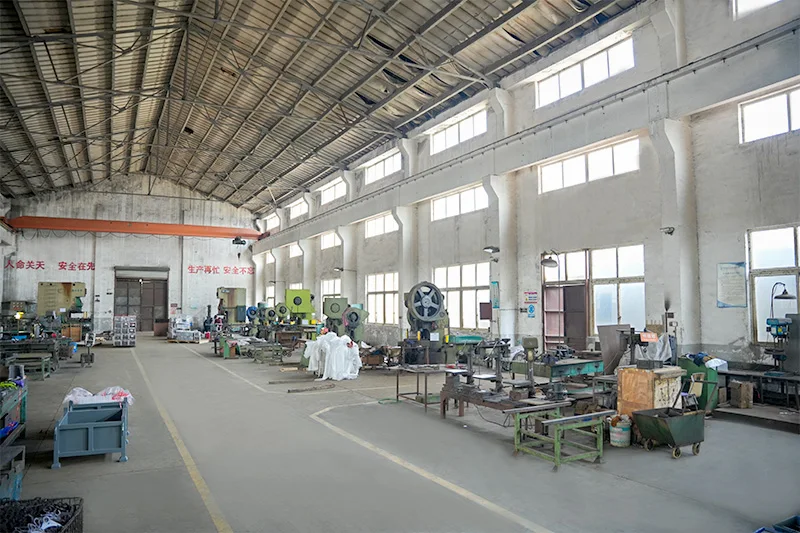
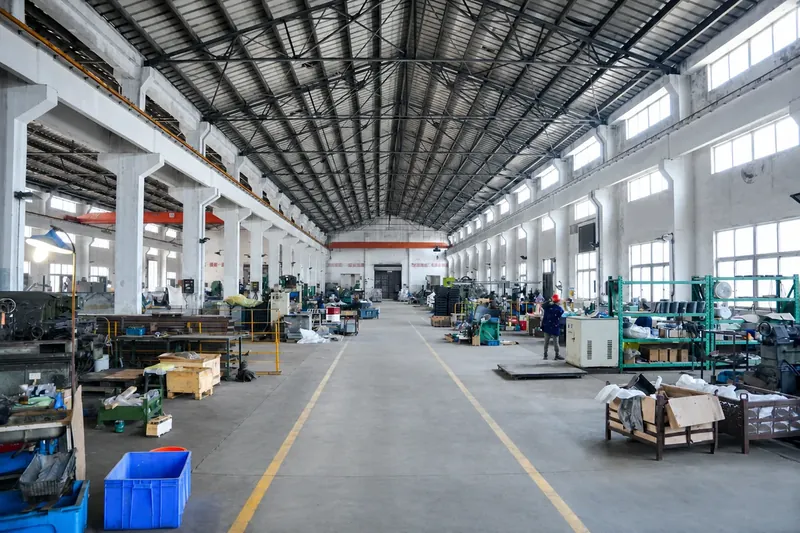
Ping Fang has been a manufacturer since 1984. The post pallet bases and posts are cut on a 6000 W plate laser and a 3000 W tube laser and welded on our 18 robot welding machines, so repeated stacking lands on consistent joints. Finishing runs on the automatic spraying line, and the plant also has a shot blasting machine. Four checks run on every order. They cover incoming material, worker self-check with inspector patrol during production, inspection before surface treatment, and a final check before shipping with a quality report.
More about the factory is on our factory page, and the full range of stillages and turnover racks is on the Stillage and Turnover Material Rack page.
 Related Questions