
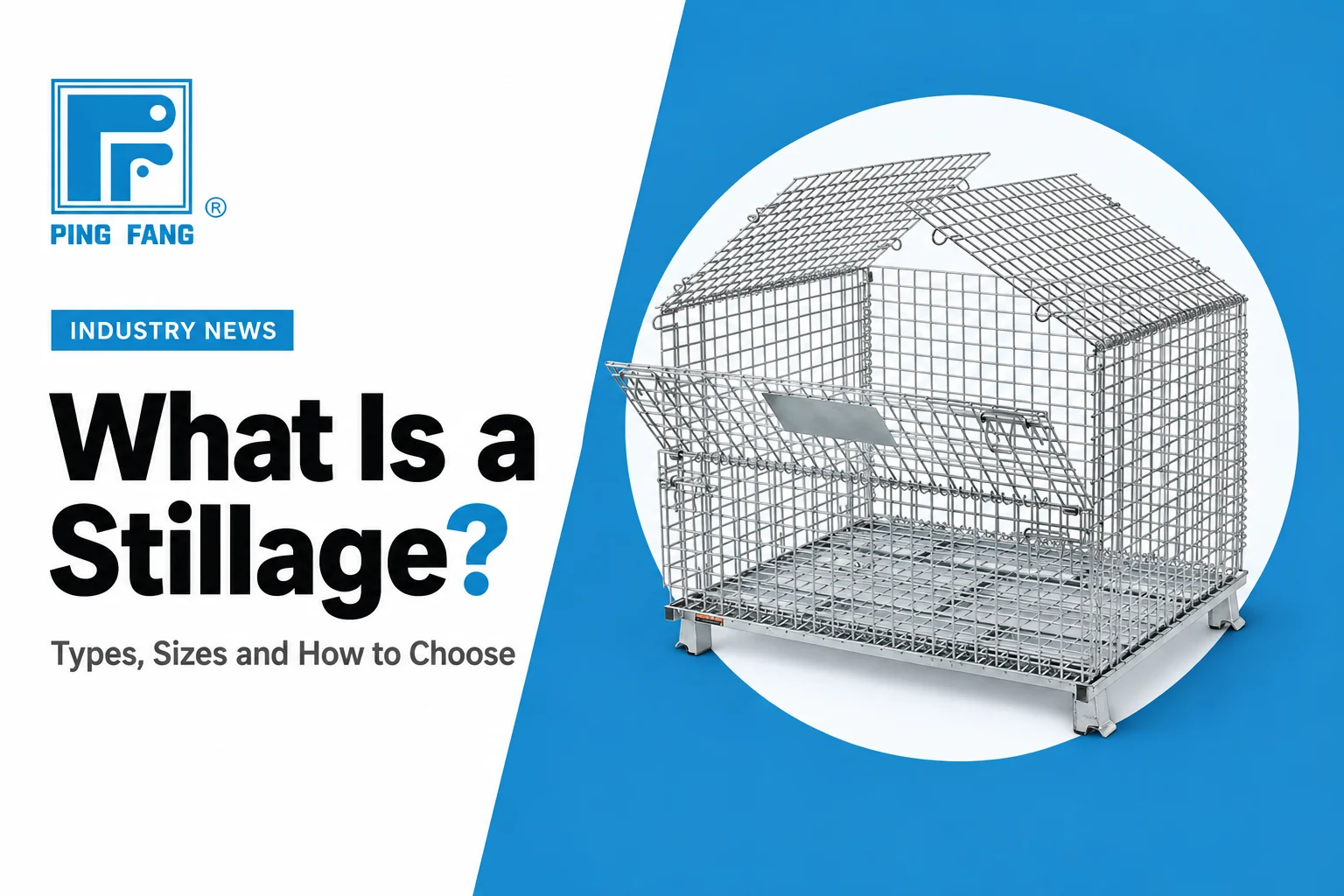
The answer to what is a stillage depends on the trade. In logistics it covers pallet cages, wire containers, steel bins and stacking frames, and in a pub it is a stand for beer barrels. This guide sets out the logistics meaning, the types on a supplier's price list, real sizes and load ratings, and what to settle before you order. It does not cover lifting-equipment regulations, which differ by country and site.
What Is a Stillage? Meaning and Definition
In logistics a stillage is a rigid steel container or frame that carries goods on a base which forklift tines or a pallet truck can enter. It protects what is inside, stacks when loaded and, in many designs, folds or nests when empty. The word covers wire cages, solid steel boxes, post frames and tire racks. That is the working stillage definition for the rest of this guide.
Dictionaries trace the word to the Dutch stellagie, a stand or framework, which is still a fair description. A stillage is a framework that holds a load off the floor. What makes it more than a shelf is the base. It is built to be lifted, and the whole unit moves as one piece between production line, warehouse, truck and customer.
The name changes with the region and the supplier. Buyers in the UK, Ireland, Australia and New Zealand say stillage. In the United States and Canada the same wire box is usually called a wire container, and a solid steel box is a steel bin. Knowing the alternatives helps when you compare quotes.
| Name you may see | What it usually means | Ping Fang family |
|---|---|---|
| Pallet cage, wire container, mesh cage | Galvanized wire mesh box on a forklift base, often with a drop gate | Wire Mesh Cages and Pallet Frames |
| Steel pallet box, steel bin, stillage container | Closed steel sides for small or heavy parts that mesh would let through | Steel Pallet Boxes |
| Stacking frame | Four posts and a frame that sit on a loaded pallet so pallets stack | Stacking Frames |
| Post pallet rack, stack rack | Welded base with removable posts, stacked loaded and flattened empty | Movable Post Pallet Racks |
| Tire stillage | Frame sized for tires and wheels, often foldable | Tire Racks |
One related product is not a stillage in the forklift sense. The roll cage trolley is a caged unit on castors that is pushed by hand, and it belongs to a different family, covered on our Roll Cage Trolley page.
How a Stillage Differs from a Pallet
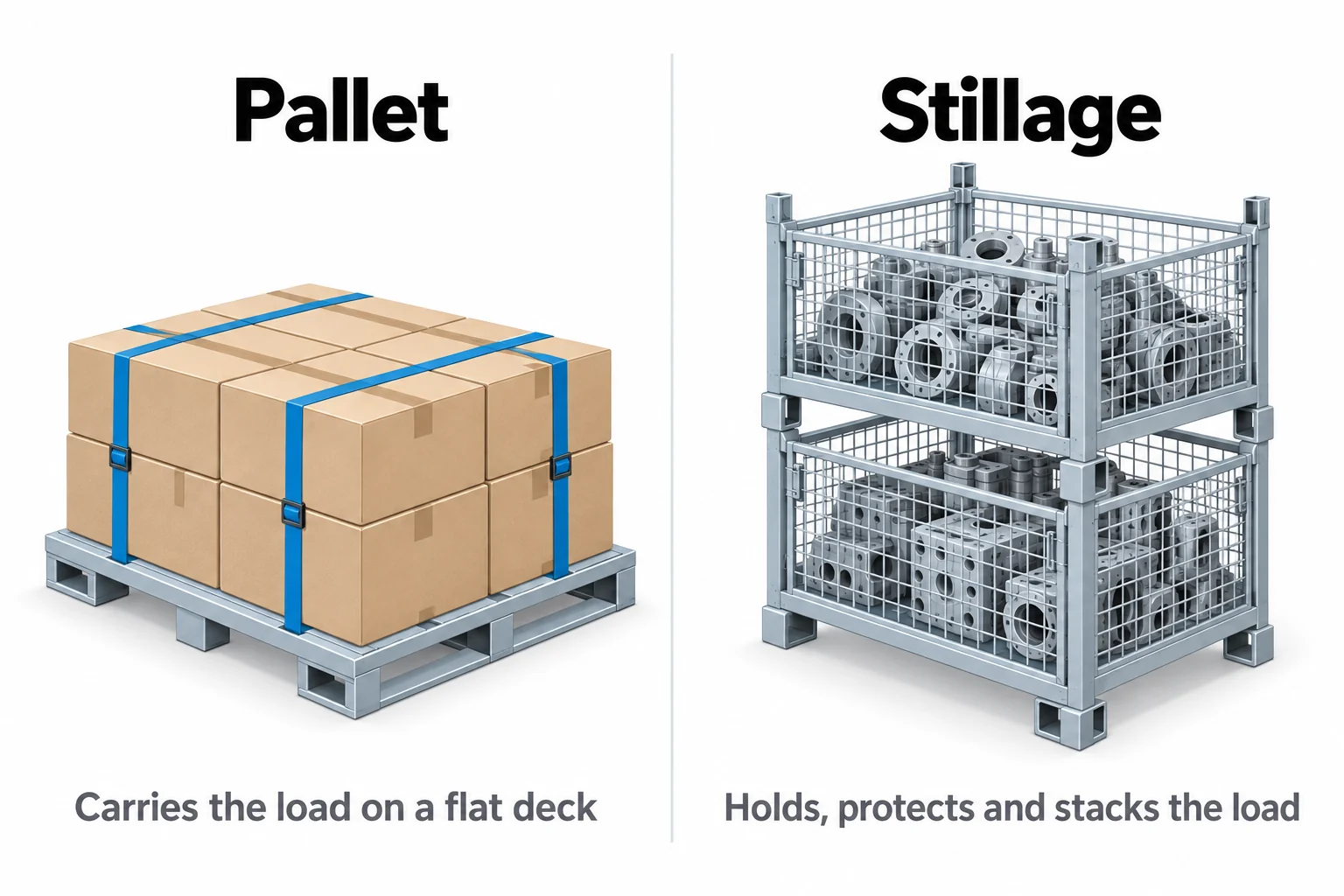
A pallet is a flat deck. It carries a load but does not contain it. Cartons need wrapping or strapping, and the stack is only as stable as the load on top. A stillage adds sides, posts or a cage to the base. Loads are held in place and units stack on their own frames.
| Question | Pallet | Stillage |
|---|---|---|
| What it does | Lifts a load off the floor | Lifts, contains and protects the load |
| Loose or small parts | Need a box, bag or wrap first | Go straight into a box or cage |
| Stacking | Depends on the load on top | Built in, through posts or frame corners |
| Visibility | Contents hidden by wrap | Wire mesh shows contents, steel boxes hide them |
| Empty return | Flat stack, but loads are one way | Folds, nests or comes apart to save truck space |
| Typical life | Wood and plastic wear out or crack | Steel stays in the loop for years |
The two are not rivals. The turnover rack range on our site sorts its 44 models by how they meet the pallet. Twenty-four models, the stacking frames, pallet frames and post pallet racks, work with the pallets you already run. Thirteen models, the tire racks, steel pallet boxes and wire mesh cages, carry goods directly with no pallet underneath. Seven models replace the pallet itself, as steel and aluminum forklift pallets for wet or hygiene-controlled floors.
Other Meanings of the Word Stillage
Search results for stillage meaning mix several unrelated things, because the term was borrowed by brewing, distilling and building before it reached logistics. Anyone who types what is stillage or what does stillage mean may want one of these meanings. Here is the short version.
A stand for beer casks
In pubs and breweries a stillage is the frame a cask of ale rests on while it settles and is served. It holds the cask on its side at a fixed angle and has nothing to do with forklifts.
A by-product of distilling
In ethanol and whisky production, stillage is the liquid and solids left in the still after distillation. It is processed or sold on as animal feed, and the word has no connection to steel.
A rack for scaffold tube and fittings
On building sites a stillage is often a steel cage used to store and deliver scaffold tubes, boards and fittings. That is the same family as the equipment in this guide, built to a specific length and loaded by forklift or crane.
The Main Types of Steel Stillage
The types of stillage split into five working types, and the choice between them starts with what you put inside. Mesh cages suit parts you want to see, boxes suit small heavy parts, frames and post racks suit loaded pallets, and tire stillages suit wheels. Examples below are standard models from our factory range.
Wire mesh pallet cages and containers
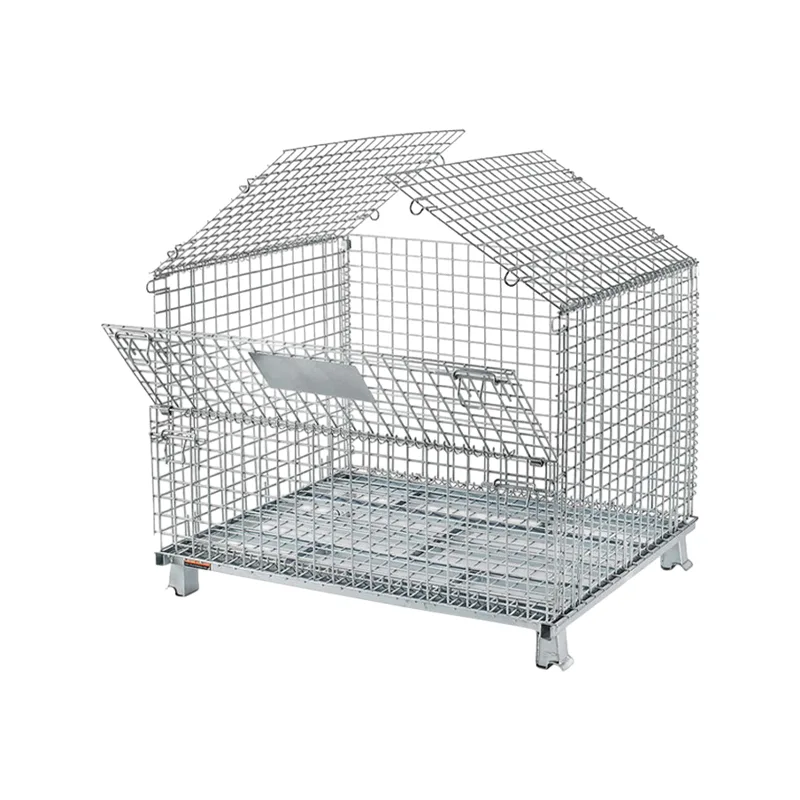
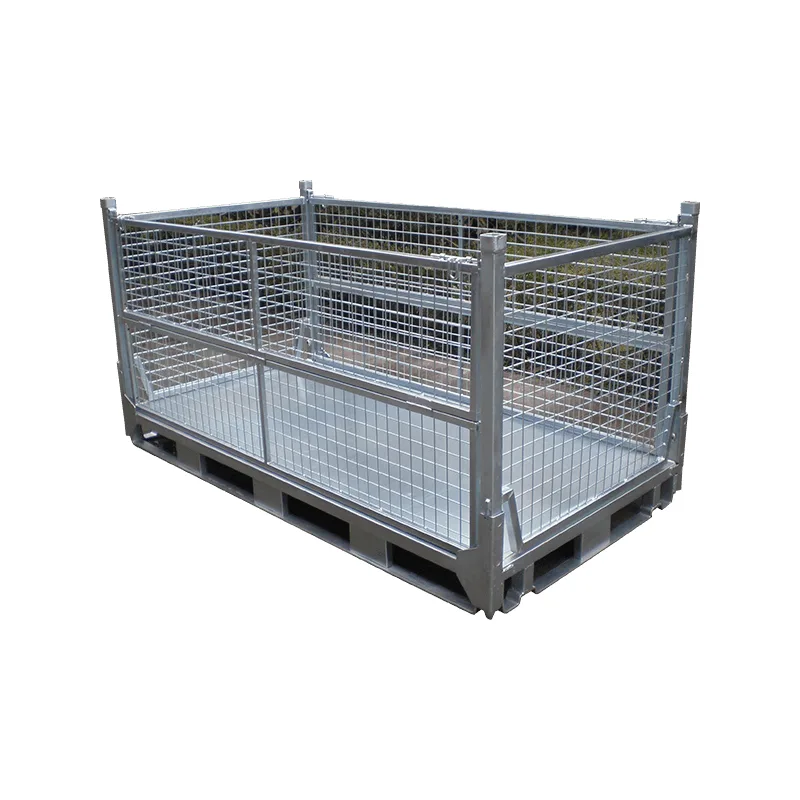
A wire mesh stillage, also sold as a stillage cage or pallet cage, is a galvanized wire box on a forklift base. The open mesh keeps contents visible and ventilated, and staff can pick and count without opening anything. Our foldable wire mesh container measures 1000 × 800 × 840 mm and holds 0.52 m³, with fold-down front gates that lock. The same shell is built in 5, 5.5 and 6 mm wire on a 50 × 50 or 50 × 100 mm grid, which gives ratings from 800 to 1,500 kg. Larger pallet cages run 1600 × 1150 × 1070 mm at 1,200 and 1,500 kg, and a 2200 × 1150 × 1120 mm pallet frame is rated 1,000 kg for long machinery parts and building materials.
Steel pallet boxes with solid sides
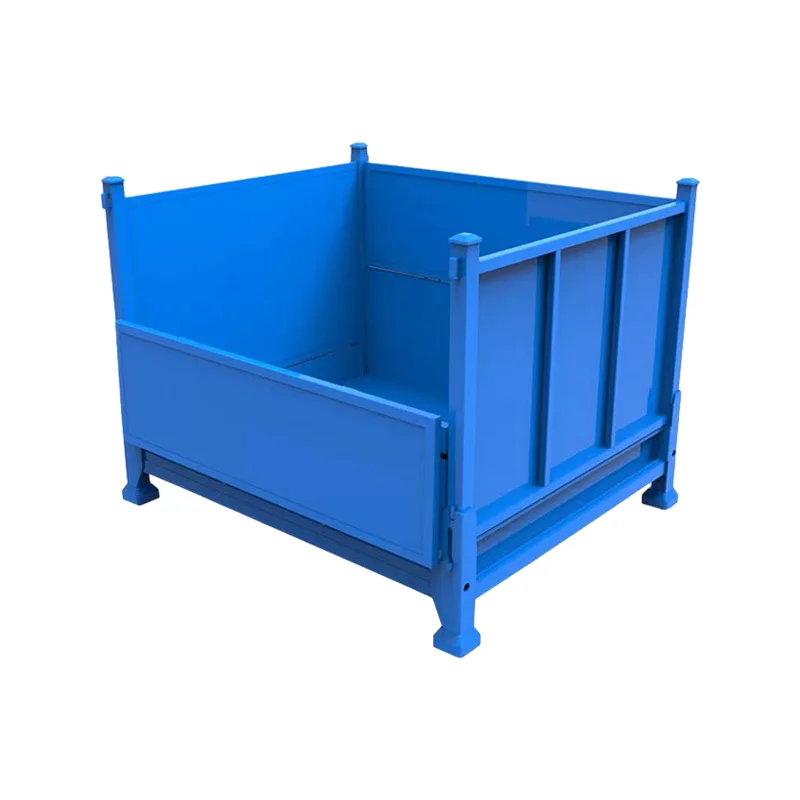
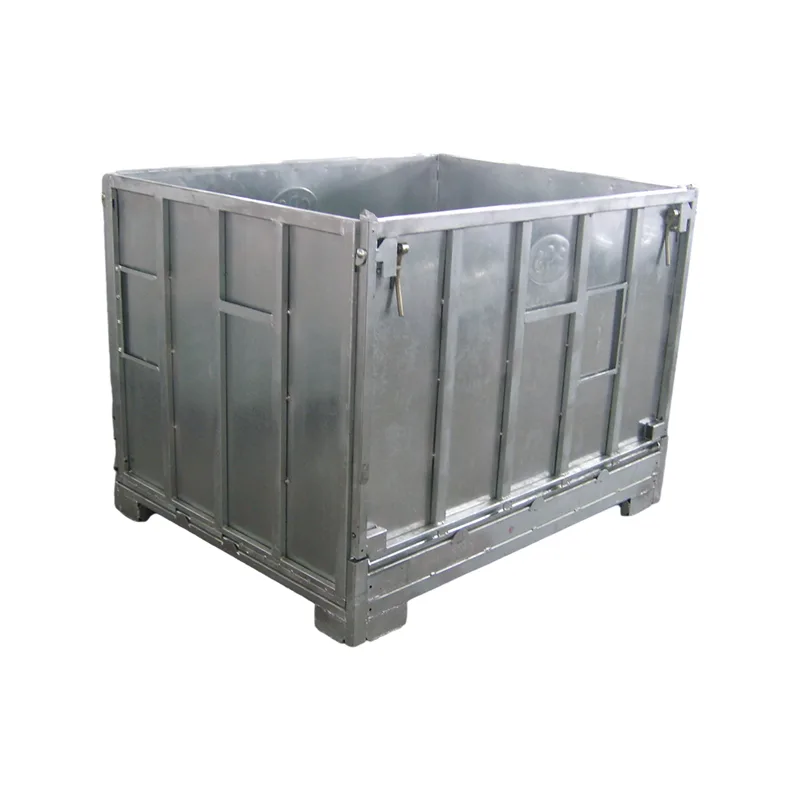
Where parts are small enough to fall through mesh, a closed steel box is the answer. Our 1000 kg bulk parts box measures 1000 × 800 × 800 mm and is made for screws, nuts, small hardware and electronic accessories stored by the tonne rather than by the tray. The family goes up to a 1,500 kg galvanized box on a 1465 × 1156 mm base, and includes a hot-dip galvanized folding container, 1060 × 865 × 670 mm, rated 1,000 kg for loads that travel between sites.
Stacking frames
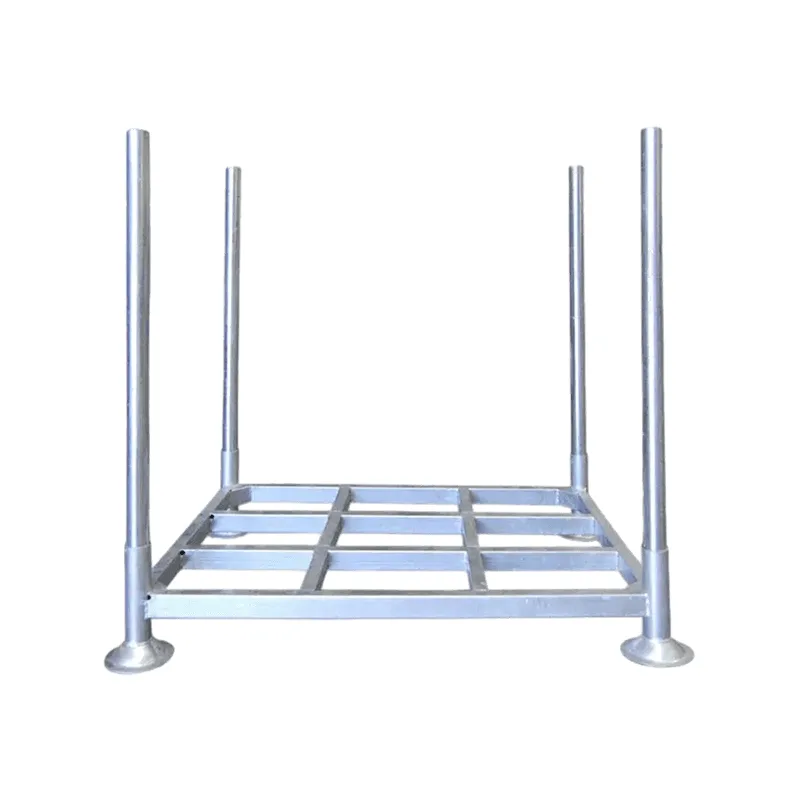
A stacking frame does not hold the goods itself. It sits on a loaded pallet and adds four posts. Each pallet becomes a stackable unit and the goods stay on the pallet you already use. We list 12 stacking frames, all powder coated and rated 1,000 kg, sized for 1210 and 1310 pallet footprints. Tell us your pallet size in millimeters and the frame is matched to it.
Post pallet racks with removable posts
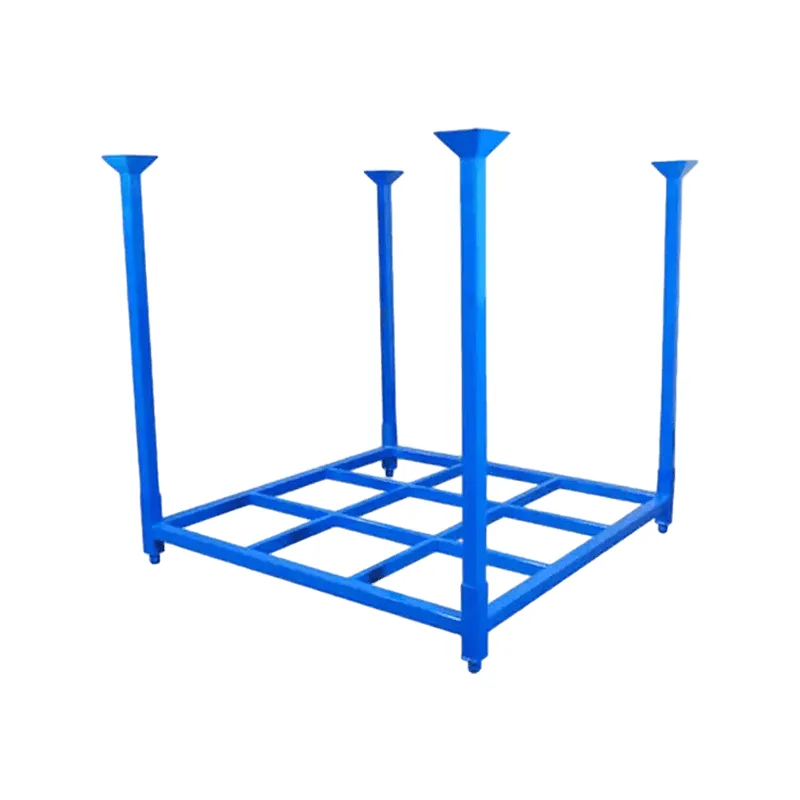
A post pallet rack is a welded base with four posts, usually topped with locating cups so the base of the unit above sits square. Loaded racks stack without any fixed racking around them. When they are empty the posts lift out and the flat bases pile up, which is the return-trip saving that makes this type popular. Our guide to post pallets covers the types and sizes in detail. We list six models between 1,000 and 1,500 kg. PFMPR001 is 1830 × 1220 × 1520 mm and powder coated at 1,000 kg, and PFMPR002 is 1395 × 1060 × 1500 mm, hot-dip galvanized, at 1,500 kg.
Tire stillages
Tires are light for their size and awkward to stack. Tire stillages are frames built around that shape. Our five tire racks fold or come apart, with factory self-weights of about 45 kg for PFTR002 (1000 × 1200 × 1000 mm), 54 kg for PFTR001 (1524 × 1524 × 1524 mm), 70 kg for PFTR003 and 89 kg for PFTR004. Read more in our guide to foldable tire racks and storage space.
The Parts of a Stillage
Every stillage, whatever the type, is built from the same four parts, and knowing them makes a data sheet easier to read. The base takes the lift, the frame carries the stack, the walls hold the load in, and the closures give access.
- Base. A welded steel frame with fork entries on two or four sides, built so tines or a pallet truck can enter without catching. Short feet or runners keep the base off the floor, and the same feet are what locate the unit when it stacks.
- Frame and posts. The corner posts carry the weight of the units stacked above. On post pallet racks each post is topped with a locating cup. The feet of the next rack sit into it and the stack stays square.
- Walls. Either galvanized wire mesh or solid steel panels. Mesh is described by wire diameter and grid, for example 5, 5.5 or 6 mm wire on a 50 × 50 or 50 × 100 mm grid. Solid boxes use reinforced side panels for strength and, on our bulk parts box, a front opening for taking parts out.
- Closures. Fold-down or drop gates that lock. A worker reaches the contents at waist height and the load stays secure in transit.
Welds join all four, and weld quality sets how many trips a stillage survives. Cracks start at joints, which is why a supplier's welding method is a fair question to ask.
Where Stillages Are Used
Stillages show up wherever the same goods move between the same places again and again. The main uses fall into four groups.
- Beside the production line. Boxes and cages hold work-in-progress and finished parts at the station. Operators fill a unit and a forklift takes it away whole. Small castings, fasteners and machined parts go into solid-sided boxes.
- In the warehouse. Mesh cages and post racks sort stock by category and stack it on the floor without fixed racking, so a block of stillages can be re-laid whenever the layout changes.
- At the distribution center. Loaded stillages are consolidated for sorting and cross-docking, then ride the truck to the customer and return empty.
- In picking and e-commerce storage. Visible mesh containers make counting and picking quicker, because the operator can see the contents without opening anything.
Specialist versions exist for tires and wheels, for automotive parts and for building materials. Our turnover racks are used in automotive parts logistics, where a part may travel the same loop between supplier and assembly plant for years.
Benefits of Using Stillages
A stillage lets one lift move what would otherwise take dozens of hand movements, and the same frame comes back for the next load.
- Vertical space. Stillages stack on their own frames and give three layers of storage on the same floor area, with no fixed racking.
- Protection. The frame holds the load. Goods in the middle of a stack are not crushed by those above them, and loose parts stay together.
- Reuse. Steel does not wear out like cardboard or crack like plastic. One stillage replaces a long run of single-use packaging.
- Less manual handling. Parts are loaded into the unit at the station and lifted away whole, which cuts lifting by hand and speeds up changeovers.
- Clear counting. A fixed unit size makes stock easy to count, since a stack of five stillages is five units whatever is inside.
Stillage Dimensions, Sizes and Load Ratings
Stillage dimensions and ratings both vary by type, and they should be read together. The table lists real models from our range, so footprint, height and rating can be compared across the families.
| Type | Example | Overall size (mm) | Rated load | Finish |
|---|---|---|---|---|
| Wire mesh container | Foldable wire container | 1000 × 800 × 840 | 800 to 1,500 kg by wire build | Galvanized |
| Wire pallet cage | 1500 kg collapsible cage | 1600 × 1150 × 1070 | 1,500 kg | Galvanized mesh, painted base |
| Wire pallet frame | Stackable pallet frame | 2200 × 1150 × 1120 | 1,000 kg | Galvanized |
| Steel box | Bulk parts box | 1000 × 800 × 800 | 1,000 kg | Spray coated |
| Steel box | Foldable steel box | 1000 × 800 × 750 | 1,200 kg | Spray coated |
| Steel box | Galvanized steel box | 1465 × 1156 × 1110 | 1,500 kg | Hot-dip galvanized |
| Folding steel box | Detachable folding container | 1060 × 865 × 670 | 1,000 kg | Hot-dip galvanized |
| Post pallet rack | PFMPR001 | 1830 × 1220 × 1520 | 1,000 kg | Powder coated |
| Post pallet rack | PFMPR002 | 1395 × 1060 × 1500 | 1,500 kg | Hot-dip galvanized |
Size also decides how well a stillage fits the rest of your handling. Pallet-based units such as stacking frames are named for the pallet they sit on, which is why our frames come in 1210 and 1310 versions. Standalone boxes and cages are built on footprints close to a pallet or half a pallet, such as 1000 × 800 mm. They travel on the same trucks and use the same bays. Check the overall height as well as the footprint, because height limits how many units can be stacked under a roof or inside a trailer, and the height of a folded unit tells you how much space the return trip really saves.
How to read a load rating
A rating is a number printed on a data sheet, and three questions decide what it means for your site. First, is it per unit or per pallet? A stacking frame rated 1,000 kg is rated for one frame, not for the whole stack. Second, is it a static rating, for a unit standing still, or does it also cover lifting and driving? One of our stacking boxes is listed as 1,000 kg static with a higher dynamic figure, which is the kind of detail to ask every supplier for. Third, what stack height does the rating assume? The bottom unit carries everything above it.
When you compare quotes, ask for the rating, the test or design basis and the stack height in writing, next to the overall size. Two stillages with the same rating and different frames are not the same product.
Materials and Finishes for Stillages
Almost every steel or metal stillage is finished one of two ways, and the choice follows the environment. Galvanized finishes resist rust, so they suit outdoor yards, damp stores and long journeys. Powder coating gives a tough painted surface that handles forks and steel-on-steel stacking, so it suits dry indoor use.
| Finish | Where it fits | Examples from our range |
|---|---|---|
| Galvanized wire mesh | Outdoor yards, visible contents, indoor and outdoor use | Foldable wire containers, pallet cages |
| Hot-dip galvanized | Moisture, long hauls and sites exposed to weather | 1,500 kg galvanized box, PFMPR002, folding container |
| Powder or spray coating | Dry indoor use with heavy abrasion | Stacking frames, PFMPR001, bulk parts box |
Hot-dip galvanizing dips the finished part in molten zinc. The bath bonds a zinc-iron alloy layer to the steel with a pure zinc layer above it, a coating that isolates oxygen, water vapor and corrosive substances from the metal. A spray-coated box kept in a dry indoor space does not need that, and costs less. If you are not sure which side of the line your site falls on, tell us where the stillages will stand and for how long, and we will recommend one.
Folding, Nesting and the Return Trip
A stillage pays back by making many trips. It holds work-in-progress beside the line, moves finished goods into the warehouse, rides the truck to the customer and comes back for the next load. The weak point of that loop is the empty return, where a full-size steel frame takes a full truck space for nothing.
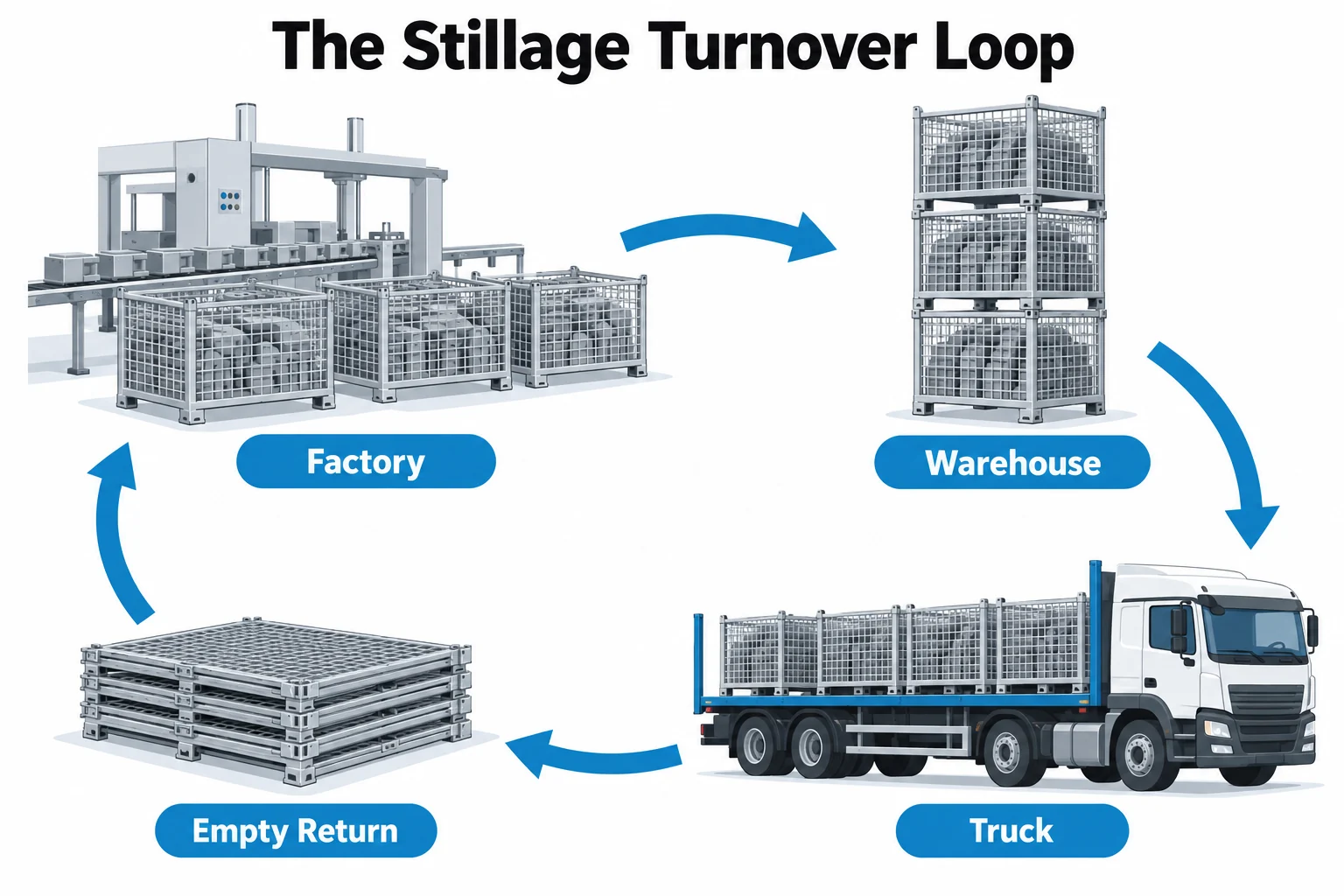
Three designs solve the empty leg in three ways. Wire containers and folding boxes collapse flat. Post pallet racks lose their posts and leave a flat base. Stacking frames pile into each other. All three cut the volume of an empty return, and by how much depends on the model. The accurate way to find out is a container loading plan, which we prepare from your pallet size, load and yearly volume, showing how many units fit in a 40HQ container full and empty.
How to Choose a Stillage
Choose in a fixed order, because the first answer narrows the next. Start from the cargo, then the pallet, the load, the environment and the return trip. Quantity comes last, because a price breakpoint should never change the type.
- What goes inside? Loose small parts need a solid-sided steel box. Parts you pick and count need mesh. Loaded pallets need a stacking frame or post rack. Tires need a tire stillage.
- What pallet and forklift do you run? Give the pallet footprint in millimeters and the fork entry height so the base and the feet match.
- What load and stack height? Choose the rating with margin, and confirm whether it is per unit and static or dynamic.
- Where will it stand? Dry indoors points to powder coating. Outdoors, damp or exported across the sea points to galvanized.
- How does it come back? If the loop returns empty, pick a design that folds, nests or comes apart.
- How many, and by when? Quantity and delivery date set the production plan, and often the choice between a standard model and a custom size.
To get a useful quote on the first reply, send photos of the parts, the pallet size, the weight per load, the stack height you want, the yearly volume and the destination country through our contact page. If none of the standard sizes fit, our OEM service builds stillages to your drawing.
Common Ordering Mistakes
Most stillage problems can be seen on the quotation. Check these six items against yours before you order.
- Buying on rating alone. A bigger number is not safer if it is a static rating and your units are lifted and driven loaded. Ask what the figure means.
- Forgetting the fork entry. The base must suit the forklift tines or pallet truck you actually use. Check the fork entry height and width on the drawing, not only the overall size.
- Using mesh for small parts. Screws, nuts and small hardware fall through a 50 × 50 mm grid. Choose a solid-sided box for them.
- Ignoring where the unit will stand. A painted frame left outdoors will rust where the coating is scratched. If the site is damp or open to the weather, specify galvanizing.
- Paying for folding you will not use. Foldable and nestable designs save money only when empties go back. For a one-way flow a fixed frame can be the cheaper choice.
- Mixing sizes in one stack. Stillages stack on their own frames, and units from different suppliers rarely sit square. Keep a stack to one model.
How Ping Fang Builds Stillages
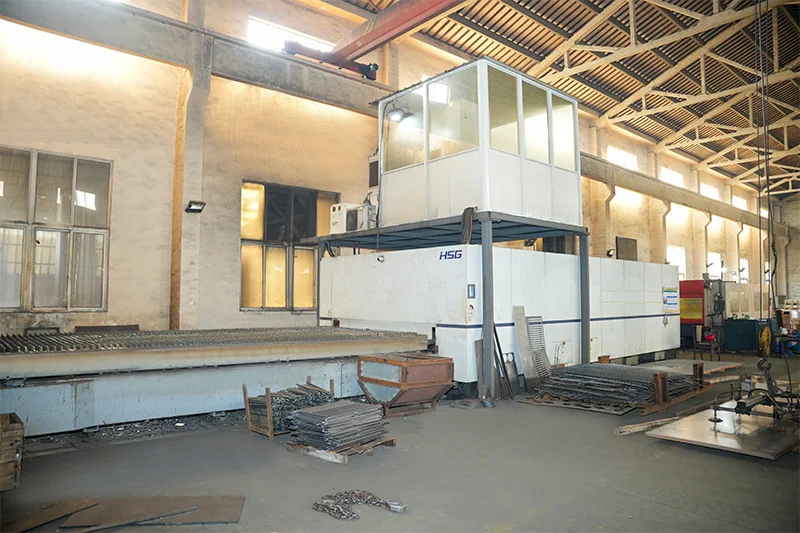
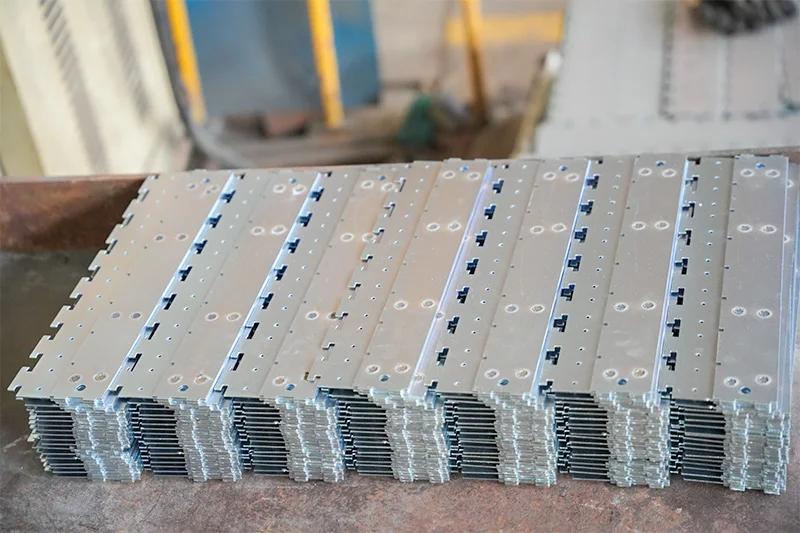
Ping Fang has been a manufacturer since 1984. Most stillage frames are welded on our 18 robot welding machines, so repeated stacking lands on consistent joints. Sheet and tube are cut on a 6000 W plate laser and a 3000 W tube laser, and finished on our automatic spraying line.
Four checks run on every order. They cover incoming material, worker self-check with inspector patrol during production, inspection before surface treatment, and a final check before shipping with a quality report.
Turnover racks from this line circulate in automotive parts logistics and in other industries that run closed loops between plant, warehouse and customer. More about the factory is on our factory page, and the full range is on the Stillage and Turnover Material Rack page.
 Related Questions