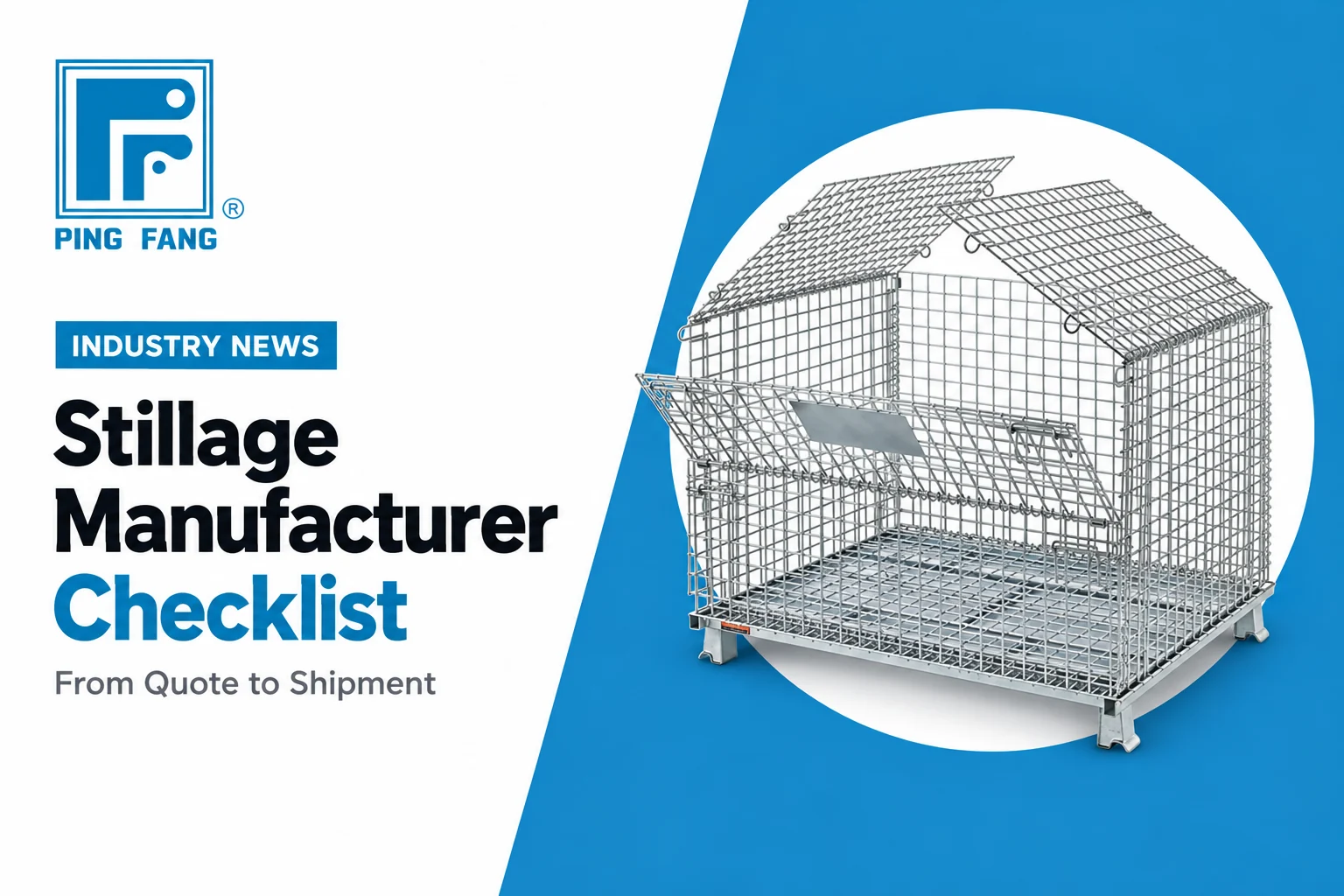
Most stillage orders that go wrong were visible before the deposit. The quotation left out the finish, the load rating had no test behind it, or nobody checked a sample. This checklist for choosing a stillage manufacturer follows the order of a real purchase, from the first email to the container at the port, and says at each step what to ask, what a good answer looks like and what you can verify yourself. It works for a stillage, a pallet cage, a wire container or a steel bin, which are the names buyers in the UK, Australia and the United States use for much the same product.
Four Places Where a Stillage Order Goes Wrong
Almost every bad stillage order fails in one of four places. Knowing which is which tells you where to spend your attention.
| What goes wrong | How it shows up | Where to catch it |
|---|---|---|
| The spec was never clear | Stillages arrive that do not fit your pallet or your rack | The inquiry and the quotation |
| The rating was a claim, not a test | Floors bow or frames bend under the rated load | Documents and the sample test |
| The build quality varies | Cracked welds, rust at joints, sloppy hinges | The factory floor and the final inspection |
| The shipment differs from the sample | Thinner wire, a different finish, a lower container count | Pre-shipment inspection and packing photos |
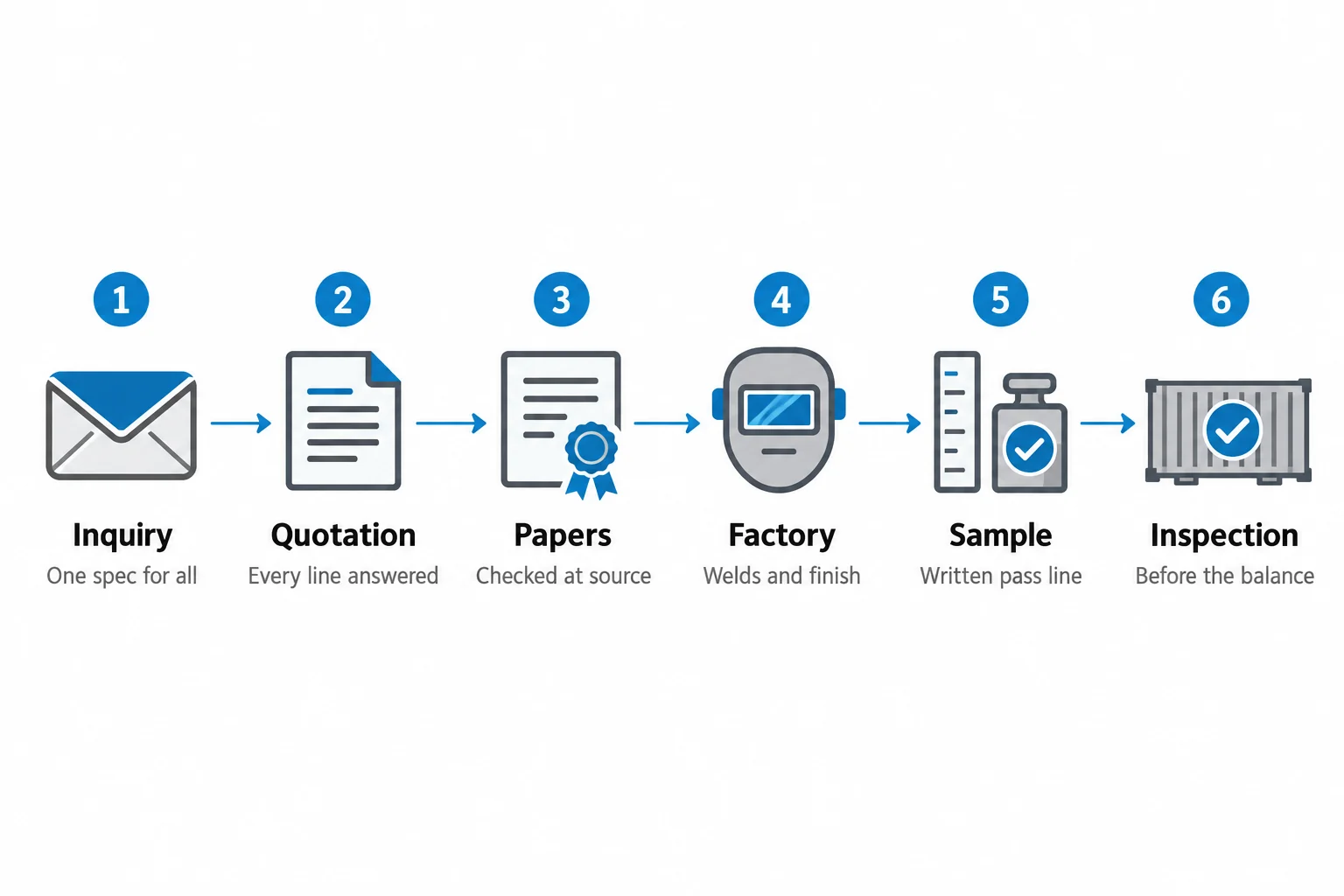
Step One, Write an Inquiry a Factory Can Price
A factory can only quote what you describe. A vague inquiry gets a vague price, and the cheapest reply is often the one that assumed the least. Send the same block of facts to every stillage manufacturer you compare, so the quotations can be set side by side.
Each line prevents a specific problem. Name the product the way your market does. The same stillage is a pallet cage in the UK and Australia, a wire container or a steel bin in the United States and a mesh cage in many other places, and a supplier who searches by the wrong word may quote the wrong product. The pallet size matters because a stillage built around 1200 × 1000 mm pallets will not take a 1200 × 800 mm pallet without sliding. The stacking levels matter because the bottom unit carries everything above it.
A drawing beats any description. If you have none, a photo with the three outside dimensions written on it is enough for a first quote. At Ping Fang, drawings, price requests and factory visit requests are answered within 24 hours on working days, and a reply that takes much longer is worth noting as a data point about the supplier.
Step Two, Read the Quotation Line by Line
When quotations come back from each stillage manufacturer, resist the urge to sort them by price. Sort them by completeness first. A quotation that lists the material, the finish, the rated load and the packing is a quotation you can hold the supplier to. One that lists only a size and a price is an invitation to a dispute later.
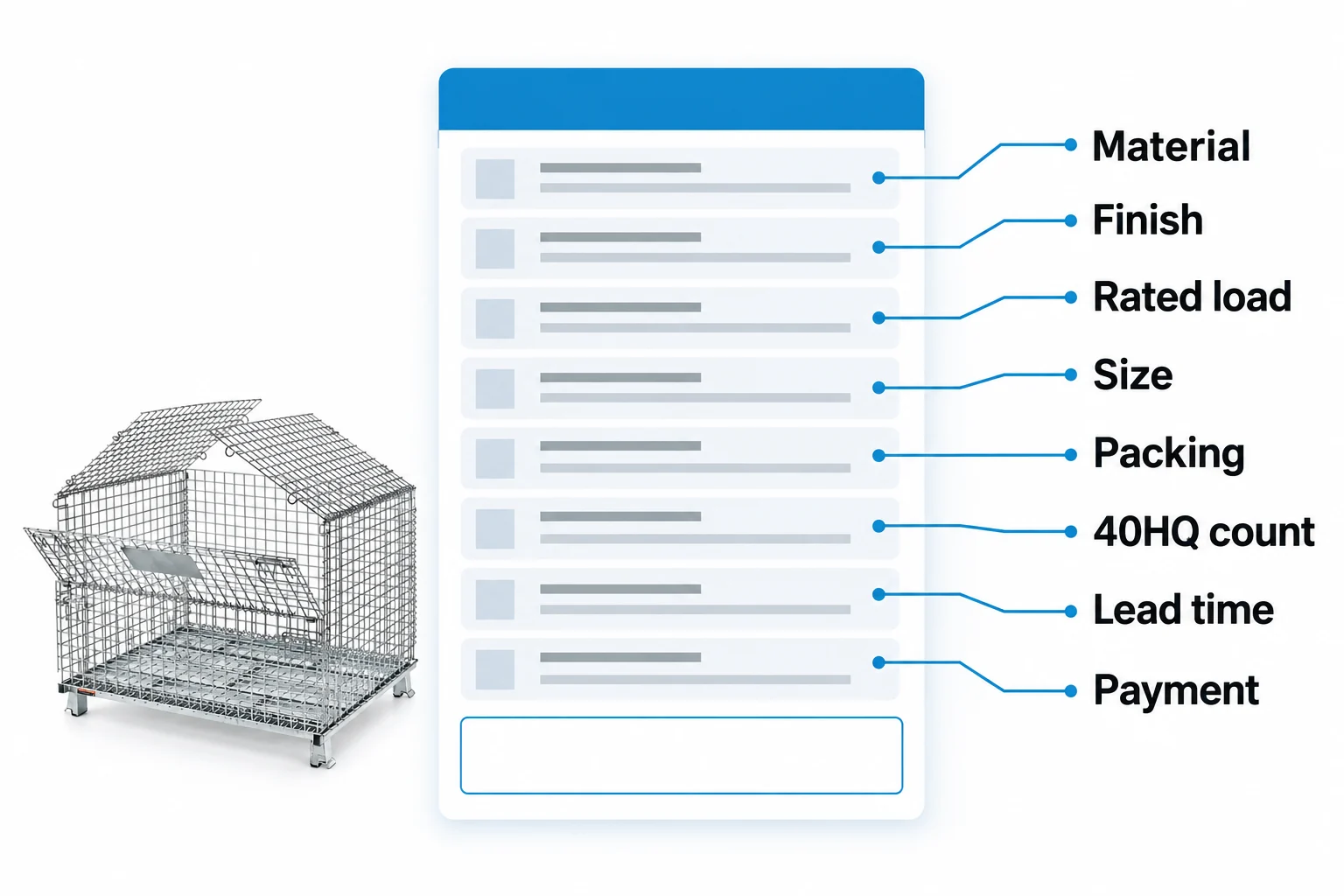
| Line | A good answer sounds like | A vague answer sounds like |
|---|---|---|
| Material | Wire and tube sizes in millimeters | Good strong steel |
| Finish | Process named, galvanized or powder coated | Anti-rust treatment |
| Rated load | Kilograms, with the test method | Heavy duty |
| Packing | Folded size and units per bundle | Packed carefully for export |
| Container count | Units per 40HQ with a loading plan | Many pieces per container |
| Lead time | Days from deposit, for the first order and repeats | Fast delivery for you |
| Payment | Deposit share and balance trigger | Flexible |
Two quotations that differ by a visible amount usually differ in one of these lines. Before you decide that one supplier is overcharging, ask the cheaper one to answer each line with a number.
Check the sea freight too. Freight is priced per container, so the rate divides across every unit in the loading plan, and a folding stillage that packs four times as many units into a container carries about a quarter of the freight per unit. Ask for the loading plan and the freight estimate together with the unit price. We reply to quantity and destination port with both.
Two quotations side by side
Here is how the comparison works in practice. Suppose you ask two suppliers for the same folding stillage and receive two replies. The first is a pallet cage manufacturer that lists wire diameter, a hot-dip finish, a load rating with a test method, a folded size and a loading plan. The second is a stillage supplier that lists a size, the words heavy duty and a price that is lower.
| Line | Quotation A | Quotation B | What to ask B |
|---|---|---|---|
| Wire and tube | Sizes in millimeters | Not stated | Send the wire diameter and tube size |
| Finish | Process named | Anti-rust | Which process, and how is it checked |
| Rated load | Kilograms with method | Heavy duty | State the load and the test |
| Folded size | Listed | Not stated | Send the folded size and the bundle |
| Container count | Loading plan attached | Not stated | Send the 40HQ plan |
The unit price of B is lower, but it tells you nothing yet. Once B answers the right-hand column, one of two things happens. Either the numbers match A, and B is simply cheaper, or they come back lighter, and the gap in price turns out to be a gap in steel. Both outcomes are useful, and neither is available if you only read the price. If the answer comes back as a promise instead of a number, treat that as the second outcome.
Step Three, Ask for Papers You Can Check
Reliable stillage manufacturers expect to be asked for papers. Documents are the cheapest form of proof, because a stillage manufacturer either has them or does not. Ask for four, and check each one yourself.
- Quality system certificate. An ISO 9001 certificate should show the certification body, the registration number, the scope and the validity dates. Check that the scope covers metal products and that the date is still valid. Our certificate, for example, was first issued in 2009, is valid until September 2027, and its scope names metal logistics vehicles, metal turnover cabinets and boxes, and metal structural parts.
- Batch quality report. Ask what the report covers and see a sample of one. A report that lists measured sizes, a load check and a finish check is useful. One that only says passed is not.
- Material records. Ask which steel grade the wire and tube are, and whether mill papers come with each purchase of material.
- Patents and design ownership. If you will ask for a custom design, you want to know who owns it. Patents carry public numbers that can be checked at the source, and ours are listed scan by scan on our certificates page.
An ISO 9001 certificate is a basic requirement in this industry rather than a mark of excellence, so treat it as a minimum. Its absence is a warning, and its presence proves very little on its own. The documents that separate suppliers are the batch reports and the material records.
Step Four, Look at the Welds and the Finish
A video call or a visit to the stillage manufacturer shows what no document can. You do not need to be an engineer. A few things are easy to see and hard to hide.
Start with the welds. Continuous beads with an even width suggest a controlled process, and pits, gaps and heavy spatter suggest haste. Look at the corners and the joints where wire meets frame, because that is where stress concentrates and where cracks start. Ask whether welding is done in a fixture, which holds parts square, or freehand. A fixture helps keep units from the same order alike, so they stack and fold the same way.
Next look at the material before it is made into anything. Ask to see the incoming steel with its markings, and ask how it is checked when it arrives. Then look at the finish line. For galvanized work, ask where the zinc is applied and how the coating is checked. For powder coating, ask about surface preparation, because paint over mill scale peels early. Sandblasting before coating is a good sign.
Finally look at the end of the line, where products are packed. A packing area with units folded and bundled to a plan shows that the container count on the quotation is a working method, not an estimate. Our plant in Changshu follows an audit route of five stops, which our factory page lists in the order an auditor walks them. The equipment register lists 18 sets of automatic robot welding machines with 20 Panasonic arms, a 6,000 W plate laser, a 3,000 W tube laser, an automatic powder coating line and sand blasting machines. Everything on that list can be counted on site.
Is the Stillage Manufacturer a Factory or a Trader?
Many stillage suppliers who answer an inquiry for a stillage manufacturer or a wire container manufacturer are trading companies that buy from several plants. A trader is not automatically a bad choice, but you should know which one you are dealing with, because it decides who is responsible when something goes wrong.
Ask a few plain questions. Can they show their own production line on a live video call, not a recorded tour? Can they name the number of welding machines and the size of the plant? Does the business license list manufacturing in its scope? Do they quote a lead time they control, or one that depends on another factory? A real plant answers these without hesitation, and usually with a number. At Ping Fang the factory page gives the plant area, the workshop area, the number of production bases and the equipment register with the year each machine entered service, so you can compare what we say with what a visit shows.
If the supplier is a trader, ask which plant makes your order and if you may audit it. A trader with long-standing plant relationships can show you this. One who refuses leaves you guessing.
Step Five, Test the Sample Before the Bulk Order
A sample is the one moment when the supplier's claims meet your own measurement. Do not skip it, and do not test it casually. Write the pass criteria down before the sample arrives, so the result cannot be argued afterward.
| Test | How to do it | What a pass looks like |
|---|---|---|
| Size check | Measure against your drawing with a tape and a square | Every size within the tolerance you wrote down |
| Fit test | Load your real pallet or product into it | Fits without forcing, and does not shift |
| Load test | Load to the rated weight and leave it for a set time | No permanent bend and no cracked weld |
| Stack test | Stack loaded units to your working height | Stable, level and square, with feet seated |
| Fold test | Fold and unfold many times by hand | No sticking, and the gate locks each time |
| Handling test | Lift with your own forklift and move it | No scraping, bouncing or racking |
Setting the pass line is the part buyers skip. For example, you might decide that no overall dimension may differ from the drawing by more than a few millimeters. You might decide that the loaded stillage must hold its rated weight for a full day without a permanent bend. You might decide that the gate must close and lock after fifty folds. The exact figures matter less than the habit of fixing them first. Photograph each test, note who ran it and keep the sheet, because it becomes the basis for any claim if the bulk order differs from the sample.
Our own custom orders follow the same logic on the supplier side. The process runs from measuring your parts and analyzing how often they move, through drawings, a sample and full process testing, to modification and production against the agreed quality standard. A stillage manufacturer who shows you a process like this expects to be tested.
If the sample passes, keep it. It becomes the reference for the bulk order, and you can compare each shipment against it.
Custom and Bespoke Stillages, What to Settle First
Standard stillages are easy to compare, and custom stillages are where the real differences appear between one stillage manufacturer and the next. If you need a size, a gate or a stacking foot that no catalogue offers, settle five points in writing before the drawing is approved.
- Who reviews the drawing. A good manufacturer checks your drawing for weak points and proposes changes. A supplier who simply copies it has added nothing.
- Who owns the design. If the supplier draws it, ask if you may take it elsewhere. If you draw it, ask for confirmation that it will not be sold to others.
- What the sample costs and when. Ask how long the sample takes, whether its cost is credited against the bulk order and how many changes are included.
- The change procedure. Once production starts, any change to size or material should need your written approval.
- The quality standard. Agree the acceptance criteria for the bulk order and attach them to the contract.
Our OEM service works in this order, with the drawing check first and the sample test before production starts.
Step Six, Inspect Before the Cargo Leaves
The last check is the one most buyers shorten, and it is the one that protects the money. By now you have paid a deposit, and the balance is usually due once the goods ship. Check before that.
Ask which inspections the stillage manufacturer runs and when. At Ping Fang there are four inspections. They cover incoming material, worker self-check with inspector patrol during production, inspection before surface treatment, and a final check before shipping with a quality report for each batch. Ask for photos of the finished goods and the loading, and compare them with the sample. Ask for the packing list and the loaded container count, and make sure they match the plan on the quotation.
For a large order, consider an independent inspector. A third party can open cartons, measure units, check welds and test fit on your behalf, and their report gives you a basis to ask for correction before the balance is paid. For bulk orders the usual payment structure is a 30 percent deposit with the balance against a copy of the bill of lading, so the inspection window sits between the two.
When the goods are loaded, ask for the set of papers that lets you reconcile the shipment. That means the packing list with the number of units and bundles, the commercial invoice, the batch quality report, the loading photos and a draft of the bill of lading. Compare the quantity on each with the order, and read the batch number on the report against the number marked on the goods. A mismatch at this stage costs a phone call. The same mismatch found at your own warehouse costs weeks.
Keeping the Standard on Repeat Orders
The first order is the one buyers watch closely. The third and the fifth are the ones where quality quietly drifts, because a supplier may change a wire supplier, a coating line or a worker without telling you. Protect yourself with three habits.
Keep the approved sample from the first order as a reference, and label it with the date and the order number. Ask that every later quotation refer to the same specification sheet, and have the supplier confirm in writing that nothing changed. And compare each shipment against the reference sample with the same measurements you used the first time. A drift in weight is the easiest early signal, because a lighter unit usually means thinner steel or a thinner coating. If you buy bespoke stillages in several designs, give each design its own reference sample.
A relationship that survives these checks is worth more than a lower price. It also puts you in a stronger position, because a supplier who knows you measure will take the same care on the tenth order as on the first.
Warning Signs That Should Slow You Down
Individually, none of these proves a supplier is poor. Together they say a lot.
- A price far below every other quotation. Steel is a commodity, so a very low price usually means less steel or a thinner finish.
- No questions about your application. A good stillage manufacturer asks what the stillage will carry and where it will stand. One that only asks for the quantity is quoting a catalogue, not a product.
- Reluctance to show the factory. A refused video call or a visit that is always postponed is a reason to look again.
- A sample that does not come from the production line. A sample made by hand tells you about the best case, not the order.
- Pressure to pay everything up front. A deposit with the balance tied to shipping documents is the normal structure, and paying in full before inspection leaves you no way to press for a fix.
- Papers that cannot be checked. A certificate without a registration number, or a patent without a public number, cannot be verified.
A Supplier Scorecard to Copy
Put the checks into a table, give each a weight and score each supplier out of five. The numbers below are a starting point, and you should change the weights to match what hurts most in your operation.
| Criterion | What to score | Weight |
|---|---|---|
| Quotation completeness | Seven lines with figures | 20% |
| Documents | Certificate, report, records | 15% |
| Factory evidence | Welds, fixtures, finish seen | 20% |
| Sample result | Passed your own criteria | 20% |
| Inspection plan | Stages, report, photos | 10% |
| Response speed and clarity of answers | Fast and direct replies | 10% |
| Price and freight | Landed cost per unit | 5% |
Notice that price carries the smallest weight. That is deliberate. By the time a supplier has passed the other checks, the price differences are small compared with the cost of one failed shipment.
Where Ping Fang Fits
As a stillage manufacturer, Ping Fang has made metal handling equipment since 1984 in Changshu, and the stillage range sits on our Turnover Material Rack page. A typical entry point is the foldable galvanized wire storage cage or the 1,000 kg detachable folding container, and our OEM service builds to your drawing. For the product itself, start with our guide to what a stillage is, and for the finish, our guide to steel pallets explains galvanizing and spray coating.
Send your inquiry block and your drawing through our contact page, and ask for a visit through the same page. You can see the plant, the welding and the packing before you place an order, and our factory page shows the route in photos.
 Related Questions