
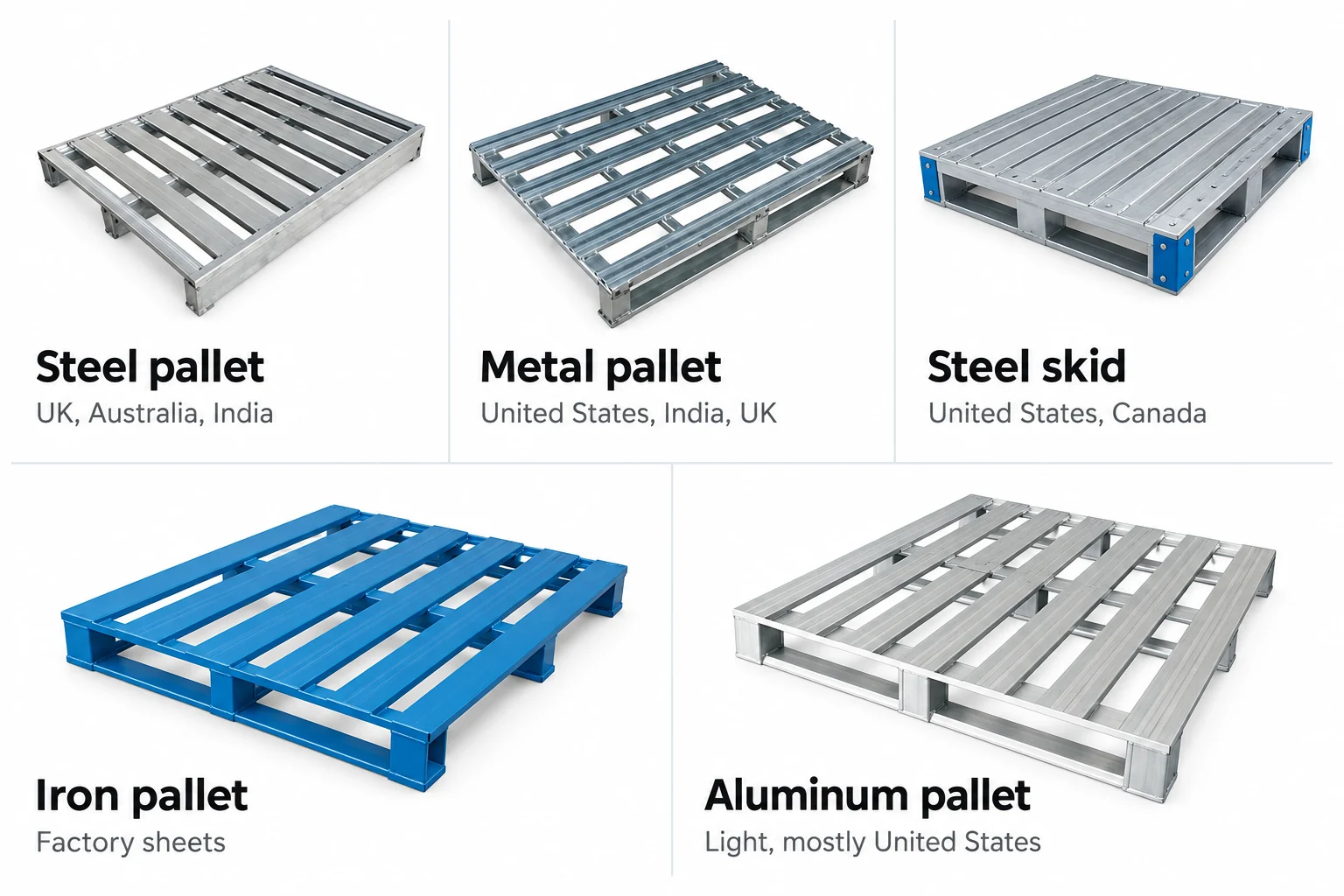
Buyers use several names for the same product. People in the UK, Australia and India say steel pallet, Americans say metal pallet or steel skid, and some suppliers write iron pallet. This guide explains what a steel pallet is, how the types differ, what the static and dynamic ratings mean, and which questions to settle before you order. The numbers come from the factory spec sheets of our own pallet range.
What Is a Steel Pallet? Meaning and Definition
A steel pallet is a flat platform for goods, built from steel tube, strip or plate and welded into one rigid unit. A forklift or a pallet truck lifts it through openings at the sides, and the goods stand on the deck. It does the same job as a wooden or plastic pallet, which is to turn many loose items into one load that moves in one lift.
What sets it apart is the material. Steel does not split, rot or absorb moisture, and it does not warp with the weather. That is why steel pallets are chosen for heavy goods, for wet and hot places, for export and for sites where a pallet makes the same trip hundreds of times.
Steel Pallet, Metal Pallet, Steel Skid, Iron Pallet and Aluminum Pallet Compared
Most of these names describe the same product, and the differences come down to the country and the metal.
| Name | What it is | Where the name is common |
|---|---|---|
| Steel pallet, steel pallets | A welded steel forklift pallet | UK, Australia, India |
| Metal pallet, metal pallets | The same pallet under a wider name, which also covers aluminum | United States, India, UK |
| Steel skid, metal skid | The same pallet, called a skid in some trades | United States, Canada |
| Iron pallet | A steel pallet as written on some factory sheets | Chinese suppliers |
| Aluminum pallet | A light pallet welded from aluminum alloy | Mostly the United States |
| Stillage, pallet cage | A pallet with sides, a different product | UK, Australia |
Our own range uses the word iron on some model sheets, because the factory lists the material that way. It is the same family of welded steel pallets. If you search for a pallet with sides, our guide to the stillage covers that product.
The Parts of a Steel Pallet
A steel pallet has four parts, and each one shows up on a spec sheet. The deck carries the goods, the support feet or blocks lift the deck off the floor, the fork openings let the forks in, and the frame joins everything.
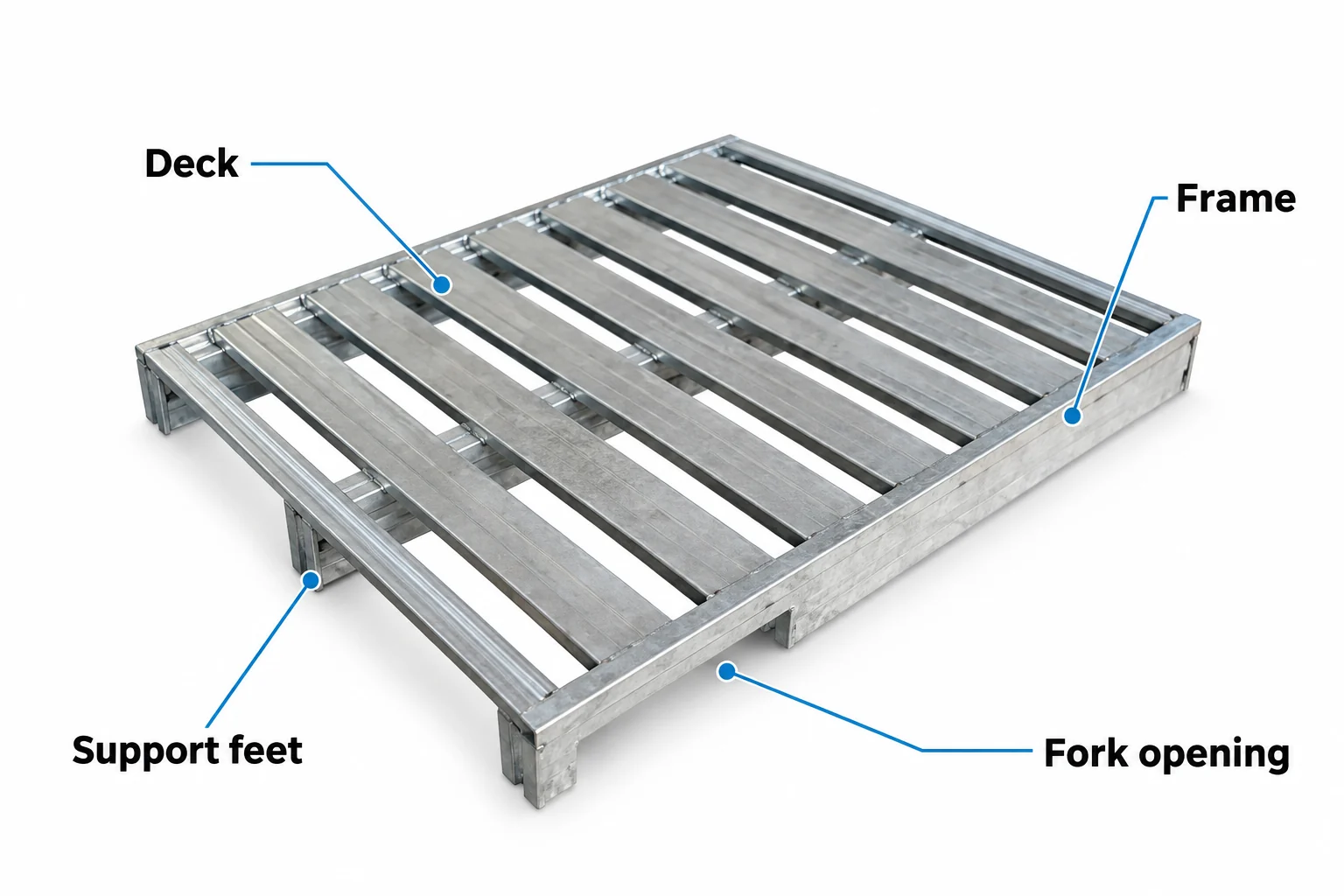
- Deck. The top surface. It can be solid, strip, grid or wire mesh, and the choice decides how the pallet drains, ventilates and cleans.
- Support feet or blocks. They raise the deck so forks can enter. Welded feet hold the load steady during fast lifts.
- Fork openings. Two-way entry takes forks from two sides, and four-way entry takes them from all four.
- Frame. The welded structure that ties the deck to the feet. Weld quality decides how long the pallet lasts under daily use.
The Main Types of Steel Pallets
The types differ mainly by the deck, because the deck decides what the pallet is good at. Pick the type from the goods and the environment.
Strip deck steel pallets
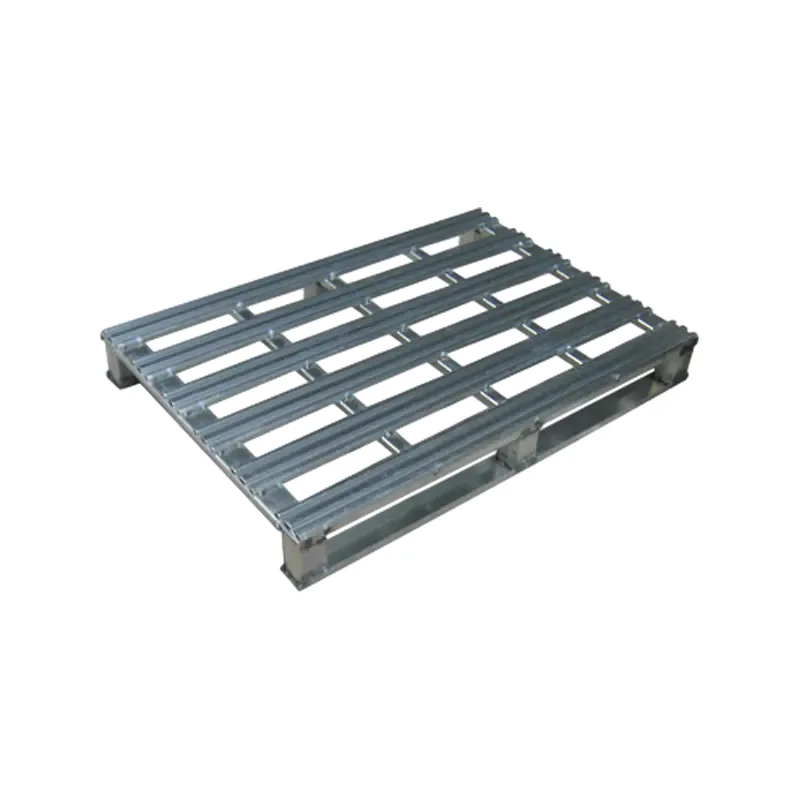
A strip deck has spaced steel strips on welded feet. The gaps ventilate and drain, and they cut the self weight. PFPSWK2008 is this kind, a 1200 × 800 mm galvanized pallet with four-way fork entry, rated 2,000 kg static and 1,200 kg dynamic. PFP454 is the heavy member of the family, a 1200 × 1000 mm galvanized pallet rated 3,000 kg static and 1,500 kg dynamic.
Grid and heavy duty steel pallets
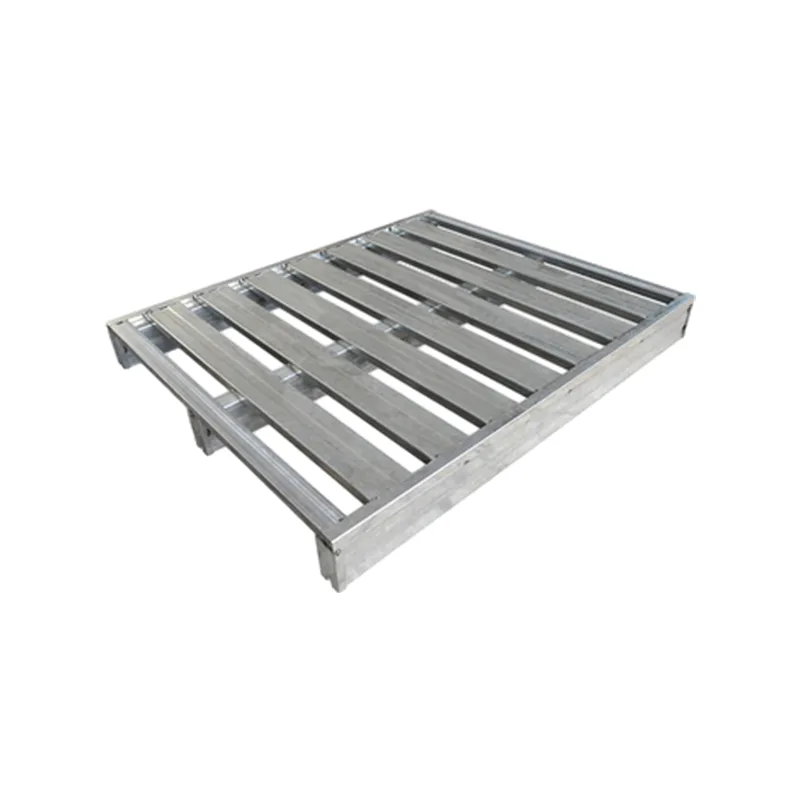
A grid deck crosses steel bars into one rigid surface. PFPLK35A is a cross-braced steel grid on welded feet, 1200 × 1000 × 210 mm, rated 2,000 kg static and 1,200 kg dynamic. The corners are treated against sharp edges, and the deep 210 mm profile keeps the deck rigid under mechanical parts and building materials.
Sealed deck and moisture-proof steel pallets
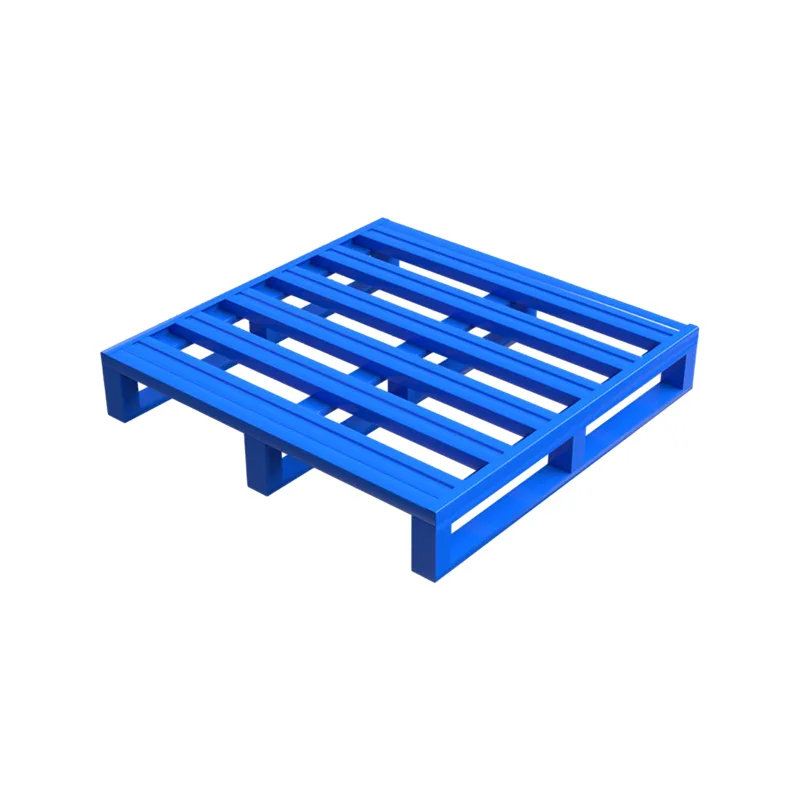
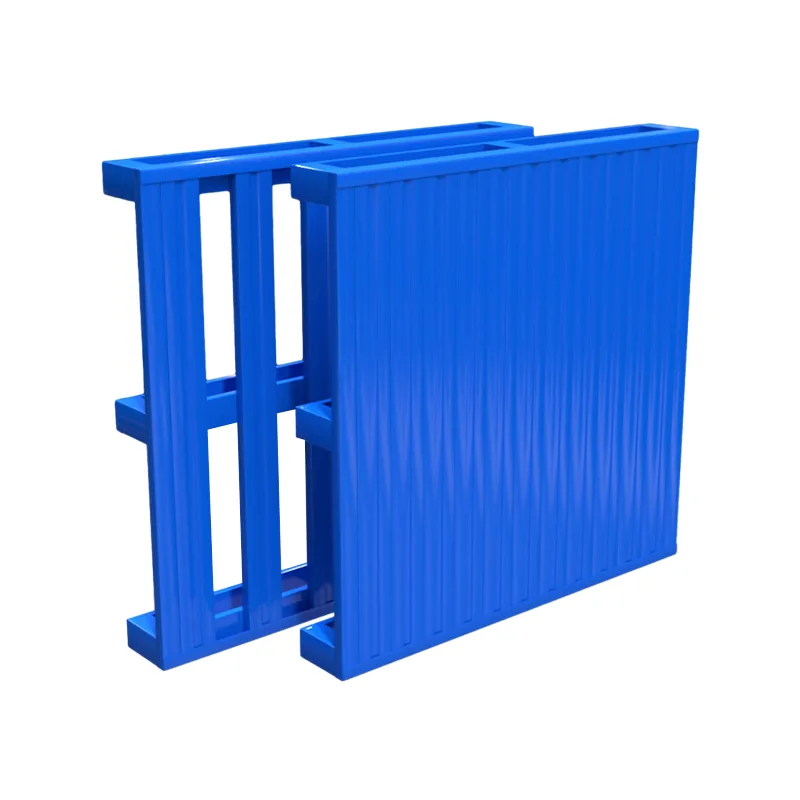
A sealed deck keeps damp off the goods. PFP01 is a 1200 × 1200 mm spray molded pallet for humid warehouses, and PFP02 is the stacking version, sealed on top and ventilated underneath with raised support blocks.
Wire mesh steel pallets
A welded wire mesh deck lets water run straight through and is easy to wash. PFP03 is a galvanized 1200 × 1000 mm mesh pallet with formed feet and four-way fork entry, used where hygiene and drainage matter, such as food, medical and chemical storage.
Aluminum alloy pallets
An aluminum pallet trades strength for weight. PHP02 is built from aluminum alloy with a robot welded frame, at about half the weight of a wooden pallet. Its deck is moisture-proof and non-slip, and the factory lists a working range from minus 50 to plus 200 degrees Celsius. Each size carries its own rated load, confirmed on the drawing.
Steel Pallet Sizes and Loads
Load rating is the number most buyers ask for first. The table lists the pallets in our range with the figures the factory spec sheets give. Where a sheet does not list a rating, the table says so and the figure is confirmed on the quotation.
| Model | Size (mm) | Static load | Dynamic load | Finish |
|---|---|---|---|---|
| PFP454 | 1200 × 1000 × 147 | 3,000 kg | 1,500 kg | Galvanized |
| PFPSWK2008 | 1200 × 800 × 130 | 2,000 kg | 1,200 kg | Galvanized |
| PFPLK35A | 1200 × 1000 × 210 | 2,000 kg | 1,200 kg | Spray molding |
| PFP03 | 1200 × 1000 × 130 | Not listed | Not listed | Galvanized |
| PFP01 | 1200 × 1200 × 125 | Not listed | Not listed | Spray molding |
| PFP02 | 1200 × 1200 × 125 | Not listed | Not listed | Spray molding |
Two things stand out. The dynamic rating is lower than the static one wherever both are listed, by about half for PFP454 and by 40 percent for the others, and a buyer who plans forklift work should read the dynamic column. And three footprints appear, 1200 × 800, 1200 × 1000 and 1200 × 1200 mm, which leads to the next question.
Which pallet footprint to choose
The footprint should match the pallet size already used in your supply chain. The 1200 × 800 mm size is the Euro pallet size, 1200 × 1000 mm is common in the UK and in Asia, and North America mostly uses 48 × 40 inch pallets, which is about 1219 × 1016 mm. A steel pallet is welded, so it can be built to the size you use. The PFP01 sheet lists multiple specifications on request, and the PFP03 sheet offers custom sizes, colors and features.
Static, Dynamic and Racking Loads
Pallet ratings come in three kinds, and they are easy to mix up.
- Static load. The weight a pallet carries while it rests on a flat floor. It is the highest number and the one on top of a spec sheet.
- Dynamic load. The weight a pallet carries while a forklift or a pallet truck lifts and moves it. It is lower than the static load.
- Racking load. The weight a pallet carries while it spans the beams of a rack. It depends on the beam spacing and is often the lowest of the three.
Our sheets list static and dynamic loads, and the racking load depends on your rack, so give the supplier the beam spacing if the pallet will sit in racking. For the same idea on stillages, see the section on ratings in our stillage guide.
Galvanized or Spray Molded
Steel needs a finish. A galvanized steel pallet is coated with zinc, which seals the steel against rust, water and moisture and leaves no paint film to flake off. Spray molded pallets carry a sprayed coating, which gives a smooth colored skin, such as the blue of the PFP01 and PFP02.
The choice follows the environment. Galvanizing suits wet, washed and food-related work, and spray molding suits dry indoor use and sites that want a colored pallet. In our range PFP454, PFPSWK2008 and PFP03 are galvanized, and PFP01, PFP02 and PFPLK35A are spray molded.
Steel, Wood and Plastic Pallets Compared
Each material wins somewhere. Wood is cheap and easy to repair, plastic is light and clean, and steel is strong and long lasting.
| Question | Steel pallet | Wooden pallet | Plastic pallet |
|---|---|---|---|
| Strength | Rated in tonnes | Varies with the timber | Good, but flexes under heat |
| Water and rot | Does not rot | Soaks up water and rots | Does not rot |
| Export treatment | No fumigation needed | Heat treatment or fumigation for export | No treatment needed |
| Weight | Heavy | Medium | Light |
| Purchase price | Highest | Lowest | Medium |
| Best for | Heavy loads, many trips, harsh sites | One-way shipping | Light loads, hygiene |
The export row matters to many buyers. International rules for wood packaging require heat treatment or fumigation, and metal pallets fall outside them, which is why our product pages say a steel pallet exports with no fumigation step. For a longer comparison, see our article on how steel forklift pallets differ from wooden or plastic ones.
When a Steel Pallet Pays Back
A steel pallet costs more than a wooden one on the day it arrives, and it earns that back over many trips. Three conditions make it worth the money.
- The pallet makes the same trip again and again. A closed loop between a plant, a warehouse and a customer, where the pallet comes back, is the best case. Each trip spreads the purchase price thinner.
- The load is heavy or the site is hard. Heavy machinery, wet yards, cold stores and washdowns break wooden pallets quickly.
- Export or hygiene rules apply. No fumigation step and a deck that wipes clean remove paperwork and risk.
The sum is simple. Divide the price of the pallet by the number of trips it makes in its life. A pallet that makes 200 trips spreads its price over 200 moves, and one that makes 5 trips spreads it over 5. Compare cost per trip, not price per pallet, and include the cost of repair, fumigation and replacement for the cheaper material. If the pallet ships one way and does not come back, wood is usually the cheaper choice. Count the trips before you decide.
Steel Pallets in Cold Rooms and Hot Rooms
Temperature changes how pallets behave. Wood takes on damp in a cold room, and plastic can turn brittle at freezing temperatures and soften when it is hot. Steel keeps its rating through both, which is why the PFPSWK2008 sheet names frozen food and medicine duty at refrigeration temperatures. The aluminum PHP02 lists a working range from minus 50 to plus 200 degrees Celsius. If your pallets go from a freezer to a loading dock in one move, check the working range with the supplier, and ask whether the finish is rated for the same range.
Hygiene, Food and Washdowns
Food, medicine and chemical plants care most about what a pallet leaves behind. A galvanized deck leaves no paint film that can flake into the goods, and the PFP03 sheet names food, medical and chemical storage among its uses. An open mesh deck lets wash water drain straight through. A sealed deck such as the PFP01 and PFP02 keeps damp off the goods. Pick the deck from the hygiene rule you work under, and ask for the finish details in writing.
Customizing a Steel Pallet
A steel pallet is welded, so the size, the deck and the finish can change from one order to the next. The PFP01 and PFP03 sheets both allow custom specifications. To get a custom quote, send the footprint and height, the static and dynamic load, the fork entry you need, the finish, the color and the yearly quantity. A drawing or a photo of the pallet you use today helps more than any description.
Reading a Steel Pallet Spec Sheet
A spec sheet is short, and each line tells you something. Read it in this order.
- Size. Length, width and height, which you match to your forks, racks and trucks.
- Static and dynamic load. Ask which one a figure refers to, and whether there is a racking figure.
- Material. Steel, iron or aluminum alloy, and the deck type.
- Surface treatment. Galvanized or spray molded.
- Fork entry. Two-way or four-way.
- Container loading count. How many pallets ship in one 40HQ container. Ours is listed for PFP454 at 208 pieces, which the factory gives as an actual loading figure.
The product pages on our site list the numbers taken from the factory spec sheet without rounding, so the figures in this guide are the same ones you will see on a quotation.
How to Choose a Steel Pallet
Choose in a fixed order, because the first answer narrows the next. Start from the load, then the place, then the handling.
- What is the heaviest load? Pick a dynamic rating above it. In our range PFP454 is rated 1,500 kg dynamic, and the 2,000 kg static models are rated 1,200 kg dynamic.
- Where will it work? Wet or washed sites call for galvanized or mesh pallets. Dry indoor sites can use spray molded ones. Cold stores and hot rooms suit steel and aluminum.
- What footprint do you need? Match your existing pallet size and your racks.
- How will it be handled? Four-way entry suits busy forklift sites, and a solid or grid deck suits loose goods.
- Does it need to stack? A stacking model such as PFP02 saves floor space.
- How many trips will it make? More trips justify steel. A few trips may not.
To get a useful quote on the first reply, send the load, the pallet size, the quantity and the destination through our contact page. Our OEM service builds a steel pallet to your drawing when none of the standard sizes fit.
Benefits of Steel Pallets
A steel pallet is built to be used for years. That gives six benefits.
- High load rating. Ratings are in tonnes, not hundreds of kilograms.
- Long working life. Steel survives forklift knocks, weather and many trips.
- No fumigation. Metal needs no treatment before export.
- No splinters or nails. Nothing comes loose to injure workers or damage goods.
- Easy cleaning. A smooth or mesh deck washes clean.
- Stable size. The pallet does not warp, so racks and conveyors work reliably.
Stacking and Storing Steel Pallets
Empty flat pallets stack deck on deck, which is how the factory loads PFP454 into a container. Stack on level ground, keep the pile square and follow your own site rules for how high a pile may go. Loaded pallets should only be stacked if the model is made for it. Stackable steel pallets such as the PFP02 have raised support blocks for exactly that. If the pallets will sit in racking, check that the beam spacing matches the footprint and the racking load.
Questions to Ask a Supplier Before You Order
A good supplier answers these without delay. Put them in your inquiry so the first reply is a useful one.
- Is the load rating static, dynamic or racking? The answer should name the type of load.
- What is the finish, and how thick is it? Galvanizing and spraying differ in how long they last.
- What does one pallet weigh? Weight sets freight and handling effort.
- How many fit in a 40HQ container? The count should match how your order is packed.
- Can I see a sample before the full order? A sample lets you test the pallet on your forks and your racks.
- Is there a quality report with each batch? Ours ships with a report after final inspection.
- Can you build to my size or add my color? Custom sizes need a drawing check.
Where Steel Pallets Are Used
- Manufacturing floors. Engines, parts and raw materials circulate between lines and stores.
- Warehouses and automated storage. Pallets work with racking to keep goods sorted and moving.
- Cold chain and food. Steel keeps its rating at low temperatures, and mesh or galvanized decks wash clean.
- Chemicals and medicine. Rust-free and washable decks meet hygiene rules.
- Agriculture and construction. Wet yards and heavy material suit a pallet that does not rot.
- Export and returnable packaging. One pallet makes many trips with no fumigation paperwork.
Ordering Steel Pallets Without Mistakes
Most ordering mistakes can be seen on the quotation. Check these points before you order.
- Reading the static rating as the working rating. Forklift work is governed by the dynamic load, which is lower.
- Ignoring the racking load. A pallet that carries 2,000 kg on a floor may carry far less across beams.
- Choosing the wrong footprint. A 1200 × 800 mm pallet in a 1200 × 1000 mm system wastes space and can sit badly on racks.
- Picking the finish by color. Match galvanized or spray molded to the environment, not to a preference.
- Skipping the weight and the container count. Freight cost per pallet follows both, so ask for them before you compare prices.
Keeping Steel Pallets in Service
Steel pallets need little care, and a short routine keeps them safe.
- Look at the deck. Bent strips or cracked welds mean the pallet should come out of use.
- Look at the feet. A bent foot makes the pallet rock under load.
- Look at the finish. A scratch through the coating lets rust start, so touch up or replace the pallet.
- Look at the fork openings. Dents here come from rough forklift entry and should be repaired.
If a pallet is damaged, tell us the model and we supply repair advice.
How Ping Fang Builds Steel Pallets
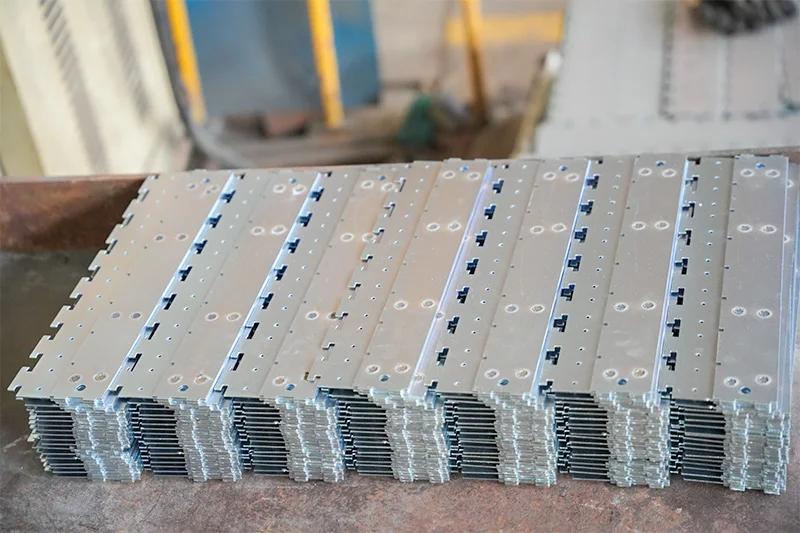
Ping Fang has been a manufacturer since 1984. The plant in Changshu builds steel pallets, stillages and handling equipment, and four checks run on every order. They cover incoming material, worker self-check with inspector patrol during production, inspection before surface treatment, and a final check before shipping with a quality report.
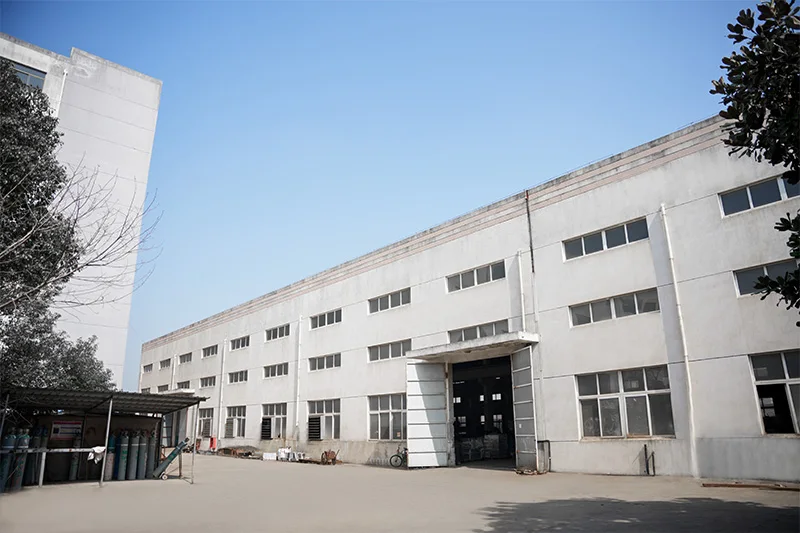
More about the factory is on our factory page. For other pallet and storage equipment, see our guides to post pallets and to roll containers.
 Related Questions