

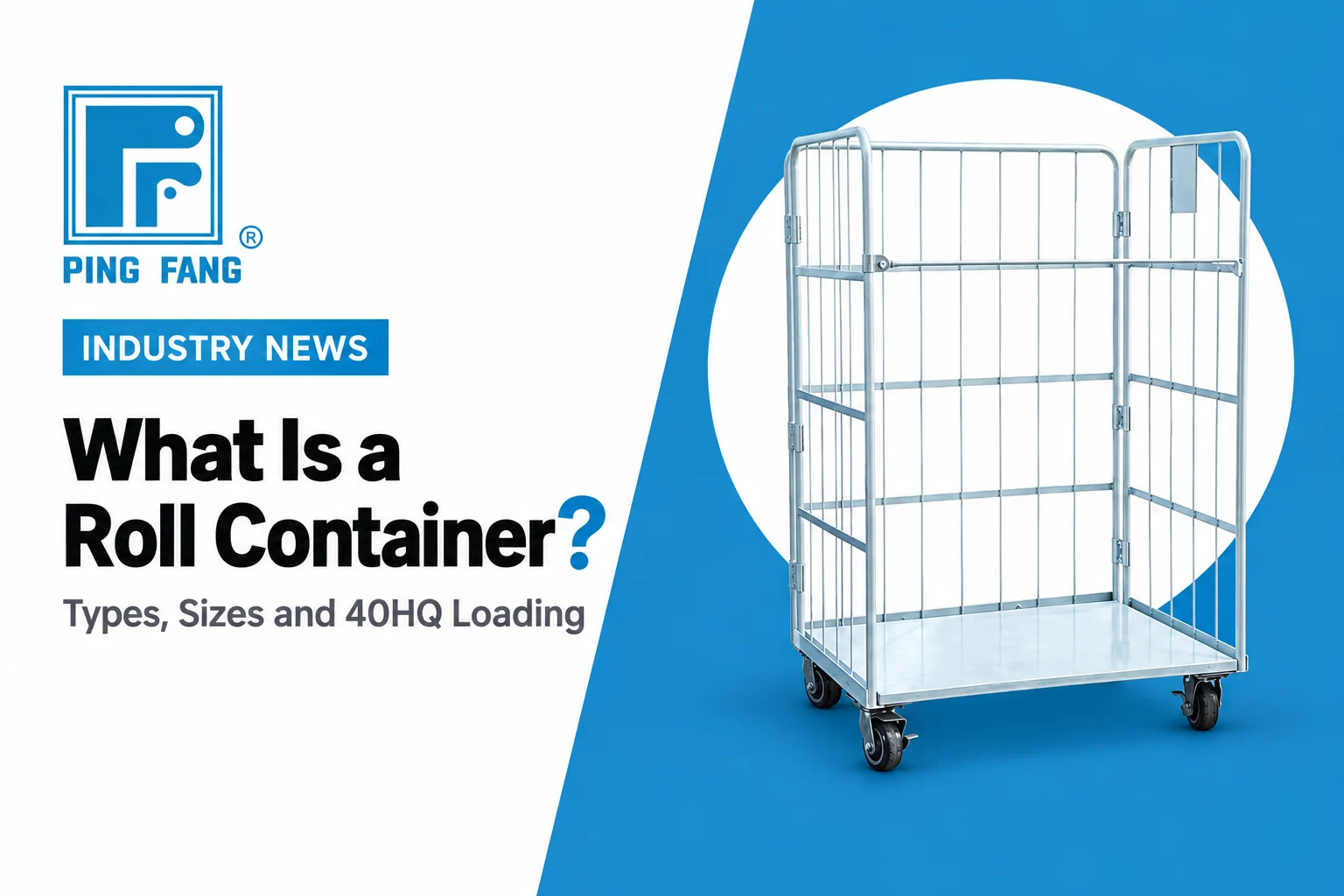
The same cage is called a roll container, a roll cage trolley, a cage trolley, a roll pallet or a cage cart depending on the country and the trade. Buyers in the UK, Ireland and New Zealand mostly say roll container or roll cage. Australia leans to roll cage trolley and cage trolley, and the United States says cage cart or security cart. This guide explains what the product is, how the types differ, the real sizes, weights and container loading numbers of a working range, and what to settle before you order.
What Is a Roll Container? Meaning and Definition
A roll container, also written roll cage trolley or cage trolley, is a rigid steel cage mounted on four castors. Goods are loaded into it, a person pushes it, and it travels as one unit from the distribution center to the truck, the dock and the shop floor. The sides keep cartons and loose goods in place, the base takes the weight, and the castors do the moving.
Roll cage trolleys belong to retail and distribution logistics. A supermarket chain loads one at the depot, trucks it to the store and wheels it straight onto the floor. A dairy loads milk crates into one at the plant. A warehouse sorts parcels into one at the packing bench. That working life is why the product is built from galvanized steel and why nearly every model folds or nests when empty.
Roll Container, Roll Cage Trolley, Cage Trolley, Roll Pallet and Danish Trolley Compared
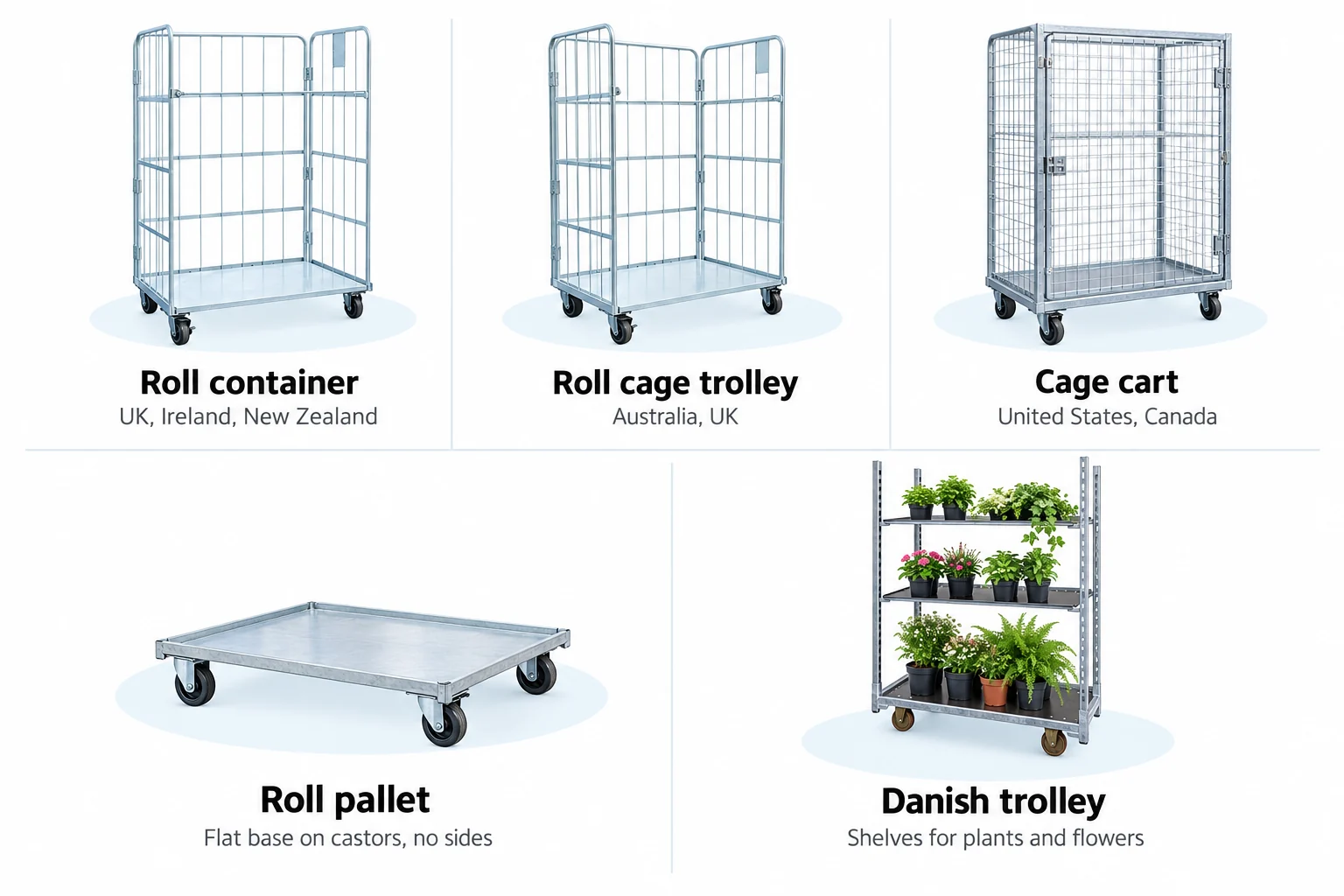
Most of these names describe the same product. The exceptions are the roll pallet and the Danish trolley, which look similar from a distance and do different jobs.
| Name | What it is | Where the name is common |
|---|---|---|
| Roll container, roll cage, roll cage trolley | Steel cage on castors with two, three or four sides | UK, Ireland, New Zealand |
| Cage trolley, trolley cage, roll cage trolley | The same cage under the Australian and British trade names | Australia, UK |
| Cage cart, security cart, rolling cage | The same cage, often with doors and locks for valuable goods | United States, Canada |
| Roll pallet | A flat base on castors with no sides | UK, United States |
| Danish trolley, CC container | A trolley with fixed shelves for plants and flowers | UK, Germany, horticulture |
Our own range reflects the split. The Roll Cage Trolley page covers the cages, a milk trolley sits in the same family, and a Danish plant trolley sits beside them as a separate product. If you search for a roll cage on its own you may meet racing roll cages instead, so the longer trade names are safer.
The Parts of a Roll Container
A roll container has five parts, and each one shows up on a spec sheet. The base carries the load, the sides hold it in, the gate gives access, the castors move it and the frame ties them together.
- Base. A closed or mesh floor that takes the weight. A solid steel floor behind a fence suits loose cartons, and a mesh floor lets dirt and water drain away.
- Sides. Wire mesh or tube panels on two, three or four sides. More sides hold more securely, fewer sides load faster.
- Gate or doors. The side that opens for loading. Security models add doors with locks.
- Castors. Four wheels, usually a mix of swivel and fixed, sometimes with brakes. The next section covers them in detail.
- Frame. The welded tube and wire structure. Weld quality sets how long the cage lasts in daily use, so ask each supplier how the frame is welded.
Castors, Wheels and Floors
Castors decide how a roll container behaves in daily use, and they are the first part to look at. Swivel castors turn freely and make the cage easy to steer in tight places. Fixed castors point one way and keep the cage tracking straight on long pushes. Many cages combine the two, and brakes on one or two wheels stop a parked cage from drifting. Our PFRC016 has four swivel castors, two of them with brakes. PFRC018 has four high-load wheels, two of them universal, which means they swivel.
The wheel material and size should match the floor. Hard wheels roll easily on a smooth depot floor. Softer wheels are quieter and kinder to the surface. Larger wheels cope better with rough yards, dock plates and door thresholds. If a cage crosses several surfaces, tell the supplier which ones before you order, because a wheel that suits a smooth floor can struggle on a ramp.
Ask for the load rating per castor and not only for the cage. The castors carry the whole weight, and a cage rated 500 kg needs wheels that carry it with margin.
The Main Types of Roll Containers
The types differ by the number of sides, by whether the cage folds or nests and by how secure it is. The choice starts from the goods and the route.
Two-sided, three-sided and four-sided roll cages
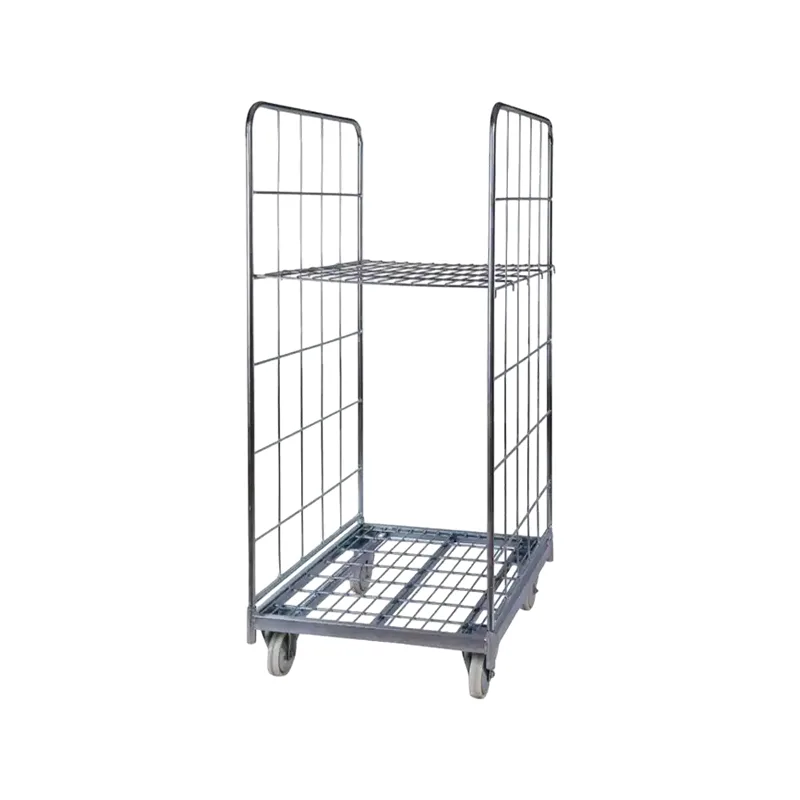
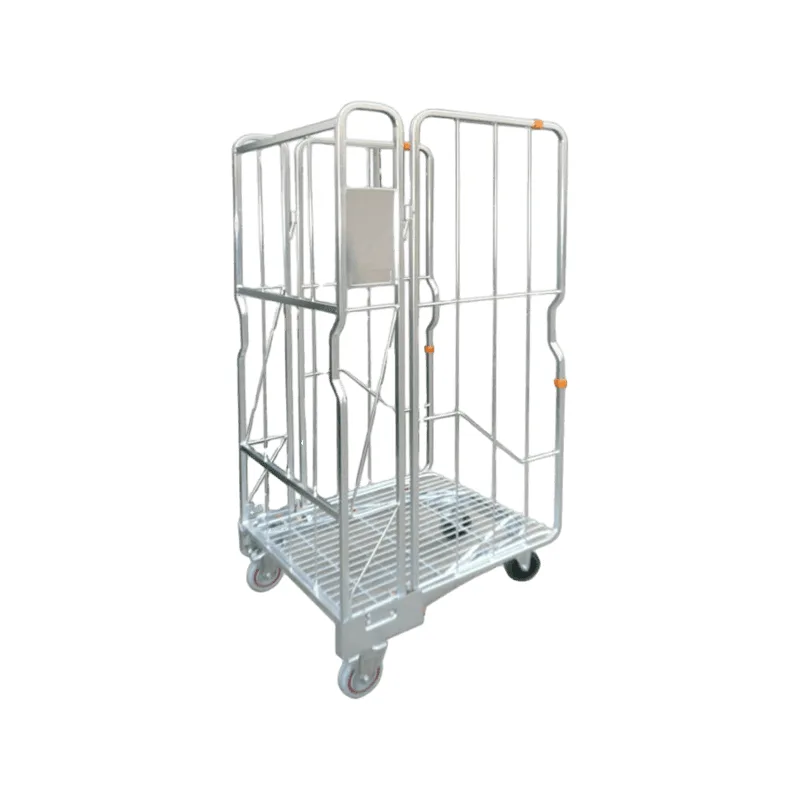
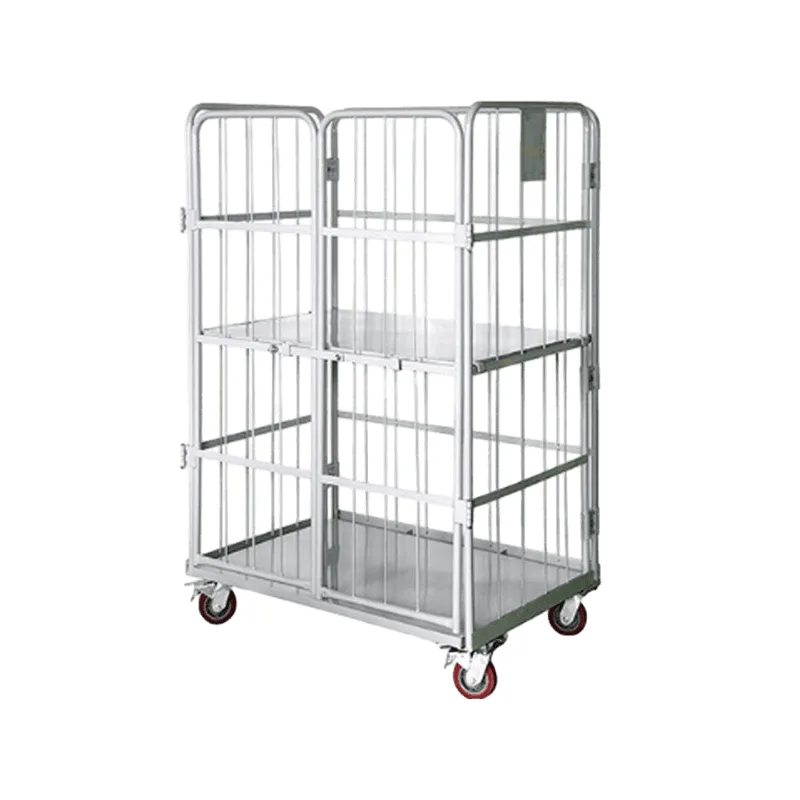
A 2 sided roll cage, a 3 sided roll cage and a 4 sided roll cage cover most needs. The two-sided PFRC001 is the lightest in the range at 26 kg and carries 300 kg. Three-sided models such as PFRC005, a nestable foldable 815 × 670 × 1739 mm cage, carry 500 kg with an open front for fast loading. Four-sided models close the load completely.
Security roll containers with doors
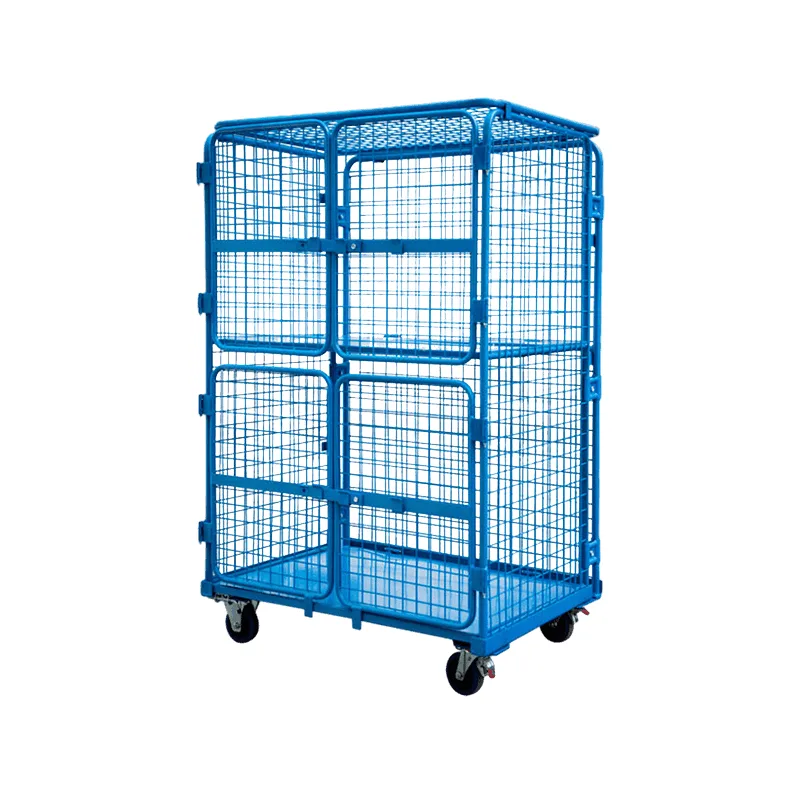
For valuable or regulated goods, PFRC017 closes all four sides with doors that carry heavy-duty locks. It is built from galvanized steel pipe with a powder coated surface, weighs 80 kg and still carries 500 kg. It is the heaviest cage in the range and travels at 100 units per 40HQ container.
Milk trolleys and picking trolleys
Some cages are built for one job. The 4-tier MT001 and the 5-tier MT002 carry 250 kg of dairy crates on shelf levels. PFRC07 is a picking trolley with fold-away steps for reaching the top shelf.
Heights, Doors and Lifts
Height and width decide whether a cage can do its job on the route, and they are easy to overlook until the first cage jams in a lift. The range runs from 1300 mm for the 4-tier milk trolley to 1992 mm for the tall PFRC004 and PFRC015, and most cages sit between 1,700 and 1,800 mm.
Check three heights before you order. The first is the inside height of the truck or trailer, because a cage that nearly touches the roof is hard to load. The second is the lift car, which sets the limit for any cage that must reach upper floors. The third is the top shelf on the shop floor, where a tall cage is awkward to unload. The PFRC07 picking trolley adds fold-away steps for exactly this reason.
Then check width against the narrowest door on the route. A cage 715 mm wide passes tighter doors than one 1100 mm wide.
Roll Container Sizes, Capacity and Weight
Footprints run from 657 × 419 mm on the milk trolleys to 1100 × 800 mm on the largest cages. Almost every cage carries 500 kg, and the self weight varies from 26 kg to 80 kg. The table lists the models with the numbers a buyer checks first, taken from the factory spec sheets.
| Model | Sides | Overall size (mm) | Load | Self weight | 40HQ units |
|---|---|---|---|---|---|
| PFRC001 | Two | 720 × 810 × 1650 | 300 kg | 26 kg | 450 |
| PFRC002 | Three | 715 × 825 × 1730 | 500 kg | 38 kg | 190 |
| PFRC003 | Three | 800 × 700 × 1800 | 500 kg | 35 kg | 294 |
| PFRC005 | Three | 815 × 670 × 1739 | 500 kg | 45 kg | 288 |
| PFRC009 | Three | 1100 × 800 × 1700 | 500 kg | 47 kg | 100 |
| PFRC010 | Four | 805 × 710 × 1795 | 500 kg | 37.4 kg | 270 |
| PFRC011 | Four | 715 × 825 × 1730 | 500 kg | 46 kg | 190 |
| PFRC016 | Four | 800 × 600 × 1700 | 500 kg | 48 kg | 168 |
| PFRC017 | Four, with doors | 1100 × 800 × 1716 | 500 kg | 80 kg | 100 |
| PFRC018 | Four | 1100 × 800 × 1700 | 500 kg | 72 kg | 150 |
| PFRC07 | Three, picking | 1025 × 460 × 1627 | 500 kg | 48 kg | 240 |
| MT001 | Milk, 4 tiers | 657 × 419 × 1300 | 250 kg | 32 kg | 500 |
| MT002 | Milk, 5 tiers | 665 × 430 × 1309 | 250 kg | 38 kg | 490 |
Two patterns stand out. Weight and unit count pull in opposite directions, because the heavy security models travel with 100 to 150 units while the light milk trolleys travel with about 500. And load is almost flat at 500 kg, so the choice between models rests on footprint, height and how the cage packs.
The footprint matters beyond the container. A 1100 × 800 mm cage has nearly the footprint of a 1200 × 800 mm pallet, which suits depot loading. A narrower cage such as the 715 × 825 mm models passes tighter store doors and lifts more easily. Ask which doors and lifts the cage must pass before you pick a size. For how to read a load rating, see the section on ratings in our stillage guide.
How Many Roll Containers Fit in a 40HQ Container
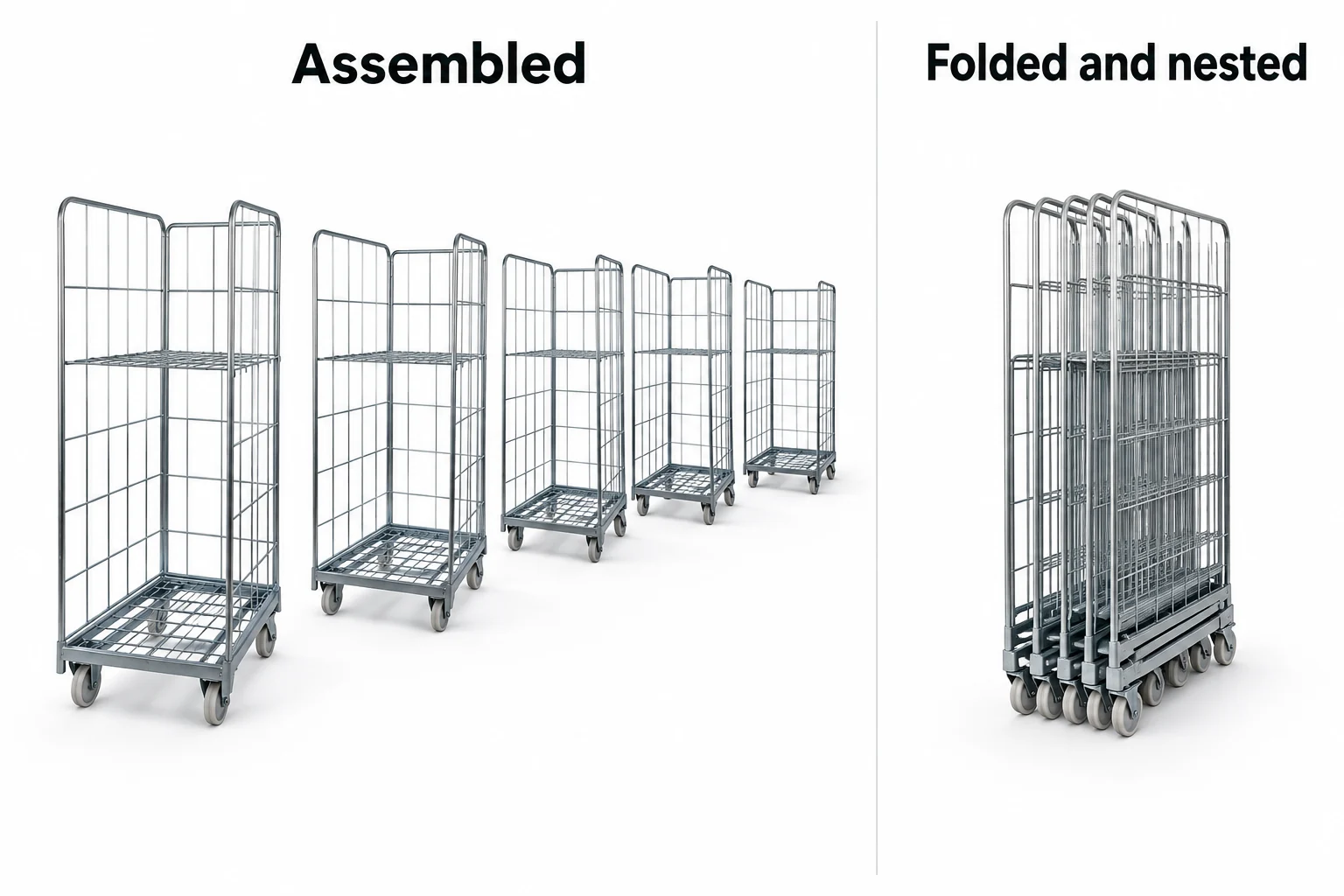
The 40HQ numbers in the table come from the factory spec sheets, and they are the numbers that decide freight cost per cage. The product pages state that the units are packed folded, stacked or nested where the design allows, to save container space.
To show what that saves, the next table sets the factory count against the number of assembled cages that fit on the floor of a 40HQ container. The assembled count is calculated from the overall size and the standard inside size of a 40HQ container (12,032 × 2,352 × 2,698 mm), with one layer because every cage is taller than half the container height. It is a guide to scale and not a measured loading figure.
| Model | Factory 40HQ count | Assembled on the floor (calculated) | Folded or nested gain |
|---|---|---|---|
| PFRC001 | 450 | 43 | 10.5 times |
| PFRC003 | 294 | 45 | 6.5 times |
| PFRC005 | 288 | 43 | 6.7 times |
| PFRC010 | 270 | 44 | 6.1 times |
| PFRC018 | 150 | 30 | 5.0 times |
| PFRC009 | 100 | 30 | 3.3 times |
| PFRC017 | 100 | 30 | 3.3 times |
| MT001 | 500 | 182 | 2.7 times |
The gain runs from 2.7 to 10.5 times. The two-sided PFRC001 shows the largest gain, and the milk trolley the smallest because its narrow footprint already packs well on the floor. For scale, freight guides put a 40 ft container at about 20 to 21 industrial pallets per floor layer.
Your container plan depends on the model, and the model is what to name in your inquiry. We calculate the exact loading plan from the model, the order quantity and the destination, and the figure on your quotation is the one that counts.
Roll Containers Compared with Pallets
A cage and a pallet both carry goods, and they suit different journeys. The pallet is the usual unit in the warehouse and on long hauls. The cage is the better unit for the last stretch, where goods leave the truck and reach the shelf.
| Question | Roll container | Pallet |
|---|---|---|
| How it moves | Pushed by hand on its own castors | Needs a forklift or a pallet truck |
| Where it can go | Onto the shop floor and into lifts | Stops at the dock or the end of the aisle |
| Holding the load | Sides are part of the unit | No sides, so the load needs wrapping or strapping |
| Stacking | Loaded cages are not normally stacked | Loaded pallets stack in racking and stacking frames |
| The empty trip | Folds or nests | Stacks flat |
Many supply chains use both. Pallets carry the goods to the depot, and roll containers carry them on from there. For the pallet side, see our guides to post pallets and to stillages.
Reading a Roll Container Spec Sheet
A spec sheet is short, and each line tells you something. Read it in this order.
- Model and sides. The number of sides and doors, which decides how secure and how fast the cage is.
- Overall size. Length, width and height of the assembled cage, which you compare with the truck, the door and the lift.
- Load capacity and self weight. The load the cage carries and what it weighs empty. Ask whether the rating assumes an even load.
- Surface treatment. Galvanized or powder coated, and for the security model both on one frame.
- Castors. Number, type and brakes. Ask for the rating per castor.
- 40HQ count. How many units ship in one container, packed the way the supplier will pack your order.
The product pages on our site list the numbers taken from the factory spec sheet without rounding, so the figures in this guide are the same ones you will see on a quotation.
Nestable or Folding
Both designs save space on the empty trip, and they work differently. A folding roll container has hinged sides that fold the cage flat or down to a slim shape, which suits storage and shipping. A nestable roll container has a tapered frame that slides into the next one, like shopping carts, so the empties stack together and roll in a line.
- Choose nestable when empties move often. A line of nested cages is easy to push back to the depot.
- Choose folding when empties are stored or shipped. A folded cage takes the smallest space on a pallet or in a container.
- Some models do both. The three-sided PFRC005 is listed as nestable and foldable.
Materials and Finishes
Most of the range is galvanized (zinc plated). Zinc protects the steel through washdowns, spills and outdoor dock time, and without a paint layer there is nothing to chip, which suits food-related work such as dairy distribution. Powder coated models such as PFRC016 and PFRC018 trade that for a colored, painted surface. The security model PFRC017 combines galvanized steel pipe with a powder coated surface. For the finishes in detail, see our stillage guide.
How to Choose a Roll Container
Choose in a fixed order, because the first answer narrows the next. Start from the goods, then the route and the doors, then the packing.
- What goes inside? Cartons on a flat floor suit a solid base, and mixed or visible goods suit a mesh floor. Valuable goods need doors with locks.
- How many sides? Three sides load fast and four sides close the load.
- What size? Check the footprint against the pallet, the truck and the narrowest door or lift on the route.
- What load? Almost every cage carries 500 kg. Check self weight as well, because a heavy cage costs more to push and to ship.
- How do empties travel? Pick nestable, folding or both, and check the 40HQ count.
- What finish? Galvanized suits wet and food-related work, and powder coated suits dry indoor use.
To get a useful quote on the first reply, send the goods, the size you need, the order quantity and the destination through our contact page. Our OEM service builds a roll container to your drawing when none of the standard sizes fit.
Benefits of Roll Containers
A cage moves goods in one piece from the packing bench to the shelf. That single idea gives six benefits.
- One load, one move. Goods are loaded once at the depot and unloaded at the shelf, with no repacking on the way.
- No forklift needed. A person pushes the cage, which lets it go where forklifts cannot, including shop floors and lifts.
- Protection on the move. The sides keep cartons and loose goods in place over ramps and dock plates.
- A cheaper return trip. Folded or nested empties take a fraction of the space of assembled cages.
- A long working life. Galvanized steel survives many trips and washdowns.
- Easy tracking. One cage per route or per store makes counting and collecting straightforward.
Questions to Ask a Supplier Before You Order
A good supplier answers these without delay, and the answers show how the supplier works. Put them in your inquiry so the first reply is a useful one.
- What is the 40HQ count for this exact model? The figure should come from the spec sheet and match how your order will be packed.
- What are the castors, and what does each one carry? A rating for the cage alone is not enough.
- Which finish does the model use? The finish should match the route and the weather.
- Can I see a sample before the full order? A sample lets you test the fold, the gate and the castors on your own floor.
- Is there a quality report with each batch? Ours ships with a report after final inspection.
- Can you build to my drawing? Custom sizes need a drawing check before production.
Where Roll Containers Are Used
- Supermarket and retail distribution. Cages travel from the depot to the store and onto the shop floor without unpacking.
- Dairy and food distribution. Milk trolleys and galvanized cages carry crates and survive washdowns.
- Parcel and e-commerce sorting. A cage per destination keeps parcels together from the bench to the truck.
- Manufacturing and internal logistics. Parts move between stations and stores without forklifts.
- Laundry and linen. Cages move linen between wash, store and delivery.
Ordering Roll Containers Without Mistakes
Most ordering mistakes can be seen on the quotation. Check these points before you order.
- Choosing by load only. Almost every cage is rated 500 kg, and the model that fits your door and your truck is the one that works.
- Forgetting self weight. An 80 kg security cage with a full load is hard to push up a ramp, and it also ships at 100 units per container.
- Ignoring the floor. Castors that suit a smooth depot floor struggle on rough yards. Tell the supplier where the cage will roll.
- Mixing nestable and fixed cages. They do not nest together, and a mixed fleet loses the saving.
- Skipping the container plan. The freight cost per cage follows the 40HQ count, so ask for it before you compare unit prices.
Keeping Roll Containers in Service
These cages live in a rough setting, with ramps, dock edges and daily knocks. A short routine keeps them rolling.
- Look at the castors. A flat spot or a loose wheel changes how the cage tracks, and it is the part that fails first.
- Look at the gate and hinges. Bent hinges stop a folding cage from closing flat.
- Look at the welds and mesh. Cracks start at joints and mesh crossings.
- Look at the finish. Scratches on a powder coated cage left outdoors rust, and galvanizing is the better choice for that route.
Follow your own site rules for inspection and for how high a cage may be stacked in transit. If a cage is damaged, tell us the model and we supply replacement parts or repair advice.
How Ping Fang Builds Roll Containers
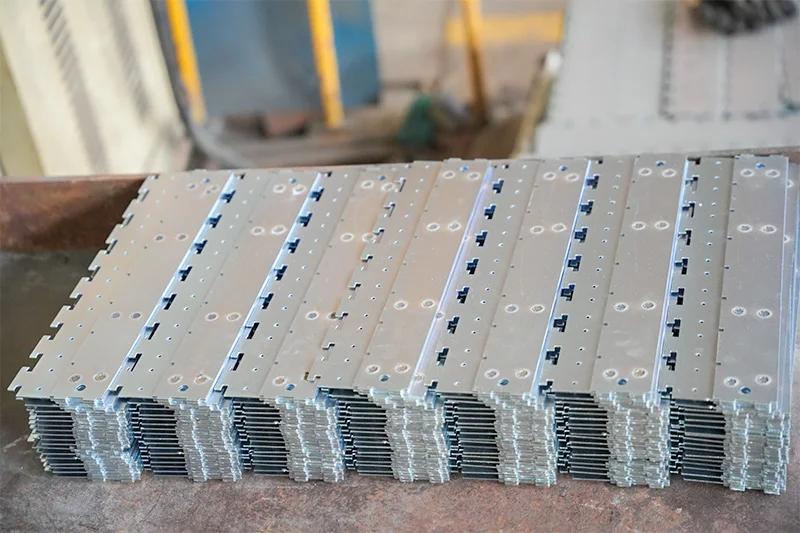
Ping Fang has been a manufacturer since 1984. Roll container frames are cut on a 6000 W plate laser and a 3000 W tube laser and welded on our 18 robot welding machines, so repeated daily use lands on consistent joints. Four checks run on every order. They cover incoming material, worker self-check with inspector patrol during production, inspection before surface treatment, and a final check before shipping with a quality report.

More about the factory is on our factory page. For other wheeled and stackable equipment, see our guide to post pallets and our article on the linkage structure of the folding roll cage trolley.
 Related Questions