

Search for a warehouse trolley and you will find twenty names for the same few machines. Industrial trolley, stock trolley, goods trolley, utility trolley, transport trolley and picking trolley all appear in catalogues, and the same product can carry three of them. This guide sorts them by what they actually do. Ping Fang makes forty models across the five families, and every figure below is taken from our own factory sheets, with links to the model pages.
Warehouse Trolley Names and What They Mean
Buyers use warehouse trolley as a broad word, and suppliers use it as a filter. In the UK, Australia, New Zealand and India it is the everyday phrase for a hand-pushed carrier. Industrial trolley is the more formal version, and warehouse trolleys in the plural is how most people type it into a search box. Stock trolley is a British term that usually means a trolley used to restock shelves, and goods trolley and utility trolley are the general names used in catalogues. Transport trolley is common in European English, and picking trolley or order picking trolley means a trolley made for collecting items from shelves.
The names overlap, and a quotation request that says only warehouse trolley will draw a dozen different quotes. A request that names the family, the load and the floor will draw comparable ones. The five families below are the vocabulary to use.
Five Warehouse Trolley Families at a Glance
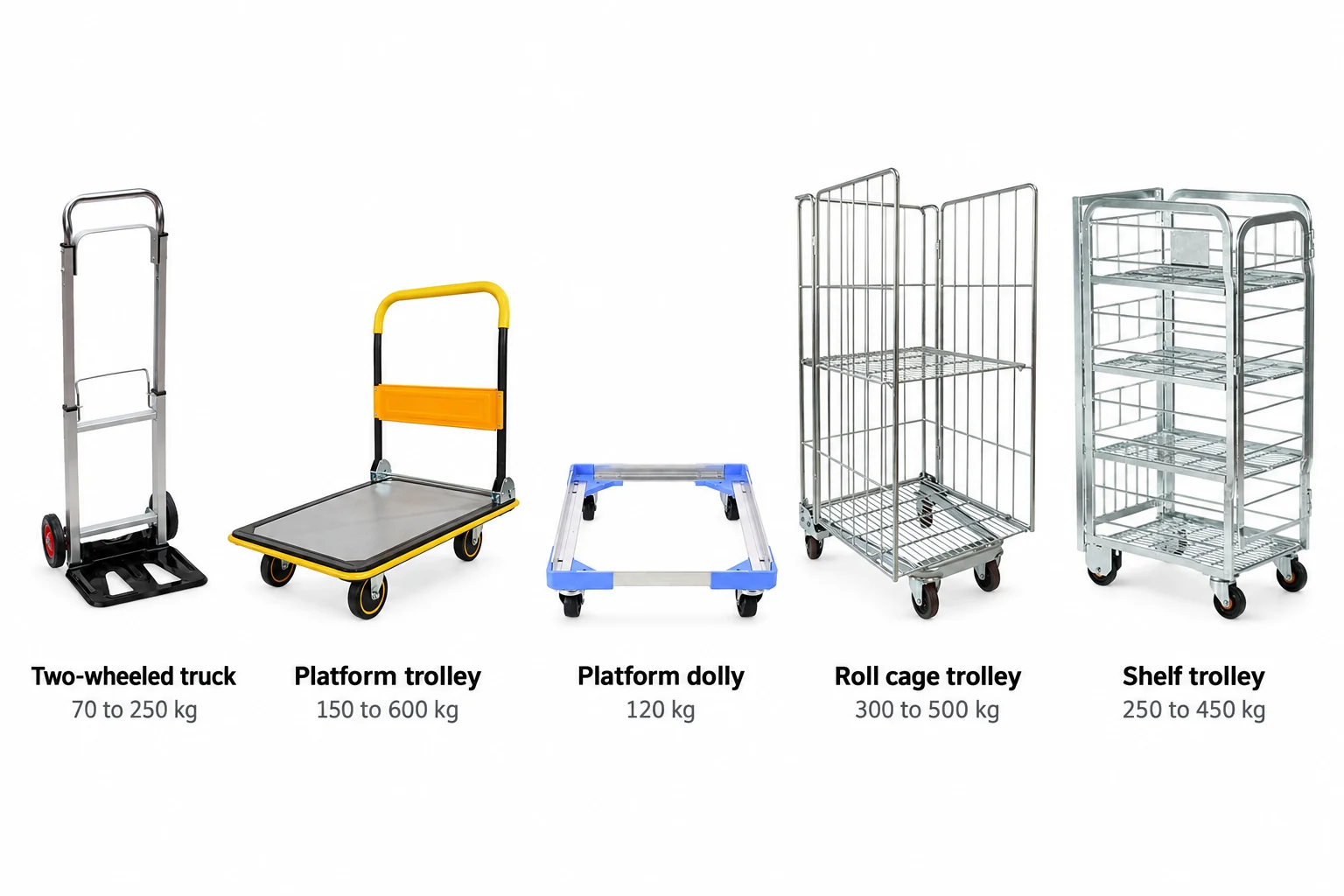
The families differ in how the load sits on the trolley. That decides almost everything else, from the number of wheels to the floor space the trolley needs in a corridor. The figure draws one model of each family at one scale, and the table gives the range of our factory sheets for each.
| Family | The load sits | Our rated range | Models | Read more |
|---|---|---|---|---|
| Two-wheeled truck | Leaning on the frame, tilted back | 70 to 250 kg | 6 | How to choose a sack truck |
| Platform trolley | Flat on a deck | 150 to 600 kg | 10 | Platform trolley by load rating |
| Platform dolly | Low on a small deck | 120 kg | 2 | Flatbed cart range |
| Roll cage trolley | Inside a cage on a base | 300 to 500 kg | 18 | What is a roll container |
| Shelf trolley | On several levels | 250 to 450 kg | 4 | Shelf trolley guide |
The roll cage family is the largest in our range, with eighteen models, and the two-wheeled family is the lightest. A roll cage can carry five times the load of a light two-wheeled truck but needs far more room, which is why the families overlap in use only a little. Most sites end up with two or three types of trolleys side by side, so a warehouse trolley plan usually covers more than one family.
Two-Wheeled Trucks, for Sacks and Boxes
A two-wheeled truck, called a sack truck in the UK and a hand truck in the United States, has a narrow frame and a toe plate. You tip it back until the load balances over the axle, and then you wheel it away. It has the smallest footprint of the families and the lowest weight, which makes it the simplest trolley to start with.
The six models in our range run from the 70 kg PFTWT001, a detachable light weight frame of 2.6 kg, to the 250 kg PFTWT006 with 10 inch pneumatic wheels. In between are an 85 kg aluminum model, a 90 kg model for warehouse work, an 80 kg folding model and a 150 kg model with 6 inch wheels. The rating is the first filter, and the weight of the truck comes second. The 2.6 kg frame is the lightest in the group and the 250 kg model the strongest. Our guide to choosing a sack truck covers wheels, toe plates and stair work in detail.
A two-wheeled truck has one limit that no rating fixes. The person pushing carries part of the load, so it suits goods that are stackable and not too tall. For wide, flat or tall loads, move to a platform trolley or a roll cage.
Platform Trolleys, for Flat Loads
A platform trolley, also called a flatbed cart or a platform truck, has a flat deck on four wheels and a handle at one end. Nothing leans on the person, which lets it carry more than most two-wheeled trucks and suits cartons, boxes and anything else that sits flat. This is the family many buyers mean when they search for a heavy duty platform trolley.
We make ten models, and they sort neatly by rating.
| Rating | Models | Deck or size (mm) | Notes |
|---|---|---|---|
| 150 kg | PFPT001, PFPT003, PFPT009, PFPT010 | 725 × 475 × 840, 700 × 425 × 830 and 710 × 420 × 930 | PFPT009 folds flat, 2,720 per 40HQ |
| 200 kg | PFPT008 | 725 × 485 × 850 | Brakes, 1,800 per 40HQ |
| 300 kg | PFPT002, PFPT004 | 910 × 610 × 870 | 5 inch wheels |
| 350 kg | PFPT005, PFPT006 | 920 × 605 × 890 (PFPT006) | PFPT005 has 8 inch wheels |
| 600 kg | PFPT007 | 1550 × 700 × 950 | 6 inch wheels, brakes, 30 kg |
A heavy duty platform trolley in our range means the 300 to 600 kg end. The 600 kg PFPT007 is the longest, with a deck of 1550 mm for long boxes, pipe and panels, and it weighs 30 kg empty. The 300 kg models share a 910 × 610 mm deck. Before you choose, read how the rating and the wheel size interact in our guide to platform trolleys by load rating.
Platform Dollies, for Low and Bulky Loads
A platform dolly is a small plastic and aluminum deck on four casters. The load rides low and you push it by the load. We make two, a heavy duty dolly with ordinary casters and a transport dolly with anti-static casters. Both are rated at 120 kg, carry 75 mm casters and are packed ten to a bundle. A dolly is not a replacement for a platform trolley, because it has no handle and a lower rating. It suits a site that needs many simple carriers more than one strong one. The American names for these three machines are sorted out in our hand truck vs dolly guide.
Roll Cage Trolleys, for Loose Goods
A roll cage trolley is a steel mesh cage on a wheeled base. It is the standard way to move loose goods without stacking them. The cage keeps the load in, so one person can push 300 or 500 kg through a warehouse and onto a truck. Our eighteen roll cage models fall into three groups.
Two, three and four sides
The number of sides is the first choice. A two-sided cage, such as our 300 kg PFRC001, leaves two sides open for fast loading. The three-sided cages, eight models rated at 500 kg, leave the front open. The nine four-sided cages are also rated at 500 kg, and they include a closed type with a top net and a security type with four doors, the 80 kg PFRC017. Our guide to roll containers explains sides, bases and nesting. For a wheeled roll cage against a pallet cage moved by forklift, see our roll cage vs pallet cage guide. The choice of sides is covered in our 3 sided roll cage guide.
How big are the cages
Roll cage sizes cluster around a base of roughly 700 to 1100 mm on one side and 600 to 830 mm on the other. The smallest base on our sheets is 800 × 600 mm on the four-sided PFRC016, and the largest are the 1100 × 800 mm PFRC009, PFRC017 and PFRC018. Heights run from 1550 mm on the PFRC013 to 1992 mm on the PFRC004 and PFRC015. Most buyers choose the base to fit a lift, a truck bed or a pallet position and then choose the height, so ask for both and check them against the narrowest door on the route.
| Sides | Models | Base range (mm) | Height range (mm) | Weight range |
|---|---|---|---|---|
| Two | 1 | 720 × 810 | 1650 | 26 kg |
| Three | 8 | 460 × 1025 to 1100 × 800 | 1600 to 1992 | 35 to 50.6 kg |
| Four | 9 | 800 × 600 to 1100 × 800 | 1550 to 1992 | 37.4 to 80 kg |
The table shows that the number of sides has less effect on weight than the steel used for the frame and the base. The lightest four-sided cage is the 37.4 kg PFRC010, which weighs about as much as some three-sided models, while the 80 kg security cage is more than twice as heavy.
The picking trolley, PFRC07
Order picking means collecting items from shelves, and a picking trolley is built to be loaded as the picker walks. Our PFRC07 is a three-sided galvanized cage of 1025 × 460 × 1627 mm with fitted steps that fold away. The steps swing out for a high shelf and fold back against the frame, so the picker does not need a separate ladder. It carries 500 kg, weighs 48 kg, and 240 fit in a 40HQ container. It is the only picking trolley in our range, so this guide does not claim more than one.
Shelf Trolleys, for Many Small Items
A shelf trolley carries several levels of goods at once. Our four models are the 4-tier milk trolley MT001, the 5-tier MT002, a Danish plant trolley rated at 450 kg and a three layer plant trolley. MT001 is rated at 250 kg on 657 × 419 × 1300 mm and weighs 32 kg, and MT002 is rated at 250 kg on 665 × 430 × 1309 mm and weighs 38 kg. Their footprints are small, about 0.28 m² for each of the two milk trolleys. The shelf trolley guide covers opening heights and finishes, and the roll cage trolley category lists them all.
Types of Trolleys and the Freight Bill
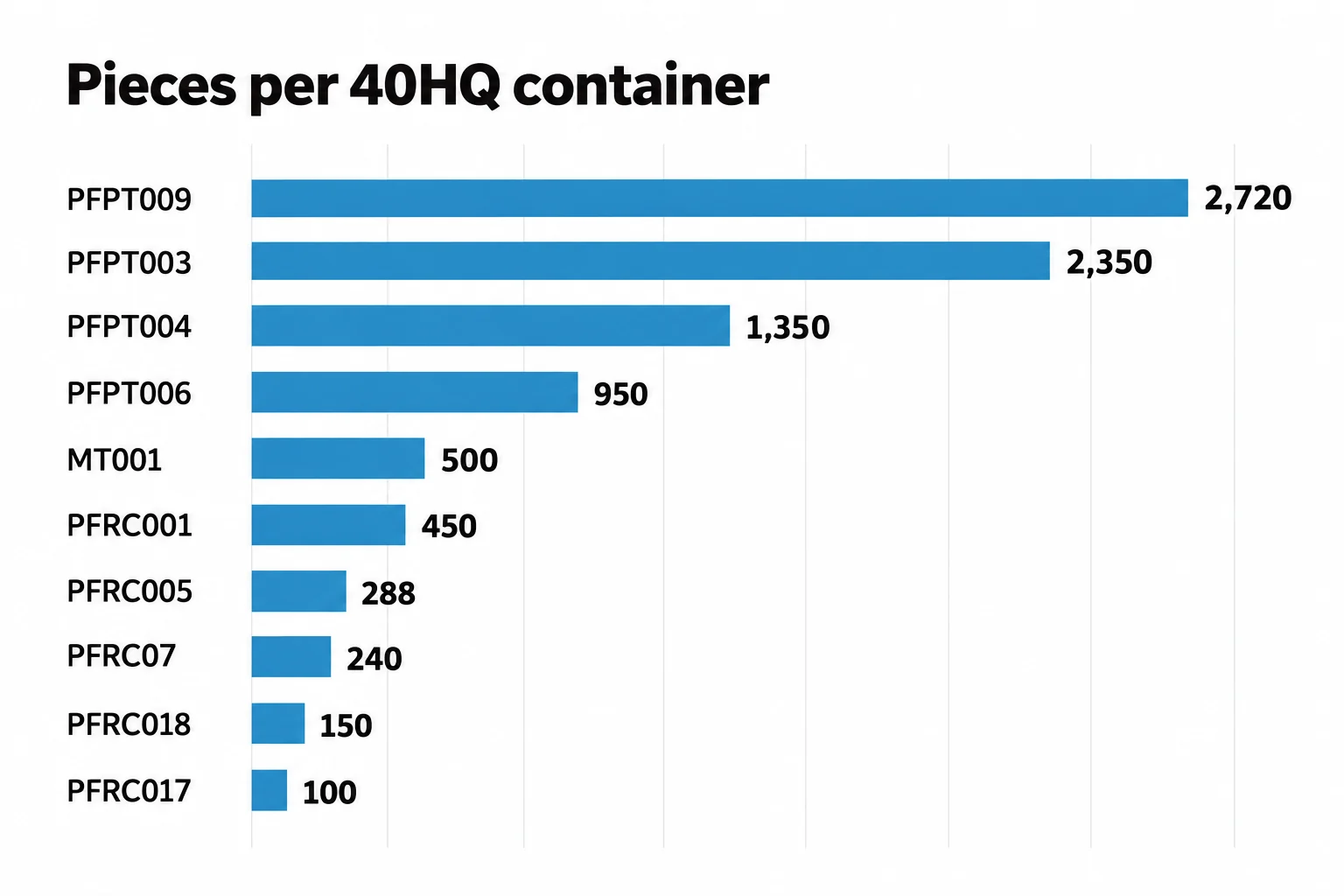
Many buyers compare the price of the warehouse trolley and forget the price of moving it. A trolley that folds flat or nests into another one costs far less to ship, and the same is true for storage on your site. The factory sheets give the number of pieces that fit in a 40HQ container, and the spread across families is wide.
| Model | Family | Rated load | Per 40HQ |
|---|---|---|---|
| PFPT009 | Platform trolley, folds flat | 150 kg | 2,720 |
| PFPT003 | Platform trolley | 150 kg | 2,350 |
| PFPT004 | Platform trolley | 300 kg | 1,350 |
| PFPT006 | Platform trolley | 350 kg | 950 |
| MT001 | Shelf trolley | 250 kg | 500 |
| PFRC001 | Roll cage, two sides | 300 kg | 450 |
| PFRC005 | Roll cage, three sides, nests | 500 kg | 288 |
| PFRC07 | Picking trolley | 500 kg | 240 |
| PFRC018 | Roll cage, four sides | 500 kg | 150 |
| PFRC017 | Roll cage, security type | 500 kg | 100 |
A flat folding platform trolley ships twenty-seven times as many to a container as a security roll cage. The roll cage still wins when the job is loose goods, since nothing else holds them. The point is to count shipping and storage when you compare, and to ask the supplier for the container count of the exact model.
Warehouse Trolley Wheels, Brakes and the Floor
The wheels matter as much as the frame. Hard wheels roll easily on smooth concrete and rattle on rough ground, while soft rubber is quieter and grips better. Our PFPT003 uses solid rubber, our PFPT007 and PFPT008 add brakes, and the PFTWT006 uses 10 inch pneumatic wheels. Fixed wheels track straight and swivel wheels steer, so a four-wheeled trolley often has two of each. Ask whether the wheels are replaceable, since a worn caster is the usual reason a warehouse trolley retires early.
Which Warehouse Trolley for Which Load
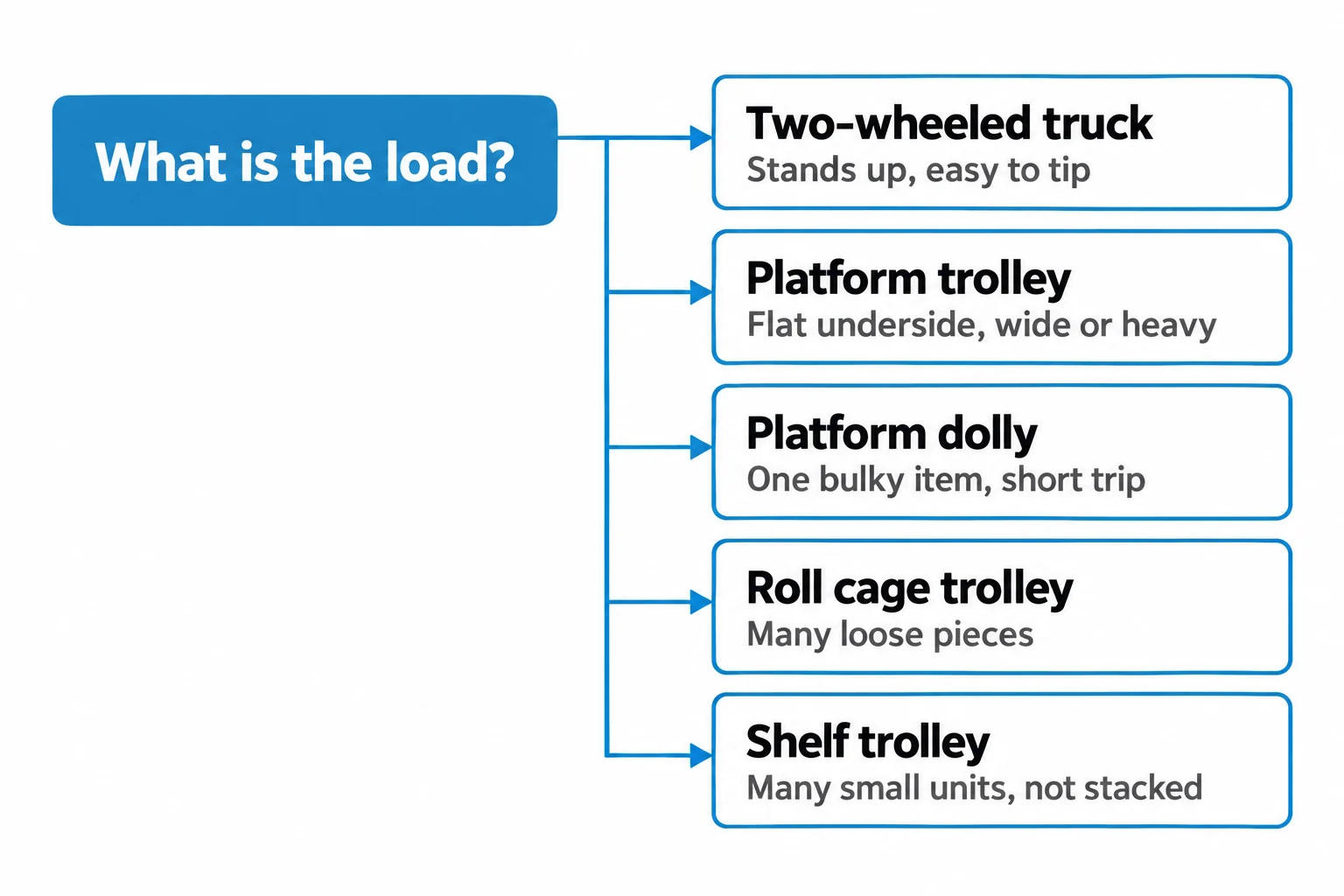
Work from the load, not the product list, when you choose a warehouse trolley. Take the heaviest and most awkward thing you move on a normal day and ask three questions about it. Does it stand on its own, does it have a flat underside, and does it come in ones or in many?
- If it stands on its own and is easy to tip, such as a stack of cartons or a sack, a two-wheeled truck is enough.
- If it has a flat underside and is too wide or too heavy to tip, use a platform trolley.
- If it is a bulky single item that only needs to travel a short way, a platform dolly is the cheapest answer.
- If it is many loose pieces that would fall off a flat deck, use a roll cage trolley.
- If it is many small units that should not be stacked on each other, use a shelf trolley.
Most real jobs match one line at once. When two lines match, pick the one with the larger rating, and look at the aisle and the door before you decide. A roll cage matches a lot of jobs, yet a 1100 × 800 mm base will not turn in every corridor. The decision figure above follows the same logic, and you can print it for a purchasing meeting.
Rating Against Own Weight
The factory sheet gives two numbers that say a lot together, the rated load and the weight of the empty trolley. Dividing one by the other shows how much load each kilogram of trolley can carry. It is a rough guide to how the trolley is built and how easy it is to push when empty, and it is a calculation from the sheets and not a measured result.
| Model | Family | Rated load | Own weight | Load per kg of trolley |
|---|---|---|---|---|
| PFTWT003 | Two-wheeled truck | 150 kg | 5 kg | 30 |
| PFPT006 | Platform trolley | 350 kg | 12.5 kg | 28 |
| PFPT002 | Platform trolley | 300 kg | 11.7 kg | 26 |
| PFPT007 | Platform trolley | 600 kg | 30 kg | 20 |
| PFRC010 | Roll cage, four sides | 500 kg | 37.4 kg | 13 |
| PFRC001 | Roll cage, two sides | 300 kg | 26 kg | 12 |
| PFRC07 | Picking trolley | 500 kg | 48 kg | 10 |
| MT001 | Shelf trolley | 250 kg | 32 kg | 8 |
| PFRC017 | Roll cage, security type | 500 kg | 80 kg | 6 |
Two patterns stand out. Open frames with a deck or two wheels carry 20 to 30 kg per kilogram of trolley, while enclosed cages carry about 10 to 13 and the security cage only 6. That is not a defect, since a cage with four sides and doors needs more steel to do a different job. It does mean that a roll cage costs more to move empty, both in handling and in freight, than a platform trolley of the same rating. If the load can sit on a flat deck without falling off, the deck is the lighter solution.
Finishes by Family
Our roll cages and shelf trolleys are galvanized or zinc plated, apart from the powder coated four-sided PFRC016 and PFRC018, and the security cage PFRC017, whose sheet names no finish. The sheets of the platform trolleys and two-wheeled trucks do not list a surface treatment, so ask for the frame material and coating before you order. Zinc suits damp, washdown and outdoor dock work because it protects the steel without a paint layer that can chip, and powder coat suits dry indoor work where colour coding helps. Our guide to steel pallets compares the two finishes in more detail, and the same reasoning applies to a trolley.
Using More Than One Family
A warehouse rarely needs just one kind of trolley. Goods may arrive on a roll cage, move to a platform trolley for the last stretch and leave on a two-wheeled truck. The families work as a set and should be compatible. Check that the platform trolley deck fits through the same doors as the cage base, that the brakes work on the same floor and that the wheel sizes suit the same ramps. Buying all of the trolleys from one factory also makes it easier to match colours, finishes and spare parts.
Brakes deserve a separate decision. A trolley that stands still while it is loaded needs at least one brake, and a trolley that works on a slope needs two. Our PFPT007 and PFPT008 platform trolleys list brakes, the MT001 has two brakes on four casters, and the MT002 pairs two swivel and two fixed wheels with brakes. If the sheet does not mention brakes, assume the trolley has none and ask. Wheel diameter changes how the trolley meets thresholds as well, since a larger wheel climbs a small step more easily than a small one.
Reading a Factory Sheet
Every model page lists the same few lines, and each one answers a different buying question. The model number is what you quote in an order, and the overall size is the outside dimension, which you check against doors, lifts and truck beds. The load capacity is the rated figure for an evenly spread load, and the self weight is the empty trolley. The surface treatment names the finish, and the 40HQ figure gives the number of pieces packed in a 40 foot high cube container. Some pages leave a line blank, and that blank tells you something too. Where our sheet gives no rating, as with the plant trolley, or no count that we can confirm, we say so and ask you to get the figure in writing before you order. Do the same with any supplier, and treat a missing line as a question to be answered, not a detail to be skipped.
Two further habits help. Compare sheets for the same quantity and the same container, since a price per piece means little without both. And ask whether the rated load applies to the whole trolley or to each level, because on shelf trolleys those two numbers are very different.
Common Buying Mistakes
Four mistakes appear again and again in quotation requests.
- Buying by name. A trolley sold as an industrial trolley may be a light two-wheeled truck, so always read the rated load.
- Using the rating as the daily load. A trolley loaded to its limit every shift wears faster than one used at half its rating.
- Ignoring the floor. A small hard wheel works on smooth concrete and struggles on rough ground, ramps and thresholds.
- Forgetting freight. A fully welded cage and a folding trolley of the same rating can differ many times over in cost per piece once they reach your dock.
Avoiding these four costs nothing, and it is the quickest way to make quotes from different suppliers comparable.
What to Include When You Ask for a Quote
Whichever family of warehouse trolleys you choose, the same facts let a supplier quote correctly the first time.
- The goods, their weight and the tallest or widest piece.
- The floor, including ramps, kerbs, lifts and door widths.
- The rated load you need, with room for the heaviest day.
- The finish, galvanized or powder coated, and where the trolley will stand.
- The quantity and the container, since 20 and 40 foot loads change the price per piece.
If none of our models fits, our OEM service builds to your drawings or samples, starting with solution drawings, then tested samples and mass production once you confirm them.
Next Step
Start with the family that matches the load, open the model page and compare the rating, the weight and the container count. If you send the goods, the floor and the quantity, we can tell you which of the forty models fits and which does not. Browse the flatbed cart category for platform trolleys and two-wheeled trucks, and the roll cage trolley category for cages and shelf trolleys.
 Related Questions