
Hand truck vs dolly is one of the most searched questions in material handling, and the confusion is easy to explain. In the United States the word dolly is used for the two-wheeled hand truck, for the four-wheeled platform and for the small moving dolly, depending on who is speaking. Ping Fang builds all three, sixteen models in total, and this guide uses our factory sheets to show what each one does, what it carries and which one fits which load. Hand trucks are called sack trucks in the UK, and our sack truck guide covers that side in depth.
Hand Truck vs Dolly vs Platform Truck
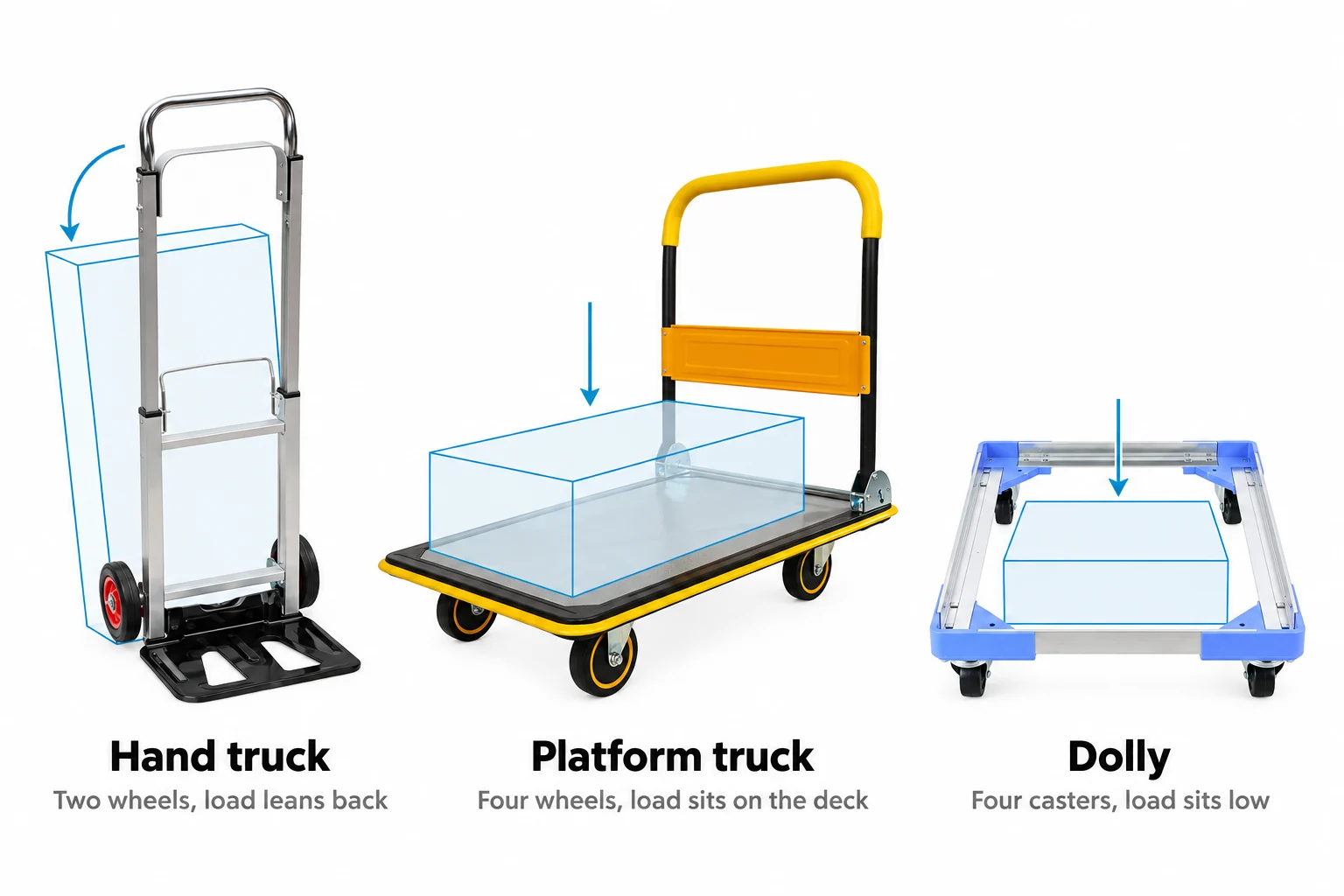
Hand truck vs dolly is easiest to settle by starting with the machines and ignoring the names for a moment. One has two wheels and stands upright, one has four wheels and a flat deck with a handle, and one has four small casters and no handle at all. Each does a different job, and the difference is clearest when the three are drawn at one scale.
| Question | Hand truck | Platform truck | Dolly |
|---|---|---|---|
| Wheels | Two | Four | Four small casters |
| Where the load sits | Leaning on the frame | Flat on the deck | Low on a small deck |
| Who carries part of the weight | The person, through the handle | Nobody, the wheels carry all of it | Nobody |
| Handle | Tall, part of the frame | One end, often folding | None |
| Our rated range | 70 to 250 kg | 150 to 600 kg | 120 kg |
| Our models | 6 | 10 | 2 |
The table already answers most of the question. A hand truck is the tool for upright loads that you can tilt, a platform truck is the tool for loads that sit flat and are too heavy or too wide to tilt, and a dolly is the cheapest way to let a bulky item roll a short way. The rest of this guide explains each choice.
The Test for Hand Truck or Dolly
Hand truck or dolly, the first question is where the load will sit once it is on the machine. If it will lean back against a frame, you need a hand truck. If it will rest on a flat deck, you need a platform truck. If it only needs to be lifted off the floor and rolled, a dolly will do. The same load can often go on two of them, and then the next question is who is pushing and over what distance.
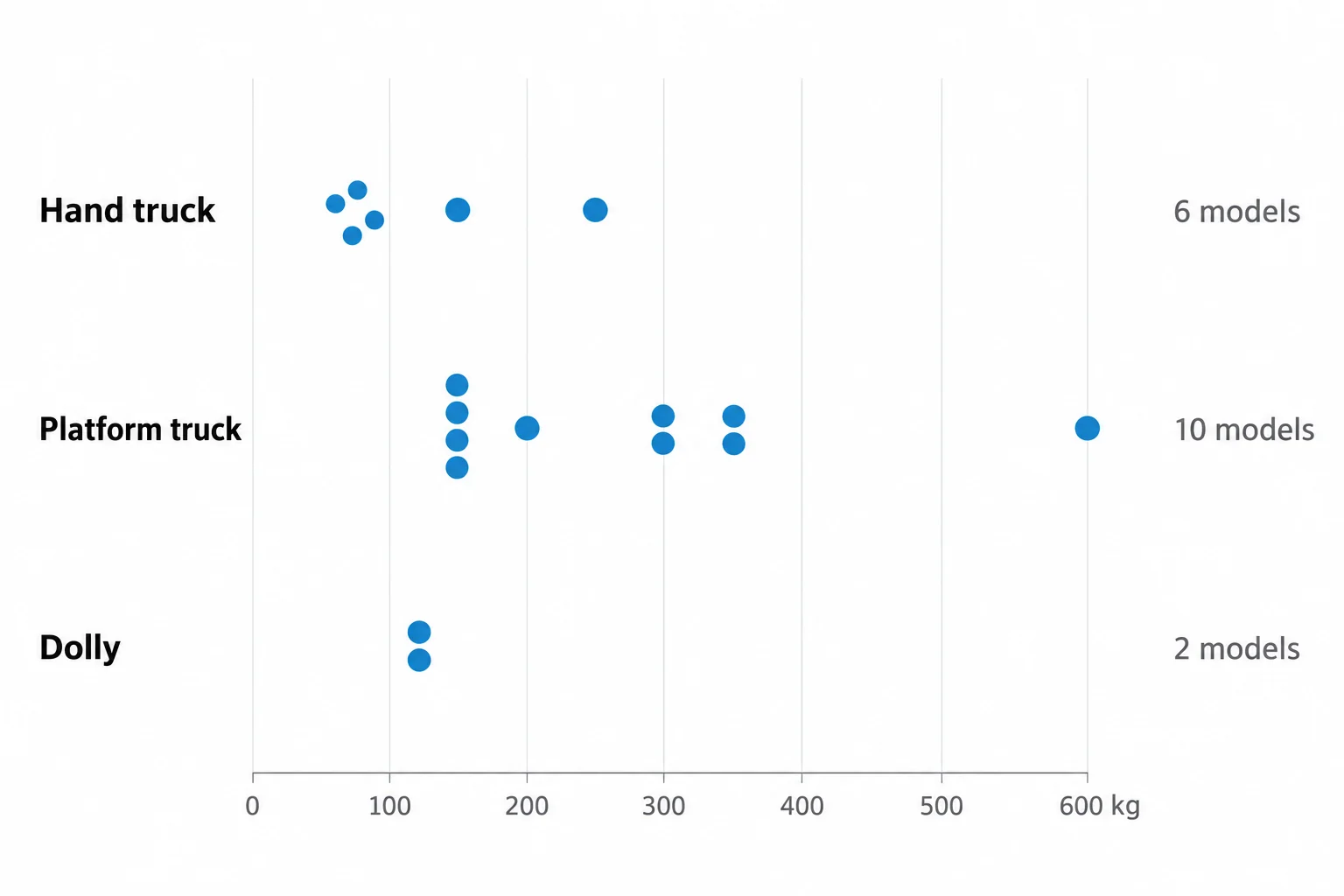
The figure shows why the choice matters for weight as well as shape. The strongest hand truck in our range is rated at 250 kg, the same as a mid-range platform truck. Above that figure there is no hand truck to choose, and a platform truck with a rating of up to 600 kg is the next step. Below 150 kg the hand truck, the platform truck and the dolly all overlap, and shape and floor space decide.
Hand Truck, the Two-Wheeled Tool
A hand truck has an upright frame, a handle at the top, a small plate at the bottom and two wheels. You slide the plate under the load, lean the frame back and wheel the load away. Because you balance part of the weight with your hands, a hand truck suits stackable goods that are not too tall or too wide, such as cartons and boxes. It takes the least floor space of the three types, and many models fold.
We make six, and the rating is the first filter.
| Model | Rating | Weight | What stands out |
|---|---|---|---|
| PFTWT001 | 70 kg | 2.6 kg | Detachable, the lightest |
| PFTWT002 | 85 kg | 3 kg | Aluminum |
| PFTWT005 | 80 kg | 6 kg | Folding |
| PFTWT004 | 90 kg | 5.6 kg | Built for warehouse use |
| PFTWT003 | 150 kg | 5 kg | 6 inch wheels |
| PFTWT006 | 250 kg | 10 kg | 10 inch pneumatic wheels |
If you search for a folding hand truck, the model to look at is the PFTWT005, and the PFTWT001 also comes apart for carrying. A folding model is easier to store and to ship, and a rigid one is often stiffer under load. For the details of wheels, plates and stair work, read the sack truck guide.
Platform Truck, the Flat Deck on Four Wheels
A platform truck has a flat deck on four wheels and a handle at one end. Different sellers call it a platform cart, a hand cart, a flatbed cart or a platform trolley, and all of those names point to the same machine. Nothing leans on you, which means the whole load rides on the wheels. That lets it carry more than most hand trucks, and it suits anything with a flat underside, such as boxes, crates and cases. The two limits are that it cannot be tipped to climb a step, and that its deck needs room to turn in a corridor.
Our ten models run from 150 kg to 600 kg.
| Rating | Models | Weight | Wheels and notes |
|---|---|---|---|
| 150 kg | PFPT001 | 6.9 kg | 4 inch swivel wheels |
| 150 kg | PFPT003 | 7.5 kg | 4 inch solid rubber wheels |
| 150 kg | PFPT010 | 7.7 kg | Standing handle |
| 150 kg | PFPT009 | Not listed | Folds flat |
| 200 kg | PFPT008 | 9.5 kg | 4 inch wheels with brakes |
| 300 kg | PFPT002 and PFPT004 | 11.7 kg and 12.5 kg | 5 inch wheels |
| 350 kg | PFPT005 and PFPT006 | 14.5 kg and 12.5 kg | PFPT005 has 8 inch wheels |
| 600 kg | PFPT007 | 30 kg | 6 inch wheels, brakes, 1550 mm deck |
The words platform truck and platform cart come up together in searches, and for buyers they mean the same thing. Our guide to platform trolleys by load rating explains how to match the rating to the load and the wheel size to the floor.
Dolly, the Low Rolling Frame
In the hand truck vs dolly debate, a dolly is a small plastic and aluminum frame on four casters. Nothing about it is tall, and it has no handle. You set the load on it and push the load, which suits bulky items that only need to roll a short way. We make two, a heavy duty dolly with ordinary casters and a transport dolly with anti-static casters. Both are rated at 120 kg, carry 75 mm casters and are packed ten to a bundle.
Many online answers to the hand truck question treat a dolly as a moving aid for furniture or appliances. The word is used that way in the United States, and our dollies are plain platform dollies and not appliance dollies with straps or a lifting lip. If you need a dolly that carries a strapped appliance, ask the supplier for a drawing before you order.
Same Machine, Different Country
The words move with the market. The United States and Canada say hand truck for the two-wheeled tool and platform truck or platform cart for the flat one, and dolly can mean any of them. The UK and Ireland say sack truck or sack barrow for the two-wheeled tool and platform trolley for the flat one. Australia and India say hand trolley for the two-wheeled one, and New Zealand says trundler. A hand truck is therefore the same tool as a sack truck, a hand trolley and a two wheel dolly, and a platform truck is the same tool as a platform trolley and a flatbed cart. An importer who sells in more than one country should list both names on the product page, and a buyer who writes to a factory should describe the load and not depend on the word.
Hand Truck vs Dolly by Load
Work through three questions in this order.
- Can the load be tipped back without falling? If yes, a hand truck is enough, and it is the lightest and the smallest.
- Is the load heavier than about 250 kg, or wider than the frame? Then a platform truck is the only choice of the two.
- Does it only need to move a short way, and is it bulky rather than heavy? A dolly will do the job at the lowest cost.
When two answers fit, look at the route. A hand truck turns in the space of its own width, and a platform truck needs its length. A hand truck can be tipped to take one step or a ramp, and a platform truck cannot. A platform truck with brakes stands still on a slope while you load it, and a hand truck is held by the person. Every one of these differences is a practical reason to pick one over the other, and none of them depends on the name.
Rating Against Own Weight
The factory sheets give the rated load and the weight of the empty machine. Dividing one by the other shows how much load each kilogram of machine can carry. It is a calculation from the sheets and not a test result, but it explains why the two families feel different in use.
| Model | Type | Rating | Own weight | Load per kg of machine |
|---|---|---|---|---|
| PFTWT003 | Hand truck | 150 kg | 5 kg | 30 |
| PFTWT002 | Hand truck | 85 kg | 3 kg | 28 |
| PFTWT001 | Hand truck | 70 kg | 2.6 kg | 27 |
| PFPT006 | Platform truck | 350 kg | 12.5 kg | 28 |
| PFPT002 | Platform truck | 300 kg | 11.7 kg | 26 |
| PFPT007 | Platform truck | 600 kg | 30 kg | 20 |
| PFTWT005 | Hand truck, folding | 80 kg | 6 kg | 13 |
Most models land between 20 and 30, which makes a hand truck and a platform truck are about equally efficient in steel for what they carry. The folding PFTWT005 is the exception at 13, because a folding mechanism adds weight. That is the price of a machine that fits in a van or a locker, and it is a fair trade for people who need that. A buyer who never has to fold the machine should choose a rigid frame with a better ratio.
Steps, Ramps and Thresholds
In a hand truck vs dolly choice, the route often decides the type before the load does. A hand truck can be tipped back and walked up a single step or a loading ramp by pulling it, and the two wheels take the edge of the step in turn. A platform truck cannot be tipped without spilling the deck, which means every step needs a ramp or a lift. Thresholds in doorways matter for both, and a larger wheel rolls over a threshold more easily than a smaller one. That is why our heaviest hand truck uses 10 inch pneumatic wheels and our 350 kg PFPT005 uses 8 inch wheels. A dolly with 75 mm casters is the least happy on a threshold, since small casters stop against an edge, and it belongs on flat floors.
Before you order, walk the route once with a tape measure. Note every step, every kerb, every door width and every corner, and write the narrowest and the lowest down. Send the list with the inquiry. It takes ten minutes and prevents most returns.
Pushing, Pulling and Loading Safely
People ask whether a hand truck or platform truck should be pushed or pulled. The usual advice is to push a loaded machine forward where the route allows it, because a push uses body weight and a pull uses the back. On a hand truck going up a step, you pull it, and that is a case where the rule changes. Load the heaviest item at the bottom, close to the wheels or the deck centre, and stack lighter items on top. Keep the load inside the width of the frame to avoid catching it on door frames. Apply the brakes when a platform truck is loaded or unloaded, and never ride on a deck. Follow the safety rules of your own site as well, since they are written for your floor.
Shipping and Storage
A machine that folds or nests costs less to ship and to store, and the factory sheets give the number of pieces per 40HQ container for several platform trucks. The count depends on the shape of the deck and on whether the handle folds down.
| Model | Rating | Per 40HQ |
|---|---|---|
| PFPT009 | 150 kg | 2,720 |
| PFPT003 | 150 kg | 2,350 |
| PFPT008 | 200 kg | 1,800 |
| PFPT004 | 300 kg | 1,350 |
| PFPT010 | 150 kg | 1,200 |
| PFPT006 | 350 kg | 950 |
The spread is nearly three to one between the most compact and the most solid. A buyer who orders a few hundred pieces can ignore the difference, but one who orders a container will feel it in the freight bill for every unit. Ask the supplier for the container count of the exact model, and ask whether the figure is for packed or assembled units. Our sheets for the two-wheeled models and the dollies give no single count we can confirm, and those are planned and quoted with the order.
Using the Three Together
Many sites end up with more than one of these machines, each doing the job it is best at. A hand truck handles single boxes and quick trips, a platform truck carries stacked cartons over longer distances, and a dolly lets a large item roll the last few metres. If you plan a set, check that the dimensions work together. The platform truck deck should fit through the same doors as the others, the wheels should suit the same floor and ramps, and the brakes should work on the same surfaces. Buying them from one factory also makes colours, finishes and spare parts easier to match.
Reading the Rating on a Spec Sheet
In any hand truck vs dolly comparison, the load capacity on every sheet is the figure for an evenly spread load, not a point load at the edge of a deck or the top of a frame. A load that overhangs the deck or sits high on a hand truck acts harder on the wheels and the frame than its weight suggests. The empty weight is on the same sheet, and the overall size is the outside dimension, which you should compare with your doors and lifts. If a line is blank, ask for it in writing, and do not assume. We do the same on our pages, and where a sheet gives no figure we leave it out and say so.
Looking After the Machine
Wheels wear first on every type, and you should ask whether they are replaceable and what the replacement costs. Check the wheel fixings and the handle joints from time to time, wipe off dirt that gets into swivel heads and stop using a machine that has a bent frame or a loose wheel. These steps cost very little and extend working life, and a supplier who offers spare wheels is saving you a whole machine.
Why the Word Dolly Causes Trouble
Search results for hand truck vs dolly, or for dolly vs hand truck, mix three kinds of page. Some come from moving companies and talk about furniture and appliances. Some come from caster and equipment makers and talk about industrial loads. Some are forum threads where people argue about what to call things. The answers often disagree, because each speaker has a different machine in mind. When a buyer writes to a factory, the same thing happens. A request for a dolly rated at 300 kg could mean a flat platform truck, a hand truck or a heavy duty moving dolly, and each has a different price and a different size.
The fix is simple. Describe the machine by its parts. Say two wheels with an upright frame, or four wheels with a flat deck and a handle, or a flat frame with four casters and no handle. Add the rating, the deck or plate size and the floor. A supplier can then answer with the right model, and the two of you avoid a week of emails about what a dolly is.
Questions to Ask a Supplier
Whatever you decide, a few questions separate a reliable quote from a vague one. Ask for the rated load and whether it applies to the whole machine. Ask for the empty weight, the overall size and the wheel size. Ask whether the wheels can be replaced and whether brakes are fitted. Ask for the number of pieces in a 40HQ container for the exact model and for the finish of the frame. Ask what happens if the load capacity is exceeded, and whether the factory tests the machines before shipping. Our own practice is to give a quality inspection report with every batch, and a good supplier will say the same about theirs.
Wheels and Floors Matter More Than Names
The wheel decides how a machine behaves on the floor. A hard small wheel rolls easily on smooth concrete and shudders over cracks. A soft rubber wheel is quieter and grips better. Pneumatic wheels, such as the 10 inch ones on our PFTWT006, absorb bumps on rough ground. On the four-wheeled types a mix of fixed and swivel wheels lets the machine track straight and still turn. Our PFPT003 uses solid rubber and our PFPT007 and PFPT008 add brakes, and the sheet tells you which models have them. If the sheet is silent, ask.
Buying Mistakes to Avoid
- Choosing by the word dolly, or by hand truck vs dolly in a headline. The word covers three different machines, and the rating and the shape tell them apart.
- Loading to the limit every shift. A machine used at half its rating wears more slowly.
- Ignoring the route. A deck that fits the load may not fit the door, the lift or the corner.
- Forgetting freight. A folding platform truck and a fixed one of the same rating ship in very different numbers per container.
What to Send With an Inquiry
A supplier can quote correctly the first time if the request names the load, the route and the quantity.
- What you carry, its weight and its largest dimension.
- The floor, with ramps, steps, lifts and the narrowest door.
- The rating you need, with room for the heaviest day.
- Say if you need it folding, with brakes or with a particular wheel.
- The quantity and the destination port, since container loading changes the price per piece.
If none of our sixteen fits, our OEM service builds to your drawings or samples, starting with solution drawings, then tested samples and mass production once you confirm them.
Next Step
Hand truck or dolly, pick the type by how the load sits, check the rating in the tables above and open the model page for the details. Our warehouse trolley types guide places hand trucks, platform trucks and dollies next to roll cages and shelf trolleys, and the flatbed cart category lists all sixteen of these models.
 Related Questions