
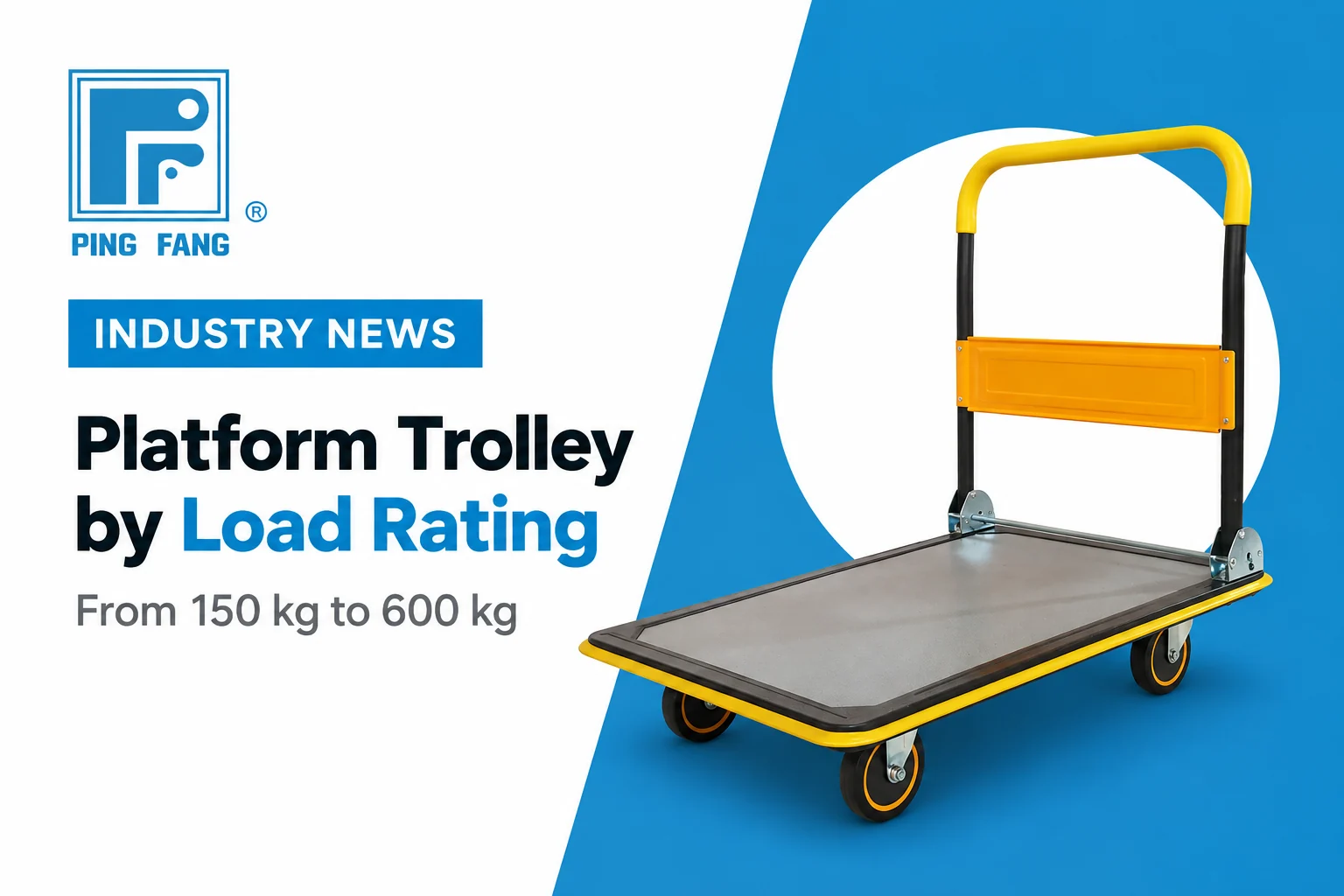
The same trolley is a platform trolley in India, the UK and Australia, a platform truck or a flatbed cart in the United States, and a flatbed trolley in Australia and the UK. Some buyers say platform cart. The smaller four-wheel boards that people slide under a load are called platform dollies. This guide climbs the load ladder one rung at a time, and at each rung it shows what the real models offer, what changes from the rung below and what the factory sheet leaves for you to ask.
The Five Rungs of the Load Ladder
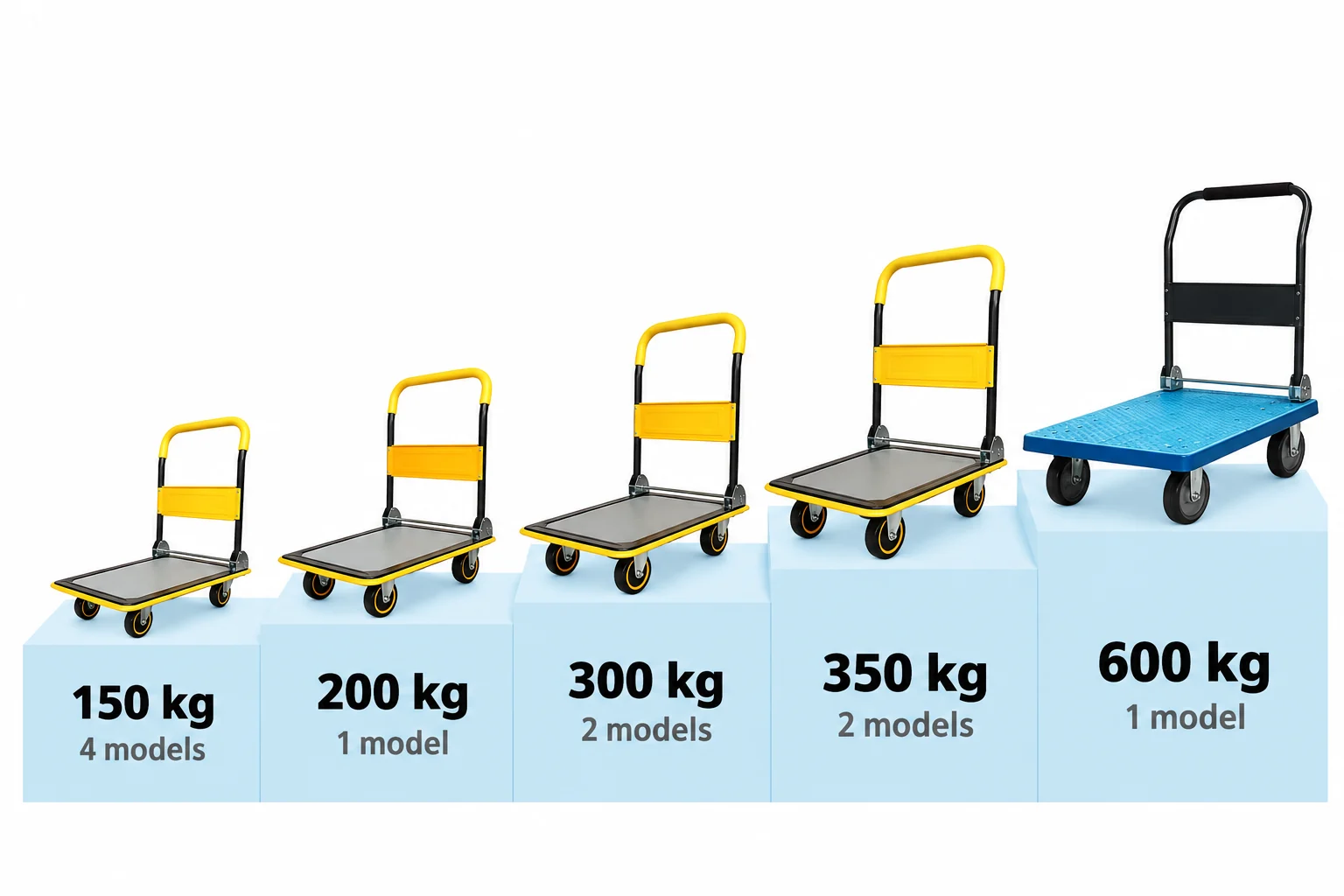
Platform trolleys cluster at a few ratings because buyers think in a few loads. A trolley for cartons is not a trolley for heavy equipment or for long loads, and the ratings follow those jobs. In our range the ratings are 150 kg on four models, 200 kg on one, 300 kg on two, 350 kg on two and 600 kg on one.
One number helps compare rungs, the load per kilogram of the trolley's own weight, which shows how much of the metal is doing the work. The table gives it for the models whose sheets list the weight, next to the footprint.
| Model | Load | Weight | Footprint (mm) | Load per kg of weight |
|---|---|---|---|---|
| PFPT001 | 150 kg | 6.9 kg | 725 × 475 | 22 |
| PFPT003 | 150 kg | 7.5 kg | 725 × 475 | 20 |
| PFPT010 | 150 kg | 7.7 kg | 710 × 420 | 19 |
| PFPT008 | 200 kg | 9.5 kg | 725 × 485 | 21 |
| PFPT002 | 300 kg | 11.7 kg | 910 × 610 | 26 |
| PFPT004 | 300 kg | 12.5 kg | 910 × 610 | 24 |
| PFPT005 | 350 kg | 14.5 kg | 610 × 910 | 24 |
| PFPT006 | 350 kg | 12.5 kg | 920 × 605 | 28 |
| PFPT007 | 600 kg | 30 kg | 1550 × 700 | 20 |
Read the last column as a measure of efficiency. The 350 kg PFPT006 carries 28 times its own weight, and the 150 kg PFPT010 carries 19 times, so the middle rungs make the best use of their steel. The 600 kg model drops back to 20, and its deck is 1550 mm long. That is the price of length, and for some loads it is worth paying.
Rung One, 150 kg
Four models share the lowest rung, and they differ more than the rating suggests. All carry 150 kg and all run on 4 inch wheels, but the decks and the build differ.
- PFPT001. A steel trolley with four 360 degree swivel wheels that turn it on the spot. It is the only 150 kg sheet that lists the steel by gauge, with a 0.5 mm deck plate, a 1.1 mm handle tube and 2.0 mm wheel brackets.
- PFPT003. The mixed floor model, with an anti-slip deck on solid rubber wheels that do not puncture. It folds flat to 40/130 mm, and 2,350 fit in a 40HQ container.
- PFPT009. A steel and polypropylene trolley whose handle folds flat onto the deck. It is the densest pack in the family at 2,720 per 40HQ container.
- PFPT010. A 7.7 kg steel trolley that ships in its own 530 × 420 × 230 mm carton, shorter than its own deck, at 1,200 per 40HQ container.
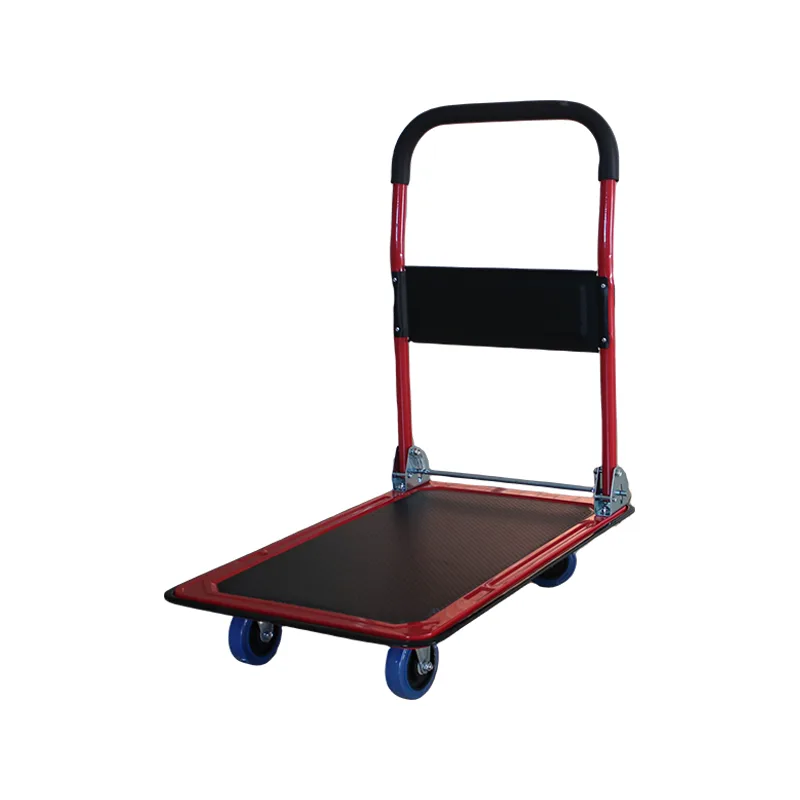
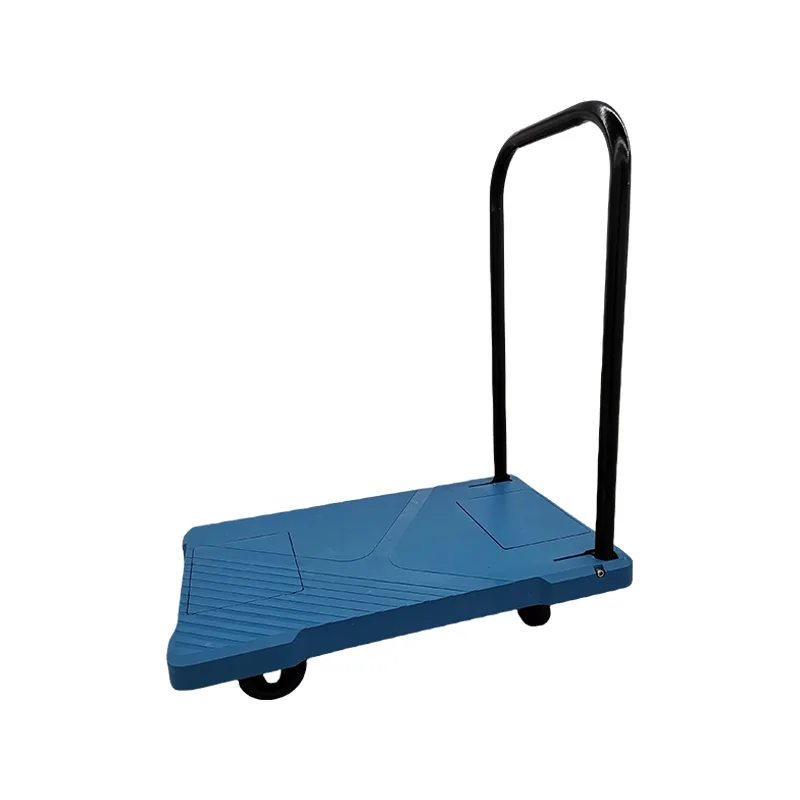
Choose within this rung by the floor and the shipping. A smooth floor and tight turns favor swivel wheels, ramps and thresholds favor solid rubber, and a buyer who ships by the container will compare the 2,720 against the 1,200. The rung suits cartons, crates and light equipment, which is what the sheets list for warehouse and retail work.
Rung Two, 200 kg
There is one model here, and it is the first to add brakes. PFPT008 has 4 inch rubber swivel wheels with brakes and handles at both ends, so it can be pushed or pulled. It measures 725 × 485 mm, nearly the same footprint as the 150 kg models, and carries 50 kg more. At 9.5 kg it weighs 2.6 kg more than PFPT001, and 1,800 fold flat into a 40HQ container.
The rung is for loads that sometimes pass 150 kg and for sites where a loaded trolley must stay put during loading. The brakes are the real reason to choose it, because a trolley with no brakes on a slope or a dock plate is a hazard once it carries weight. Handles at both ends also help in a narrow aisle, where a worker may need to pull the trolley back out the way it came in.
Rung Three, 300 kg
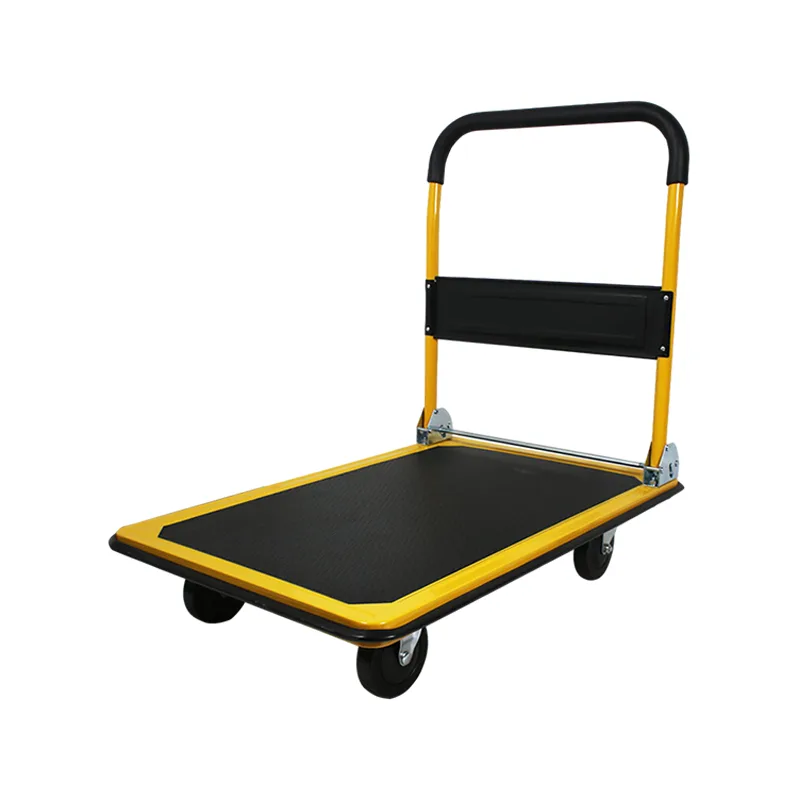
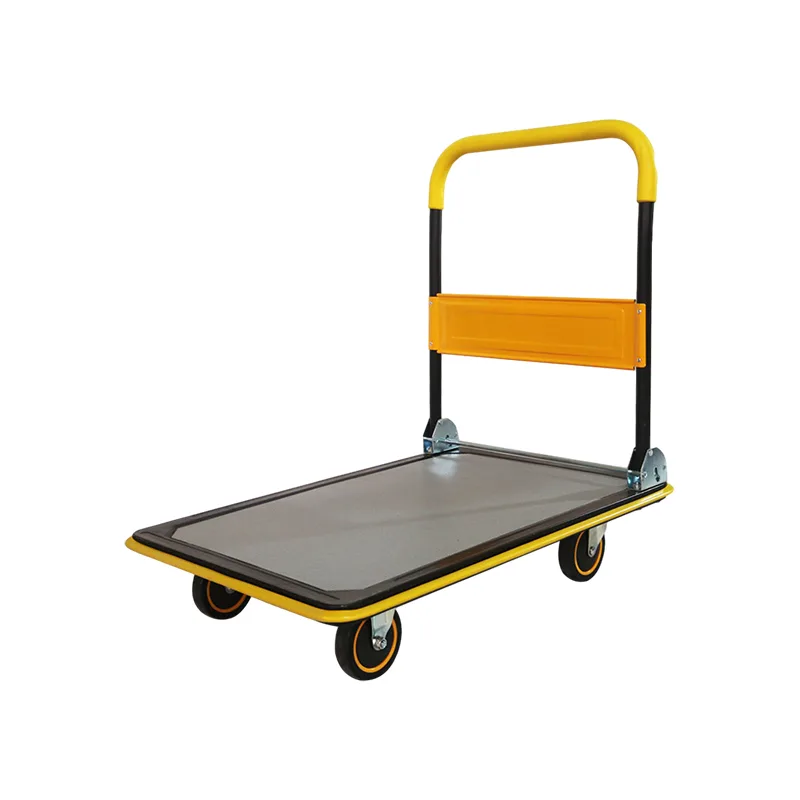
The deck grows to 910 × 610 mm here, about 1.6 times the area of the largest 150 kg models, and the wheels go to 5 inch. Two models share the rung, and they are the same size and rating.
PFPT002 weighs 11.7 kg and lists its steel gauges, 0.5 mm deck, 1.1 mm handle and 2.0 mm brackets. PFPT004 weighs 12.5 kg and has a non-slip deck with raised edges that keep bags, boxes and tools from sliding, with 1,350 per 40HQ container on its sheet. The choice is between a lighter trolley with a documented steel and a trolley with a raised edge. If your loads are loose bags or small items, the raised edge matters. If you compare suppliers by steel gauge, the gauge sheet matters. Both fold flat, and both run on 5 inch wheels, so the rest of the decision is small.
Rung Four, 350 kg
Two models carry 350 kg on nearly the same deck, and the difference is the wheels. PFPT005 runs on 8 inch wheels, the largest in the family, under a 610 × 910 mm deck with a non-slip surface, and weighs 14.5 kg. PFPT006 runs on 5 inch wheels under a 920 × 605 mm deck, weighs 12.5 kg and folds to a 70/170 mm pack, with 950 per 40HQ container.
Wheel size is the whole decision here. Eight inch wheels roll over thresholds, cracks and rough yards more easily, and the 8 inch trolley is 2 kg heavier. Five inch wheels are lighter and fine on a smooth floor. If your route crosses door rails, ramps or an outdoor stretch, take the 8 inch trolley.
Rung Five, 600 kg
PFPT007 stands alone at the top as the heavy duty platform trolley of the range. Its deck is 1550 × 700 mm, about 630 mm longer than any 300 or 350 kg model, and it rolls on 6 inch 360 degree rotating wheels with brakes. The deck is blue so that it is easy to see in a busy workplace. It weighs 30 kg and its sheet lists no folding or container count, so ask for its packing before you plan a shipment.
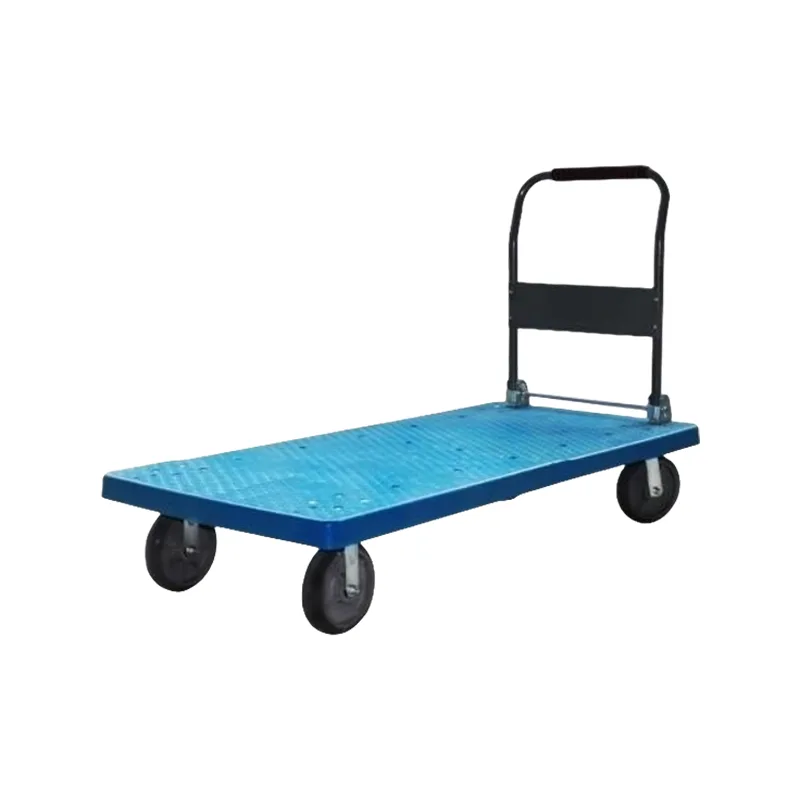
This rung is for loads that are long as well as heavy. It is not simply a stronger version of the 350 kg trolley, since the length changes how you maneuver it in aisles. Measure your narrowest aisle and your longest turn before you choose it.
Which Rung for Which Job
Our product pages name the jobs each model was described for, and they sort neatly onto the ladder. Use the table as a starting point, then check your real load against the rating.
| Rung | Jobs named on the sheets | Models |
|---|---|---|
| The 150 kg rung | Warehouse runs, retail, workshops | PFPT001, 003, 009 and 010 |
| The 200 kg rung | Distribution, airports, hotels, malls | PFPT008 only |
| The 300 kg rung | Warehouses, factories, offices, delivery | PFPT002 and 004 |
| The 350 kg rung | Workshops, industrial hauling, furniture | PFPT005 and 006 |
| The 600 kg rung | Heavy industrial and warehouse transport | PFPT007 only |
The pattern is that the rating climbs as the setting moves from retail and offices toward workshops and heavy industry. If you are unsure, the 300 kg rung names the widest mix of settings on our sheets, though it is also the first rung where the deck is large enough to be awkward in a narrow aisle.
Wheels, Read in Inches
The wheel set is the part buyers underrate. In our range the wheels run from 4 inch on the 150 and 200 kg models, through 5 inch on the 300 kg models and the PFPT006, to 6 inch on the 600 kg model and 8 inch on the PFPT005. Bigger wheels roll over obstacles more easily, and smaller ones keep the deck low and the trolley light.
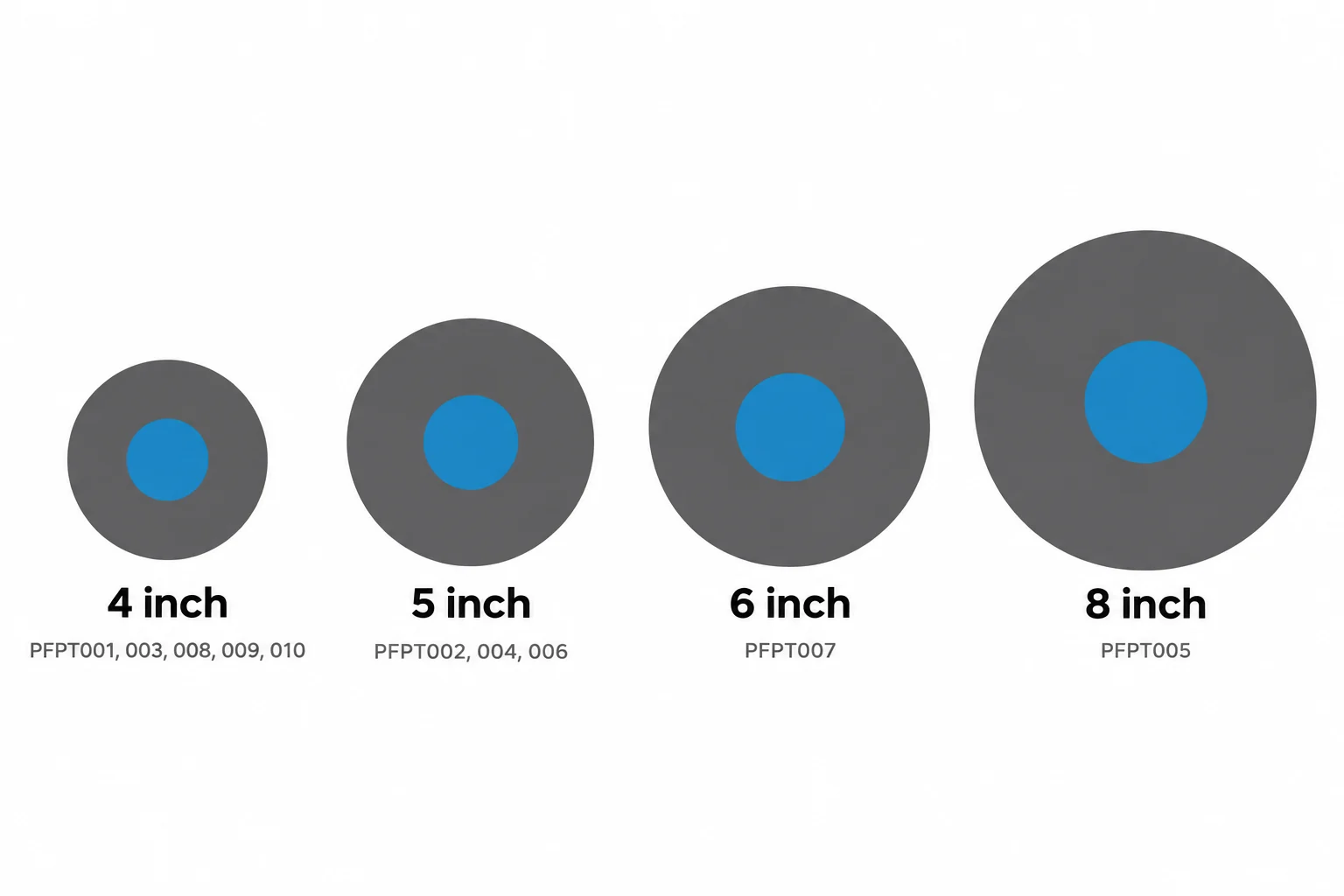
Beyond size, the sheets list three wheel features worth asking about. Swivel wheels, as on PFPT001, turn on the spot. Solid rubber, as on PFPT003, does not puncture. Brakes, as on PFPT007 and PFPT008, hold a loaded deck still. A trolley that needs all three should be specified that way in the brief, since not every model has them.
Decks and Handles
The deck is where the load rests. Our decks are steel, polypropylene or steel with a non-slip surface, and one has raised edges. A steel deck is rigid and takes impact, and a polypropylene deck does not rust or need paint. A non-slip surface keeps cartons from sliding when the trolley starts and stops, and a raised edge adds a lip for loose goods. The steel gauges on the PFPT001 and PFPT002 sheets, 0.5 mm for the deck and 1.1 mm for the handle tube, are the only gauges our sheets give, so ask for the others on the quotation drawing.
Most handles fold. On PFPT009 and PFPT006 the handle folds onto the deck for the flat pack, and on PFPT005 the handles lie down to a 170 mm pack. That is how the trolleys reach counts of 950 to 2,720 per 40HQ container.
One Spec Sheet, Line by Line
Take the factory sheet of PFPT004 and read it the way a buyer should. The overall size, 910 × 610 × 870 mm, is the open size, and its 910 × 610 mm footprint tells you the deck is about 0.55 m². The packing size, 920 × 620 × 50/140 mm, is the folded size, and the sheet gives two thicknesses, 50 and 140 mm, for the flat pack. The self weight, 12.5 kg, is the weight of the trolley itself. The load capacity, 300 kg, is the rating. The wheel size, 5 inch heavy duty, tells you the diameter and the grade. And the two container lines, 550 per 20FT and 1,100 per 40FT container with 1,350 per 40HQ, tell you how the folded trolleys ship.
What the sheet does not say is just as useful. It does not say how the 300 kg rating was set, whether it is a static or a rolling figure, what the steel gauges are or whether the wheels swivel. Those are the questions for the quotation. A sheet that answers them is a better sheet, and a supplier who answers them quickly is a better supplier.
Folding and Shipping
Folding changes the economics of a purchase. A folding platform trolley that folds flat takes a fraction of the shelf, truck or container space of an open one, and the saving repeats on every shipment.
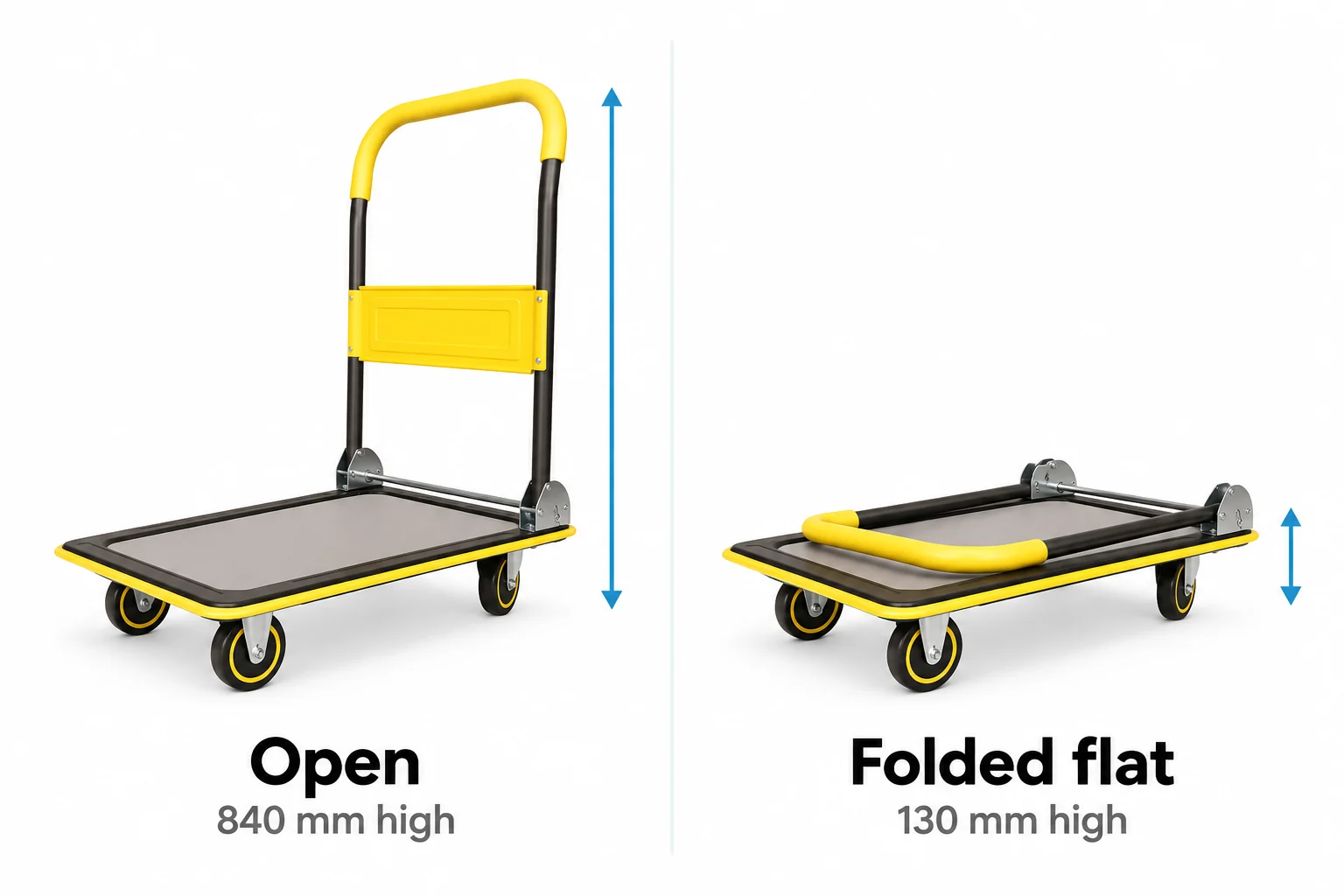
PFPT003 stands 840 mm high open and packs to 40/130 mm folded, so it fits in a carton about a sixth of its open height. Its packing size of 740 × 490 mm matches its footprint, which is why 2,350 fit in one 40HQ container. Counts depend on the model, so ask for the loading plan with the unit price, because freight per trolley follows it.
| Model | Rating | Folded pack (mm) | Per 40HQ |
|---|---|---|---|
| PFPT009 | 150 kg | 705 × 430 × 81 | 2,720 |
| PFPT003 | 150 kg | 740 × 490 × 40/130 | 2,350 |
| PFPT008 | 200 kg | 735 × 490 × 55/145 | 1,800 |
| PFPT010 | 150 kg | 530 × 420 × 230 | 1,200 |
| PFPT004 | 300 kg | 920 × 620 × 50/140 | 1,350 |
| PFPT006 | 350 kg | 935 × 620 × 70/170 | 950 |
The pattern is plain. The lighter and flatter the pack, the more trolleys per container, and the heavier models give up density for capacity. A 40HQ container of the flattest 150 kg trolley holds nearly three times as many units as one of the 350 kg PFPT006, at 2,720 against 950, which matters when freight is a large part of the landed cost.
Rating, Load and the Real World
A rating is the most a trolley should carry on a smooth, level floor, with the load spread over the deck. Real jobs add stress. A load stacked high raises the center of gravity and makes the trolley tip on a turn. A slope adds a rolling force. A bump adds a shock. And a load concentrated on one corner stresses the wheel bracket more than the same weight spread across the deck.
The practical rule is to keep a margin. Pick a rung above your heaviest regular load, spread the load across the deck, keep it low and tied down if it can shift, and never use the trolley as a ladder or a seat. If a load goes up a ramp regularly, choose brakes and larger wheels. The sheets give the rating but not the test behind it, so ask the supplier how the rating was set.
Platform Trolley, Sack Truck or Platform Dolly
A platform trolley is one of three tools that move loads on wheels, and many buyers confuse them. A sack truck stands upright on two wheels and tips the load back, as our guide to the sack truck explains. A platform dolly is a small, low board on four casters that carries a load close to the floor. Our platform dollies carry 120 kg each on 75 mm casters, with an aluminum frame and plastic corner seats, and they ship ten to a bundle.
| Question | Platform trolley | Sack truck | Platform dolly |
|---|---|---|---|
| Wheels | Four, with a handle | Two, upright | Four casters |
| Our rating | 150 to 600 kg | 70 to 250 kg | 120 kg |
| Best for | Wide, flat, long loads | Tall, narrow loads | Short moves under a load |
| Folds | Yes, flat | Many models | Ten to a bundle |
Choose by the load's shape and the length of the trip. For a long carry with wide cartons, take the platform trolley. For a short slide under a heavy item, take the dolly. For a tall box or an appliance, take the sack truck. Many sites use more than one.
Questions to Ask Before You Order
A good supplier answers these without delay, and the answers show how the supplier works. Put them in your inquiry so the first reply is a useful one.
- How was the rating set? The answer should name a test, not just a number.
- What are the steel gauges? Deck, handle and wheel brackets differ, and only two of our sheets list them.
- What is the deck made of, and does it have a raised edge? Steel, polypropylene and non-slip decks suit different loads.
- What are the wheels, and do they swivel, brake or resist punctures? Give the diameter in inches and the material.
- What is the folded size and the container count? Both set freight cost per trolley.
- Is there a quality report with each batch? Ours ships with a report after final inspection.
Ordering for a Fleet or for Resale
Distributors and fleet buyers face a different question from a single user. Which rungs should you stock? A simple assortment uses one model on each rung that matches your customers' loads. For most general markets that means one 150 kg trolley for cartons, one 300 kg trolley for heavier boxes and one 350 kg trolley on 8 inch wheels for rough routes. Add the 200 kg model if you serve hotels and airports, and the 600 kg model if you serve workshops with long loads. The suggestion is a starting point and not a rule, because your market's habits matter more than any assortment.
Buyers who resell should also ask about packing and branding. Our sheets show each model's packing size and container count, which let you plan the shipment before you place the order. If you want the trolleys under your own brand, ask our OEM service about colors and markings, since the sheets do not list them.
Looking After a Platform Trolley
A platform trolley is simple, and it still wears where it works hardest. The wheels take the impact, the brackets take the twisting load and the handle hinge takes the folding. Check the wheels and fixings first, because a loose wheel changes how the trolley tracks. Look for bent brackets after any heavy shock, and look at the handle hinge if the handle no longer locks upright. Keep the deck free of grit so the non-slip surface can do its work. If a part fails, tell us the model code from the sheet, for example PFPT004, and we supply repair advice.
What Moves the Price
Prices differ between models, and the factors are the same ones the sheets show. They are the rung, since a higher rating uses more steel, the deck material, the wheel size and type, the brakes and the folding hardware. Add the quantity, because the container count decides the freight per trolley. We do not publish prices, because a fair quote needs your quantity and destination. What we can do is send the loading plan and a per-unit freight estimate with the unit price, so that you compare landed cost and not only the factory price.
A Brief to Send With Your Inquiry
Drawings and requirements are answered within 24 hours on working days, and every batch ships with a quality report after final inspection. If none of the ten models fits, our OEM service builds to your drawing.
The full range sits on our flatbed cart page, and you can send your brief through the contact page. For other equipment on wheels, see our guides to airport luggage trolleys and to roll containers.
 Related Questions