

Airport operators in India, the UK and Australia say airport trolley or luggage trolley, and operators in the United States say luggage cart or baggage cart. They all mean a passenger trolley that rolls through the terminal, carries bags and returns to a pickup point. This guide follows the airport luggage trolley along a passenger's path instead of a catalog, because each stop sets a requirement that you can check against a real spec sheet. The numbers come from the factory sheets of our own range of airport luggage trolleys.
Airport Luggage Trolley, Cart or Baggage Cart, the Same Thing
Search volume splits by country. Airport trolley and airport luggage trolley carry the traffic in India, the UK and Australia, while airport luggage cart, airport baggage cart and luggage cart airport carry it in the United States and Canada. Plural forms such as airport luggage carts and airport baggage carts are common in the United States too. An airport baggage trolley can also mean the heavy tug-drawn carts that move bags between aircraft and the terminal, which is a different product. This guide covers the airport luggage trolley for passengers, the kind that stands in a row in the arrivals hall.
Why an Airport Trolley Is Not a Supermarket Cart
A supermarket cart stays on a smooth store floor and returns to a corral a few meters away. An airport trolley crosses a terminal, goes through doors, rides ramps between levels and may be left anywhere. It carries long suitcases and heavy bags that sit higher and tip more than groceries. And the people who use it have just traveled, are often in a hurry and do not read instructions.
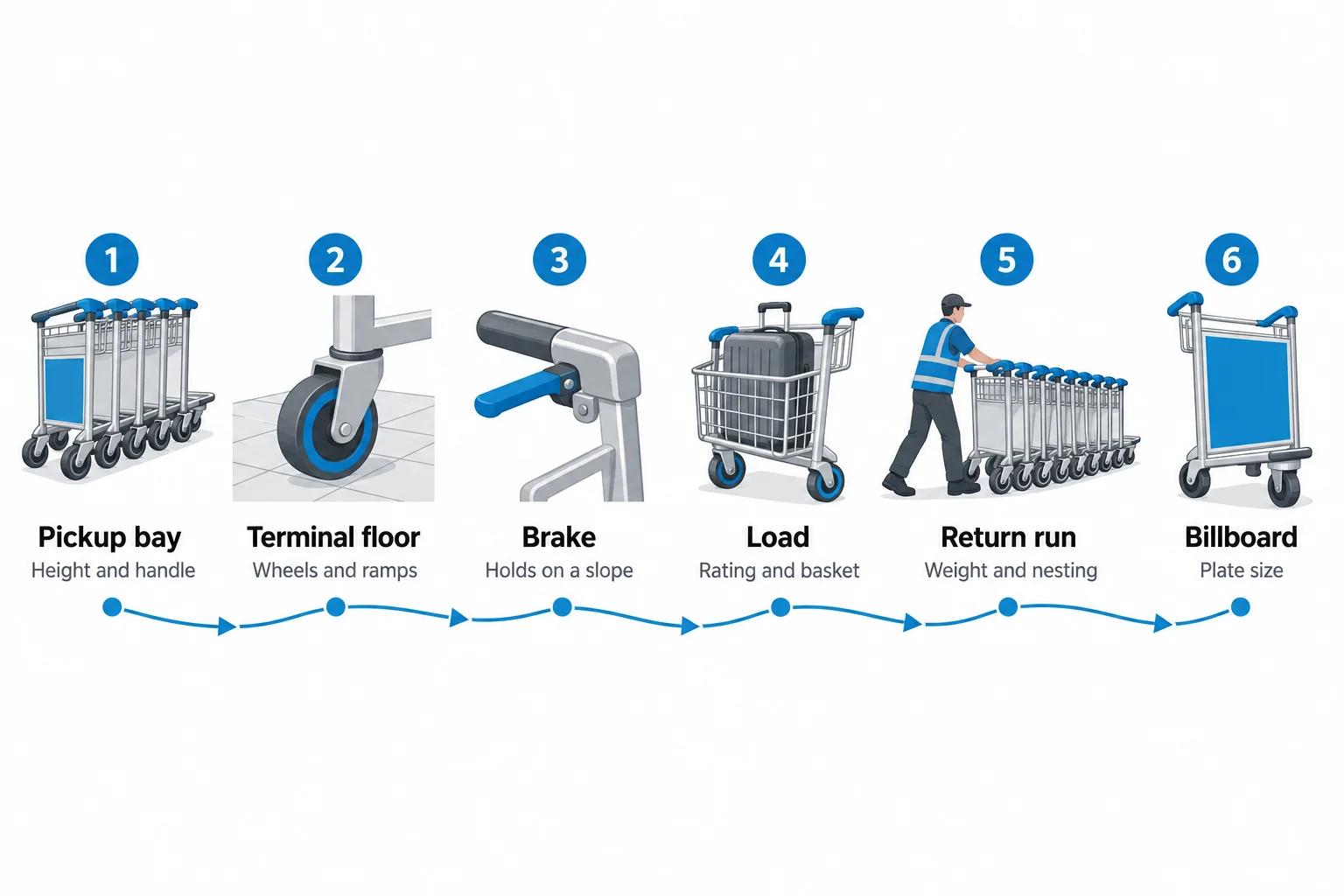
Those differences shape the specification, which lists a load rating, a brake, wheel sizes and an advertising plate, and they make it matter that the trolleys nest into tight rows. The rest of this guide walks the trolley through a passenger's path, and each of these requirements gets a place on it.
Stop One, the Pickup Bay
A passenger meets the airport luggage trolley at a row. The first question is how it looks and feels in a line. Our trolleys are between 710 and 1250 mm long, 510 to 675 mm wide and 980 to 1070 mm high. The height matters most. At about one meter, the handle sits at a comfortable level for most adults, and the advertising plate faces the passenger who walks up to it.
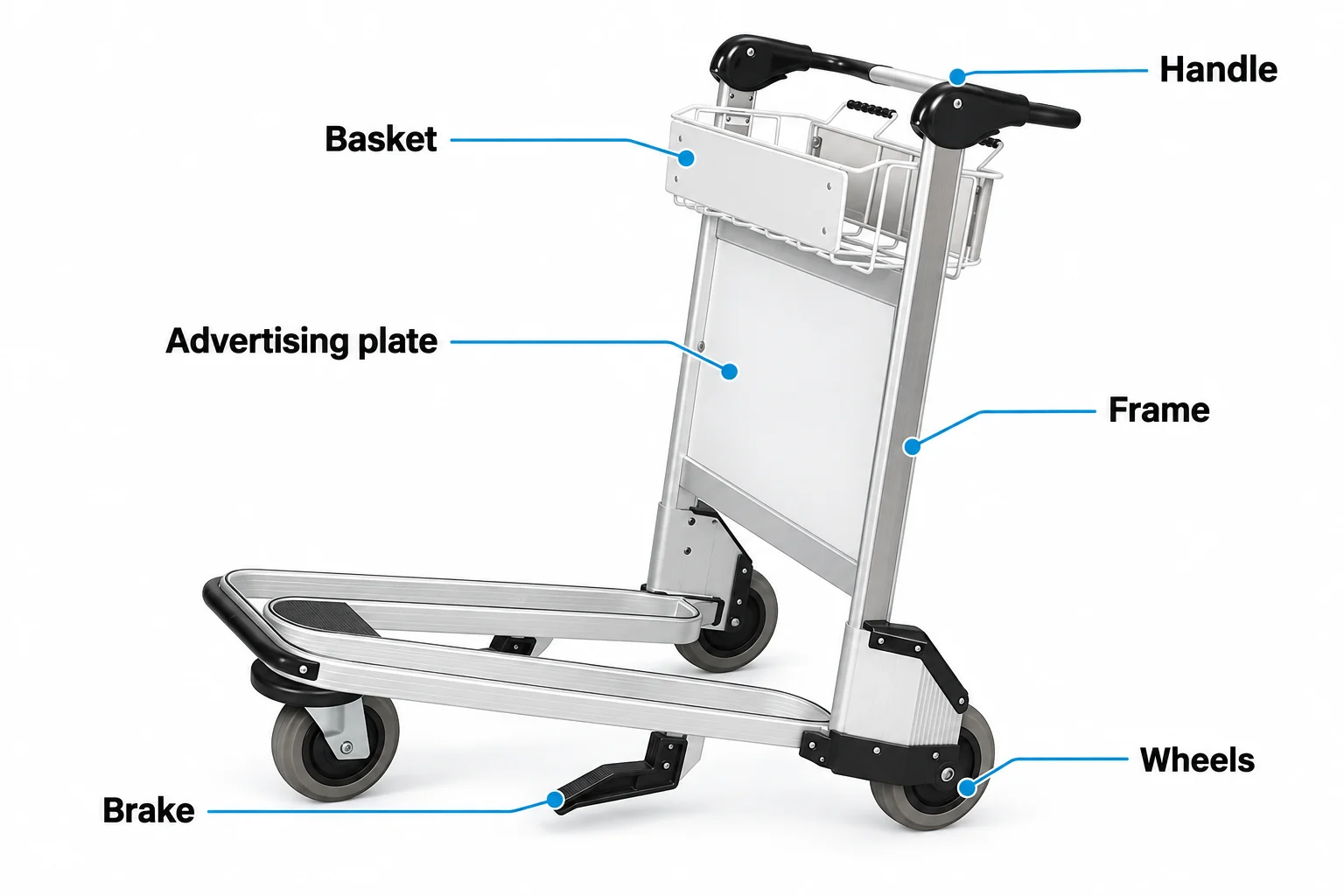
The handle is the part everyone touches, whether it is the PVC grip on the aluminum 1030 mm trolley or the metal handle on other models. In our range it is PVC on seven models, aluminum alloy on four and stainless steel on one, and the remaining four sheets do not list it. A PVC grip is usually softer in the hand, and a metal handle is usually harder wearing. Ask which is used if the trolleys will be pushed by hundreds of people a day, and ask how the grip is fixed to the tube.
Stop Two, the Terminal Floor
The wheels decide how the trolley sounds and how it takes a threshold. Ten of the 16 sheets list natural rubber wheels. Four use TPU, two as swivel wheels at 125 mm on the compact 90 kg models and two combine 125 mm TPU with 180 mm natural rubber. One model has 5 inch PU swivel wheels at the front and 180 mm natural rubber at the rear, and the steel trolley runs on 5 inch PU wheels on double axles.
| Wheel set | Found on | Rated load |
|---|---|---|
| 180 mm natural rubber | Ten of the 250 kg models | 250 kg |
| 125 mm TPU swivel | The two 90 kg compact models | 90 kg |
| 125 mm TPU with 180 mm rubber | Two stainless models | 250 kg |
| 5 inch PU front, 180 mm rubber rear | The 150 L basket model | 100 kg |
| 5 inch PU on double axles | The steel model | 100 kg |
Bigger wheels roll over expansion joints, door rails and the ramp between a curb and the hall more easily, and softer tires are quieter. If your terminal has a rough apron, a long ramp or outdoor stretches, choose the 180 mm rubber. If every floor is smooth and the pickup bay is tight, a smaller TPU wheel is lighter and turns easily. Ask for the wheel diameter in millimeters, since "large wheels" tells you nothing.
Stop Three, the Brake
An airport luggage trolley that rolls away on a slope is a hazard in a terminal, where floors are polished and ramps are common. Eleven of our 16 models list an automatic brake, three list none and two do not mention it. The sheets say automatic brake and do not describe how it works, so ask the supplier to show it on a real trolley. The short video below, titled passenger baggage trolley with hand brake, shows a trolley being handled.
Decide early if your operation wants an automatic brake, a hand brake or none. A hand brake gives the user control but needs the user to learn it. An automatic brake needs no instruction, but its setting matters, because one that grips too hard annoys passengers. Whatever you choose, ask the supplier to demonstrate it on a real floor with a loaded trolley, and write the check into your acceptance test.
Stop Four, the Load
Twelve of the 16 models are rated 250 kg, which is a generous rating for a trolley that carries suitcases. The two compact models, such as the 790 mm aluminum trolley, are rated 90 kg, and the steel model and the large basket model are rated 100 kg. The rating tells you how strong the frame is, not how much a passenger should carry. A high number is a margin and not a promise to load it.
Look at the basket as well. The standard basket measures 525 × 220 × 150 mm and is powder coated steel on the aluminum models and stainless steel on the stainless ones, a small tray. One aluminum model, the 150 L basket trolley, holds a large basket and is rated 100 kg, which suits a terminal where passengers carry loose items. The sheet of that model says it has no baby seat. If your terminal wants one, ask.
Stop Five, the Return Run
The working life of an airport luggage trolley is a loop. A passenger leaves it at a curb or a gate, and staff gather it and return it to a bay. That return run is where weight and shipping figures turn into daily labor.
Self weight in our range runs from 13 kg for the compact models to 24.5 kg for the heaviest stainless one. A lighter trolley is easier for staff to push in a long line, and weight also reflects the metal and the basket. The container counts show how the trolleys are packed. One 40HQ container holds 252 of most of the 250 kg models, and 114 fit into a 20FT container. That is only possible because the trolleys nest or ship knocked down. A 1030 × 670 × 1040 mm trolley takes about 0.72 m³ assembled, so 252 of them would need about 180 m³, while a 40HQ container offers about 76 m³ inside, so the packing is more than twice as dense as the assembled volume allows. The calculation uses the standard inside size of 12,032 × 2,352 × 2,698 mm and is a guide, not a measured loading figure.
The compact models pack tighter still, at 408 per 40HQ container, and the steel model at 410. Whichever model you choose, ask for the loading plan with the unit price, because freight per trolley follows it.
Stop Six, the Billboard
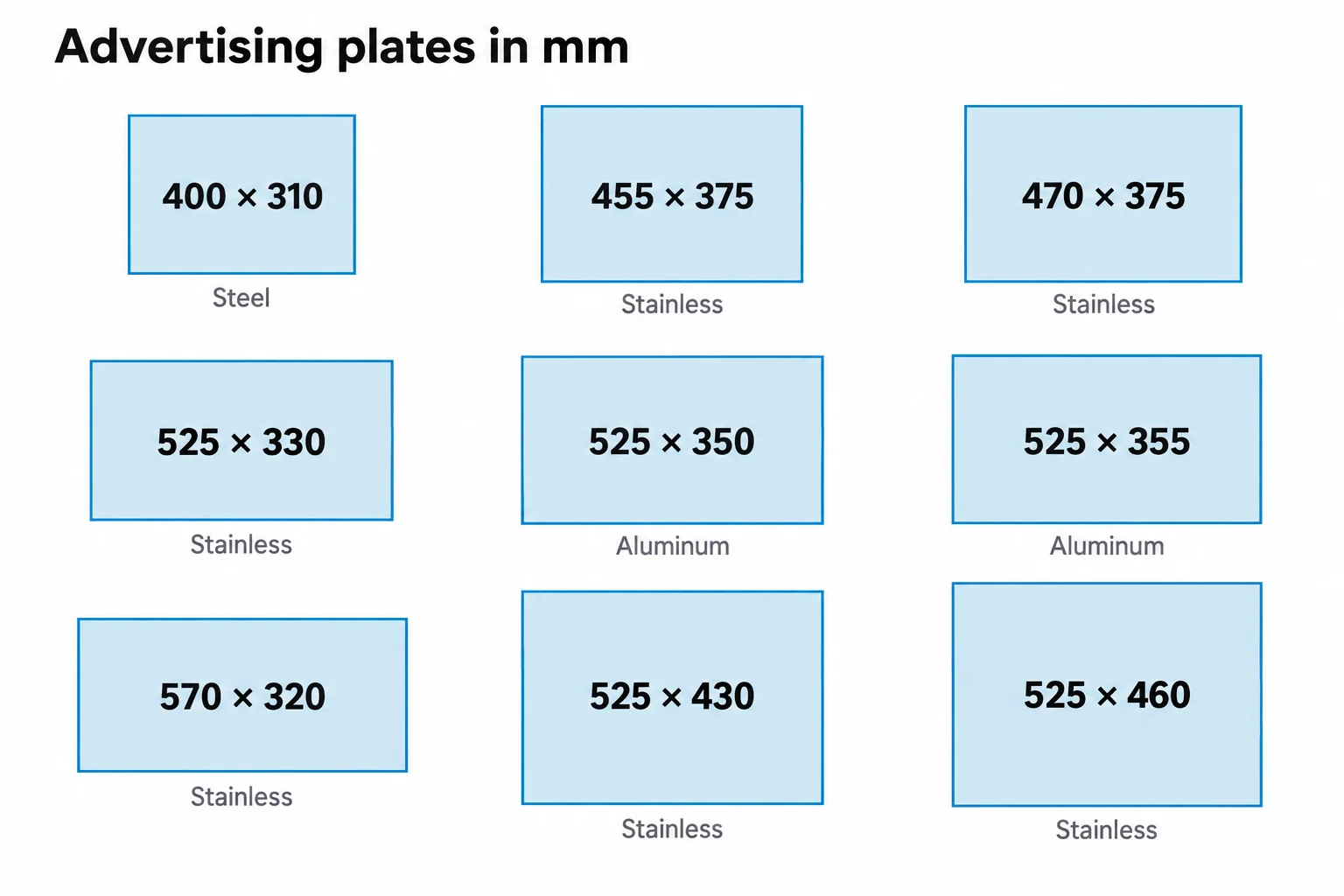
Many airports sell advertising on the trolley, and the advertising plate is the surface they sell. Thirteen of our 16 sheets list a plate, and the sizes vary more than buyers expect.
| Plate size (mm) | Where it is used |
|---|---|
| 400 × 310 | Steel trolley |
| 570 × 320 | 1250 mm stainless trolley |
| 525 × 330 | Two stainless trolleys |
| 525 × 350 and 525 × 355 | Five aluminum trolleys |
| 470 × 375 and 455 × 375 | Two stainless trolleys |
| 525 × 430 and 525 × 460 | Two stainless trolleys |
If advertising pays for part of the fleet, the plate is a revenue question and not a styling one. A larger plate carries a larger message, and two plates with the same width can differ by 130 mm in height. Decide the size that your advertisers want before you choose the model, and ask what the plate is made of and how a new poster is fitted. The aluminum plates on our sheets are listed with a thickness of 6 mm on three models.
How Many Trolleys a Terminal Needs
Operators often ask how many airport luggage trolleys to buy, and a rule of thumb gives a starting point. Estimate the passengers who will take a trolley in the busiest hour. Divide by the number of uses one trolley gets in that hour, which depends on how long a passenger keeps it and how quickly staff return it. Add the trolleys that sit in the return run or in repair, and a margin for peak days.
For example, if 600 passengers an hour want a trolley and each trolley completes two uses an hour, 300 trolleys are in service. If 15 percent are always in the return run or being repaired, the fleet is about 350. The figures are only an illustration, but the sum shows why a faster return run reduces the fleet you must buy. Whatever the final number, plan the pickup bays first, because each bay holds a fixed number of nested trolleys, and the bay count and the fleet size must agree.
Aluminum, Stainless or Steel for an Airport Luggage Trolley
Frame material is the decision buyers usually start with, and it comes last here because the other five stops narrow it. Our range has seven aluminum alloy models, eight stainless steel and one steel.
| Frame | Models | Weight range | Load | Per 40HQ |
|---|---|---|---|---|
| Aluminum alloy | 7 | 13 to 22.6 kg | 90 to 250 kg | 204 to 408 |
| Stainless steel | 8 | 13 to 24.5 kg | 90 to 250 kg | 240 to 408 |
| Steel, zinc and powder coat | 1 | 18.5 kg | 100 kg | 410 |
Aluminum alloy is the lighter family and resists corrosion. Stainless steel suits a terminal that wants a bright, hard surface. Steel with a zinc and powder coat finish is a simpler build, and a scratch through the finish needs attention in wet places. The weight ranges overlap, so the metal alone does not set the weight. A stainless trolley can weigh the same as a compact aluminum one, and an aluminum trolley with a large basket can weigh as much as a stainless one.
Two Models Side by Side
Pick two sheets and the real differences show up. Take the aluminum 1030 × 670 × 1040 mm trolley and the stainless steel 1070 × 620 × 1030 mm trolley. Both are rated 250 kg, both run on 180 mm natural rubber wheels, both list an automatic brake and a PVC handle, and both carry the same 525 × 220 × 150 mm basket. Both pack 114 to a 20FT container and 252 to a 40HQ container.
| Line | Aluminum 1030 | Stainless 1070 |
|---|---|---|
| Frame | Aluminum alloy | Stainless steel |
| Basket | Powder coated steel | Stainless steel |
| Advertising plate | 525 × 350 mm | 525 × 330 mm |
| Self weight | 18 kg | 24.5 kg |
| Footprint | 1030 × 670 mm | 1070 × 620 mm |
The metal changes the weight by 6.5 kg and the basket material, and little else on these two sheets. That is a useful lesson. The decision between aluminum and stainless is mostly about weight, finish and appearance, and not about capacity or container count. If your staff push long lines, take the lighter one. If you prefer the look of stainless or your cleaning routine suits it, take the heavier one, and check that the extra weight does not slow the return run.
The category page of our airport luggage trolleys lists all 16 models with their sizes, loads and container counts in one table, so you can compare any two the same way.
Match the Stops to Your Terminal
The six stops do not matter equally in every airport, and the table below is a rough guide. A small regional terminal has different needs from a large international hub, and a station or a hotel lobby has different needs again.
| Setting | Stops that matter most | What to lean toward |
|---|---|---|
| Large international hub | Floor, return run, billboard | 180 mm wheels, light frame, large plate |
| Regional airport | Load, price, brake | Simpler model, automatic brake |
| Airport with ramps or outdoor stretches | Floor, brake | Large rubber wheels, tested brake |
| Tight pickup bays | Pickup, return run | Compact models, nesting |
Write your terminal into a short profile before you ask for quotes, and send it with the brief below. A supplier who sees the setting can suggest a model, and a supplier who sees only a quantity can only quote a price.
What Passengers Notice First
Passengers do not read spec sheets. They notice four things in the first ten seconds, and each one traces back to a line on the sheet. They notice whether the trolley pulls free of the row without a fight, which is the nesting. They notice whether it rolls straight and quietly, which is the wheels. They notice whether it stays put when they let go, which is the brake. And they notice whether it feels solid, which is the frame, the handle and the plate.
A trolley that fails any of these tells the passenger something about the airport before the flight has begun. That is why operators who compare quotations should put the passenger's first ten seconds into the acceptance test as well as the numbers. A trolley that meets every number and still sticks in the row is the wrong trolley.
Replacing an Existing Fleet
If you are replacing trolleys, the old fleet is the best specification you have. Measure one trolley, record its wheel size, handle height, basket size and the pitch at which trolleys nest, and photograph the brake and the plate fixing. Send those with your brief, and ask the supplier whether the new trolleys will nest with the old ones during the changeover. A mixed fleet that does not nest forces staff to sort trolleys by type, and the sorting costs more than most buyers expect.
If you are adding to a fleet, ask for a sample of the new model to be tested in your own bay before you commit. Our standard models cover many sizes, and if none matches your existing trolley closely, our OEM service builds to your drawing.
Acceptance Tests for a Delivery
When the first batch arrives, test it against the sheet before the rest ships. Write the pass lines into the contract, and run the same tests on a sample from every later batch.
| Test | How to run it | What a pass looks like |
|---|---|---|
| Size and weight | Measure and weigh five trolleys | Within your stated tolerance |
| Push test | Load to a realistic weight and push a set distance | Tracks straight and rolls quietly |
| Brake test | Park a loaded trolley on a slope | Holds without creeping |
| Threshold test | Roll over a door rail and a ramp | No jam and no wobble |
| Handle and plate | Pull on both with force | Nothing loosens |
| Nesting test | Nest ten trolleys in a row | They slide in without force |
The nesting test matters more than it looks. A trolley that does not nest cleanly wastes bay space and forces staff to separate trolleys by hand, and a fleet of them slows the return run for years.
Keeping the Fleet Rolling
Trolleys wear where they are used hardest. Wheels flat-spot and pick up thread, brakes loosen and grips split. Plan for it from the start. Order spare wheels and grips with the first shipment, because a part for a trolley that was made two years ago can be hard to match. Write down the model, the wheel size and the brake type in your maintenance sheet, and give each trolley a number so that repeat faults can be traced.
Walk the pickup bays on a fixed schedule and pull out any trolley that rolls badly, brakes poorly or carries a loose plate. A bad trolley in the row costs more in passenger goodwill than it saves in fleet size. If a model keeps failing in the same place, tell the supplier. A design change such as a stronger fixing or a different wheel is a normal request, and it is one of the reasons to buy from a manufacturer who can modify the product.
What Moves the Price of an Airport Luggage Trolley
Buyers always ask how much an airport luggage trolley costs, and the honest answer is that the quotation depends on five things. They are the frame metal and its finish, the weight, which tracks the amount of material, the wheel set and the brake, the advertising plate and any printing, and the quantity with the freight, since the container count decides the freight per trolley. We do not publish prices, because a fair quote needs your destination and quantity. What we can do is give the loading plan and a per-unit freight estimate along with the unit price, so that you compare landed cost and not only the factory price.
What Can Be Changed on a Standard Model
Most airport buyers want a standard frame with a few changes, and it helps to know where the room is. Our sheets already show variety in wheels, handles, baskets and plates. Ask whether the plate size, the basket, the handle material or the wheel set can change on the model you like, and whether a baby seat can be added. Frame length and width change the nesting and the container count, so they need a fresh look at the drawing. Keep the list of changes short, because each one adds a drawing check, and ask for a sample of the changed trolley before the full order.
A Brief to Send With Your Inquiry
Drawings and requirements are answered within 24 hours on working days. If none of the 16 standard models fits your bay, our OEM service builds to your drawing, and every batch ships with a quality report after final inspection.
The full range sits on our airport luggage trolley page, and you can send your brief through the contact page. For other wheeled equipment, see our guides to sack trucks and to roll containers.
 Related Questions