

Buyers search for the same family under many names. In the UK, Australia and India it is a shelf trolley or a trolley with shelves, in the United States a shelf cart, and in horticulture a Danish trolley, a plant trolley or a nursery trolley. Dairies and supermarkets call the same idea a milk trolley. Ping Fang builds four of them, and they show clearly how one idea changes with the load. This guide uses those four as worked examples.
Names by Country
Search habits show which name your market uses. Shelf trolley is the most common term in the UK, Australia and India, while shelf cart is the United States term. Trolley with shelves and shelved trolley appear in the same markets. Plant trolley is used in Australia and the UK, plant cart in the United States, nursery trolley in Australia, India and the UK, and nursery cart in the United States. Garden centre trolley is a British phrase, and Danish trolley is used mainly in the UK. Milk trolley is a UK, Ireland and Australia term. A good supplier will recognize every one of them, and an inquiry that names the goods will always be clearer than one that names the trolley.
Four Shelf Trolleys at One Scale
The four models share a galvanized steel frame and shelves, and they differ in size, in the number of levels and in what the shelves are made of. The figure draws them at one scale, and the table gives the factory sheet numbers.
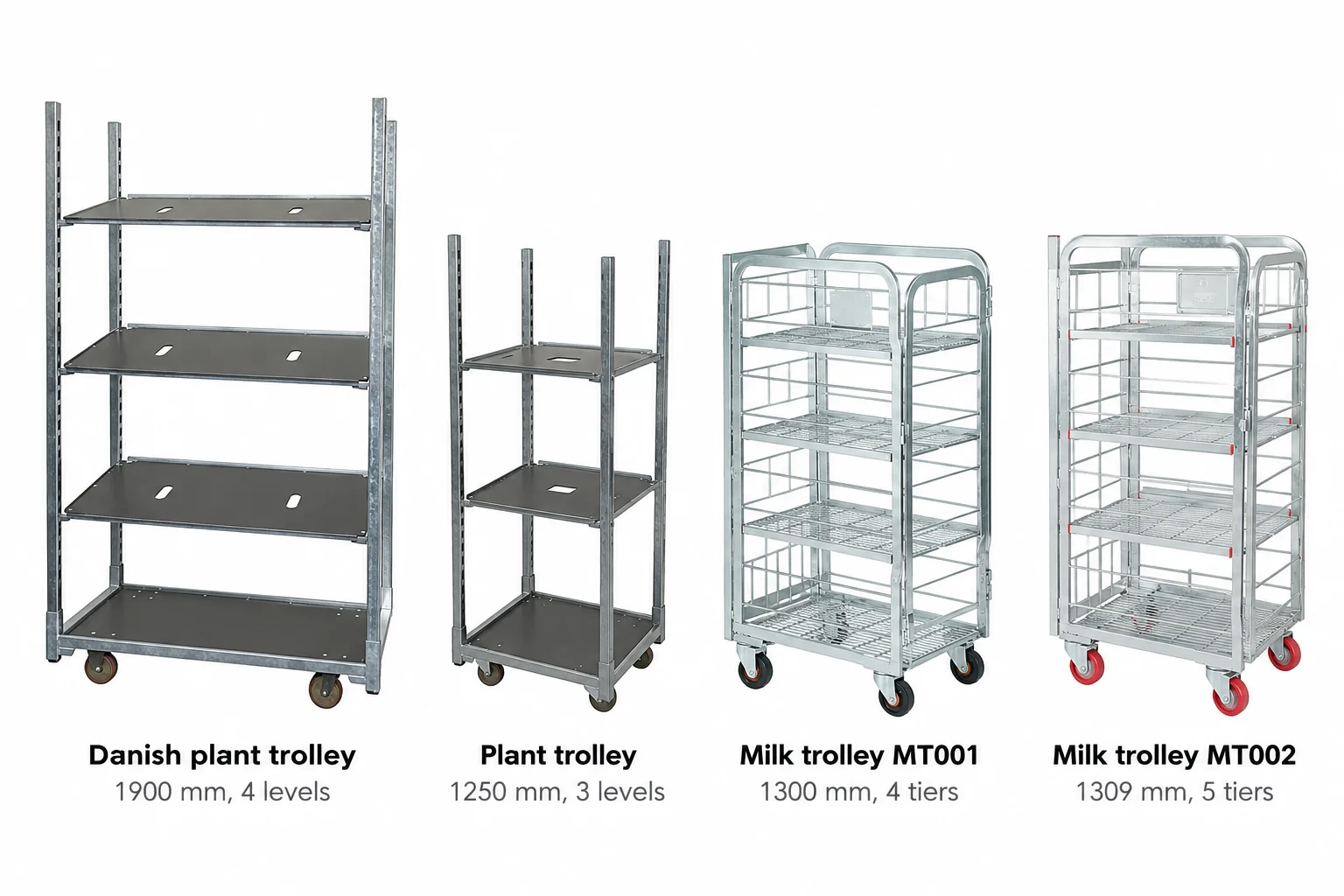
| Model | Size (mm) | Levels | Rating | Weight |
|---|---|---|---|---|
| Danish plant trolley | 1350 × 560 × 1900 | 4 | 450 kg | 42.5 kg |
| Plant trolley | 675 × 565 × 1250 | 3 | Not listed | 18 kg |
| 4-tier milk trolley MT001 | 657 × 419 × 1300 | 4 | 250 kg | 32 kg |
| 5-tier milk trolley MT002 | 665 × 430 × 1309 | 5 | 250 kg | 38 kg |
The Danish trolley is by far the biggest, with a footprint of 1350 × 560 mm, about 0.76 m². The milk trolleys are about 0.28 m², and the plant trolley is about 0.38 m². The Danish trolley carries 450 kg, the most in the group, and it weighs 42.5 kg, a ratio of load to its own weight of about 11 to 1, the best of the four. The milk trolleys manage about 8 and 7 to 1. The plant trolley sheet gives no rating. Ask for it before you plan a load.
Start With What Sits on the Shelf
A shelf trolley is a shelf first and a trolley second. The shelf decides three things, namely how tall an item can be, how much it can weigh and how it must be cleaned. Work out those three before you look at the frame.
Wire mesh for dairy and food
Both milk trolleys use wire mesh shelves. Mesh lets staff see stock at a glance, lets air move around the product and lets washdown water run through. The 4-tier MT001 gives each level more height and suits full dairy crates as the unit load. The 5-tier MT002 has shorter openings and suits bottles, small cartons and mixed dairy products, which sort by shelf and let one trolley carry more product lines per trip.
Waterproof plywood for plants
The Danish plant trolley uses shelves of waterproof plywood with metal edging that resists moisture and abrasion. A solid shelf suits pots and trays, and the metal edging protects the plywood edge. The frame is galvanized steel. The page text calls the frame electrolytic galvanized and describes the shelves. Confirm the exact number and spacing of shelves on the quotation drawing.
How tall is each opening?
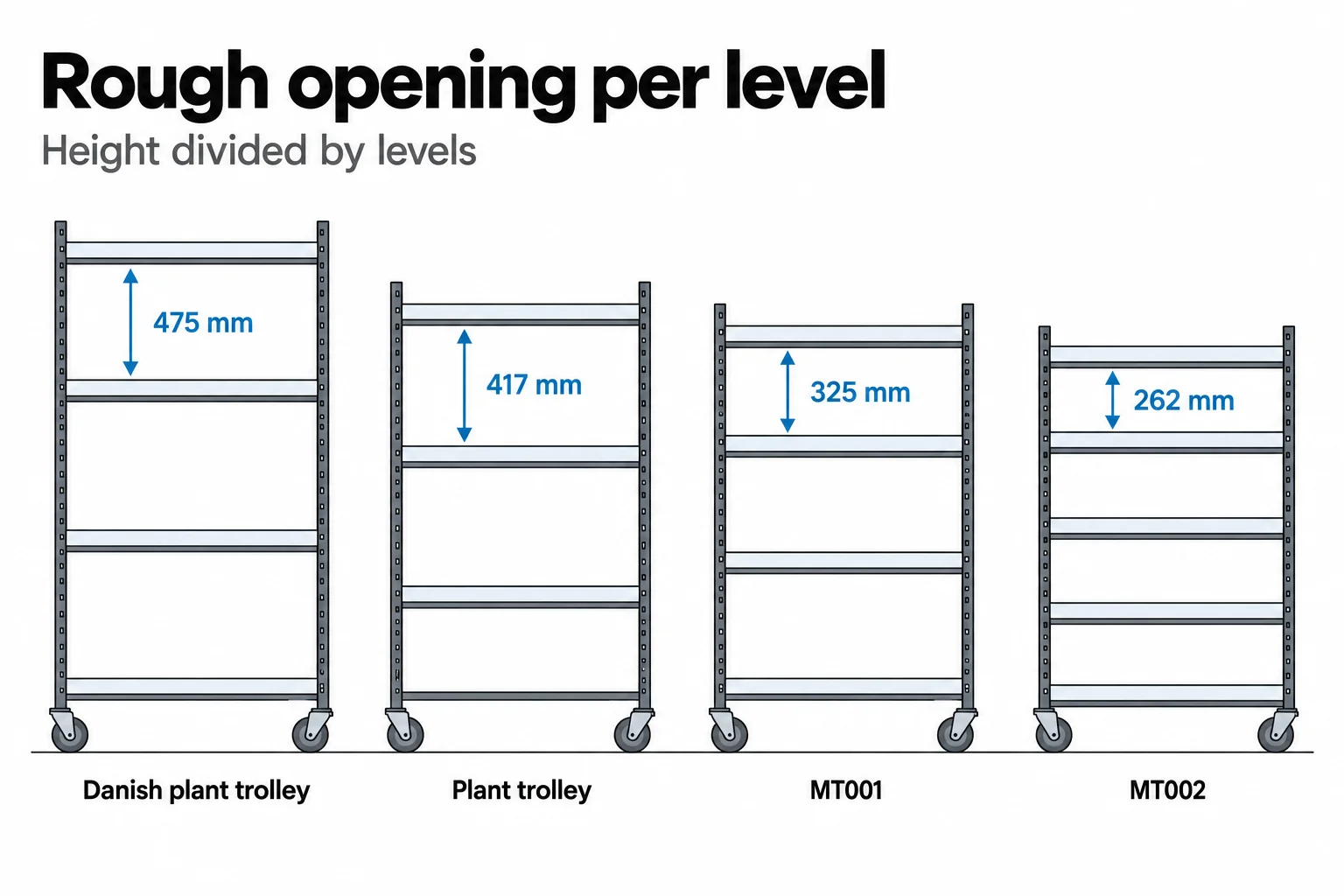
The sheet gives the overall height and the number of levels, not the opening between shelves. A rough guide is to divide the overall height by the number of levels. That includes the wheels and the top frame, and the true opening is a little smaller, but it shows the order of size.
| Model | Height | Levels | Roughly per level | Per level load |
|---|---|---|---|---|
| Danish plant trolley | 1900 mm | 4 | 475 mm | About 112 kg |
| Plant trolley | 1250 mm | 3 | 417 mm | Not listed |
| MT001 | 1300 mm | 4 | 325 mm | About 62 kg |
| MT002 | 1309 mm | 5 | 262 mm | About 50 kg |
The last column spreads the rating evenly across the levels. It is a guide and not a rated figure for one shelf. It still tells you something. A level on MT002 is meant for about 50 kg of cartons, and a level on the Danish trolley for more than twice that. If your heaviest single item is close to the per level figure, ask the supplier for the rated load of one shelf.
A worked example of shelf spacing
Suppose your tallest item is a carton 300 mm high. It needs a clear opening of at least that, plus room to slide it in and out, which makes about 340 mm. On MT001 the rough opening is 325 mm, too tight, and on the Danish trolley it is 475 mm, with room to spare. The example is only an illustration, but the habit is useful. Write down the tallest item, add clearance for hands, and compare the sum with the opening height of each level before you look at anything else.
Spacing cuts both ways. A trolley with openings much taller than the goods wastes space that another shelf could use. A trolley whose openings are too small forces stacking, and stacking crushes bottom items. The 5-tier model suits small goods for this reason, since a shorter opening wastes less height.
Why These Frames Are Galvanized
All four trolleys are galvanized. The reason differs by use. A milk trolley meets washdowns, spills and outdoor dock time, and without a paint layer there is nothing to chip into the food area. A plant trolley meets watering, damp air and fertilizer, and these attack bare steel quickly. In both places zinc protects the steel without a paint layer. The milk trolley sheets say zinc plated and the Danish sheet says galvanized. Ask each supplier what process is used and how thick the coating is, since the two terms can mean different things. Our guide to steel pallets explains how galvanized and sprayed finishes differ.
Wheels, Brakes and the Route
A shelf trolley is only useful if it rolls where the work is. The MT001 has four casters with two brakes, and the MT002 has two swivel and two fixed wheels with brakes, the fixed pair tracking straight and the swivel pair steering. The sheets of the Danish and plant trolleys list no wheel details. Ask for the wheel size, material and brake before you order. A tall trolley loaded high rolls differently from a low one, and the 1900 mm Danish trolley is the tallest in the group.
The route matters as much as the wheel. A trolley that goes up a loading ramp, across a greenhouse floor or over a store threshold needs wheels that suit all three. Walk the route and write down every slope, step and door before you choose.
Folding, Nesting and the Container
Empty shelf trolleys take a lot of space for little weight, and the way they pack decides the freight. The milk trolleys fold flat and nest, which is why 500 MT001 or 490 MT002 fit in one 40HQ container. The extra shelf on MT002 adds steel to every trolley, which is why it ships ten fewer.
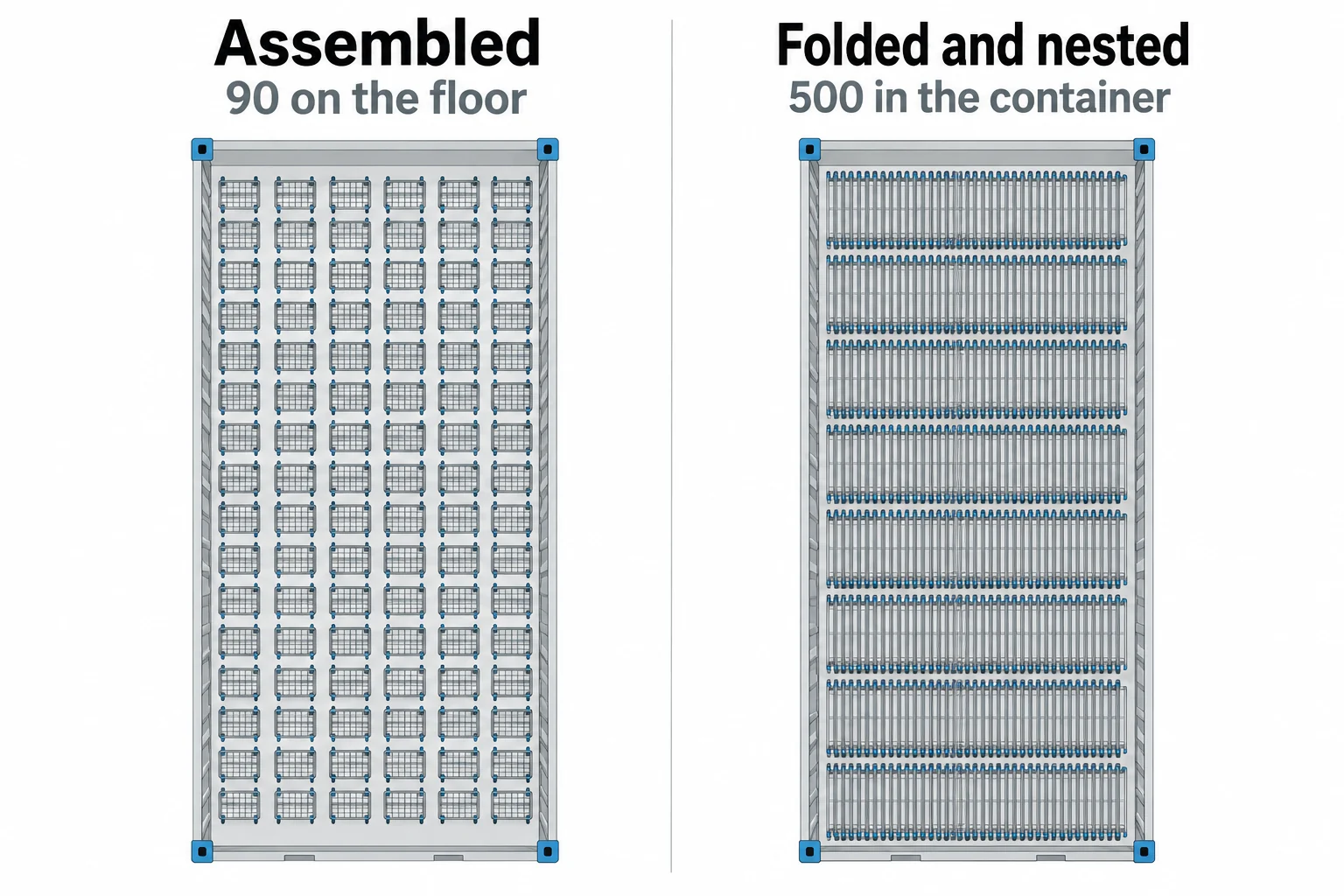
To find out how much folding and nesting saves, compare the factory count with the number of assembled trolleys that fit on the floor of a 40HQ container. The calculation uses the standard inside size of 12,032 × 2,352 × 2,698 mm and a single layer. That suits every model except possibly the 1250 mm plant trolley, whose page mentions stackability. It is a guide to scale and not a measured loading figure.
| Model | Assembled on the floor | Factory count | Gain |
|---|---|---|---|
| MT001 | 90 | 500 | 5.6 times |
| MT002 | 90 | 490 | 5.4 times |
| Plant trolley | 68 | Quoted with the order | Not listed |
| Danish plant trolley | 32 | Quoted with the order | Not listed |
The milk trolleys pack more than five times as many as assembled frames could. The Danish and plant trolley sheets give no container count, and the product pages say it is planned and quoted with the order. A buyer should ask whether the shelves and the frame can be knocked down or stacked, and how many then fit.
Dairy Rounds in Detail
The milk trolley shows a shelf trolley doing one job week after week. It is loaded at the dairy, rolled into the truck and wheeled to the store chiller. Braked casters hold it steady on the dock and in the truck. The wire mesh shelves keep crates and bottles ventilated and visible, so staff can find a product without unloading a level. When the route is done, the frame folds flat and nests with others for the return trip. That cycle explains every feature. The mesh serves the chiller, the brakes serve the truck, the zinc serves the washdown and the nesting serves the empty leg.
The two models split the work. MT001 gives each level more height and carries full dairy crates as the unit load. MT002 splits the same 250 kg working load over five shorter levels, and bottles, small cartons and mixed products sort by shelf. Both are standard models, and a custom tier count or shelf size can be built from your drawings.
Shelf Trolley, Roll Cage or Platform Trolley
A shelf trolley is easy to confuse with two neighbors. A roll cage trolley has sides and a gate, and it holds loose or boxed goods in one open space, as our guide to the roll container explains. A platform trolley has one flat deck and no shelves, as our guide to platform trolleys explains. A shelf trolley sits between them. It has several decks, so it carries many small units in a small footprint, and its open or meshed sides keep each level visible.
| Question | Shelf trolley | Roll cage | Platform trolley |
|---|---|---|---|
| Levels | Several | One space | One deck |
| Best for | Many small units, sorted by level | Mixed or loose goods | Wide, flat loads |
Milk trolleys are a hybrid. They are roll cages with shelves, which is why our milk trolleys sit with the roll cage range on our site. Choose the shelf version when units are small and must be sorted, and the plain cage when the goods are bulky and loose.
Loading and Stability
A tall narrow trolley is only as safe as its loading. Put the heaviest items on the lowest shelves, keep the load centered, and avoid loading one side more than the other. Brake the trolley whenever it is parked, and release the brake before you push. On a ramp, keep the trolley under control and never let it run ahead of you. A trolley that is full on top and empty at the bottom is a tipping hazard, however good the frame.
Two features help. Brakes hold the loaded trolley still at a dock or in a truck, and a wider footprint resists tipping. The Danish trolley has the widest footprint in the group. If your site has steep ramps or uneven floors, say so in the brief and the supplier can discuss wheels and brakes with you.
Cleaning and Care
Galvanized shelf trolleys need little care, and the routine depends on what they carry. For milk trolleys, hose and detergent cleaning does not lift the zinc layer, and the open mesh drains and dries on its own, which makes routine care simply washing the trolley. For plant trolleys, rinse off fertilizer and soil, and let plywood shelves dry so that they do not stay wet. For every trolley, check the wheels and brakes, look for bent shelf supports and replace any shelf that has cracked or swollen.
If a trolley is damaged, tell us the model and we supply repair advice. A bent upright or a failed weld is a safety issue, and the trolley should come out of service until it is repaired.
Which Trolley for Which Round
The same four trolleys fit different rounds, and the table below shows the match. It follows the jobs named on the product pages. Use it as a starting point and check it against your own goods.
| Round | What rides the shelves | Trolley to look at |
|---|---|---|
| Dairy to store | Full milk crates | 4-tier MT001 |
| Supermarket restocking | Bottles, cartons, mixed dairy lines | 5-tier MT002 |
| Nursery to truck to garden center | Potted plants, flowers, various goods | Danish plant trolley |
| Display and storage on a shop floor | Plants and flowers on show | Three layer plant trolley |
Danish and Plant Trolleys in Horticulture
Plants move many times between the grower, the truck, a market or auction, and the shelf in a garden center. A Danish trolley is made for that chain, and the sheet of our model says it is favored by nurseries, gardens and flower auction businesses. The 1350 × 560 mm footprint is the size listed, and the page text gives the overall dimension as 1350 × 565 × 1900 mm with an inner space of 1270 × 540 mm. The two figures differ by 5 mm. Confirm the exact size before you buy trolleys that must work with an existing fleet.
The smaller three layer plant trolley is described for displaying, storing and transporting plants, flowers and horticultural products, in garden centers, nurseries and florists. Its page says it meets the main requirements of the industry, including size, weight, stackability and quality. If your customers rent or pool trolleys, check whether they require trolleys from a specific pooling system, because that decides whether a standard Danish trolley is acceptable. We make no claim of membership in any pool.
What the Four Sheets Do Not Say
Reading a sheet for what it leaves out is half the job. The Danish plant trolley sheet gives size, levels, rating, weight and finish, but no wheel details and no container count, and the shelf count and the rating of a single shelf should be confirmed in writing. The plant trolley sheet gives size, levels, weight and finish, with no rating. The milk trolley sheets give size, rating, weight, tiers, finish and container count, and they describe the casters in the text, but they do not give the wire diameter or the rating of one shelf. None of the four lists a coating thickness.
These gaps are normal for a catalog. They are also exactly what a buyer should ask about, because each one changes how the trolley behaves in daily use. Put the missing items on your question list and ask for the answers in writing with the quotation, so that nothing is left to memory.
How Many Trolleys for a Round
A route needs enough trolleys to cover every one that is full, empty, in transit or waiting. Count the trolleys one delivery uses. Multiply by the deliveries in one round trip, and that number depends on how fast empties return. Add a margin for repair.
As an example, if a store takes 12 trolleys per delivery and the empties return after one more delivery, you need two sets of 12, or 24 trolleys, in the loop for that store. Ten such stores need 240. If each trolley is fully used and folds flat on the return, the truck space saved on the empty leg also lets you carry more full trolleys on the outbound leg. The figures are an illustration, and your loop will differ. The shape of the sum is the useful part, because it shows why a faster return saves you from buying trolleys as surely as a cheaper trolley does.
One more check applies to the Danish trolley. Its sheet lists four layers and 450 kg. Ask the supplier to state in the quotation how many shelves are fitted and what one shelf carries, since a buyer cares about both.
Questions to Settle Before You Order
- What is the tallest item on the shelf? Compare it with the opening height of each level.
- What is the heaviest load on one shelf? Ask for the rated load of a single level as well as the total.
- Mesh or solid shelves? Mesh drains and breathes, and solid shelves carry pots and trays.
- Which wheels and brakes? Give the diameter, the material and the number of brakes.
- Does it fold or nest? The answer sets the empty return and the container count.
- Which finish, and how thick? Ask for the process and the coating thickness.
- Must it match an existing fleet? Send the old trolley's dimensions and shelf spacing.
Custom Tiers and Sizes
The standard range already shows how the same frame changes. The 5-tier MT002 is a standard variant of the 4-tier MT001, and our OEM service builds to your drawings or samples. The process starts with solution drawings, then tested samples and mass production after you confirm them. A utility model patent covers our milk trolley structure, and the certificates page lists it by number, ZL 2023 2 0649660.7.
Drawings and requirements are answered within 24 hours on working days, and every batch ships with a quality report after final inspection. The full range sits on our roll cage and milk trolley page, and you can send your brief through the contact page. For other wheeled equipment, see our guides to roll containers and to platform trolleys.
 Related Questions