
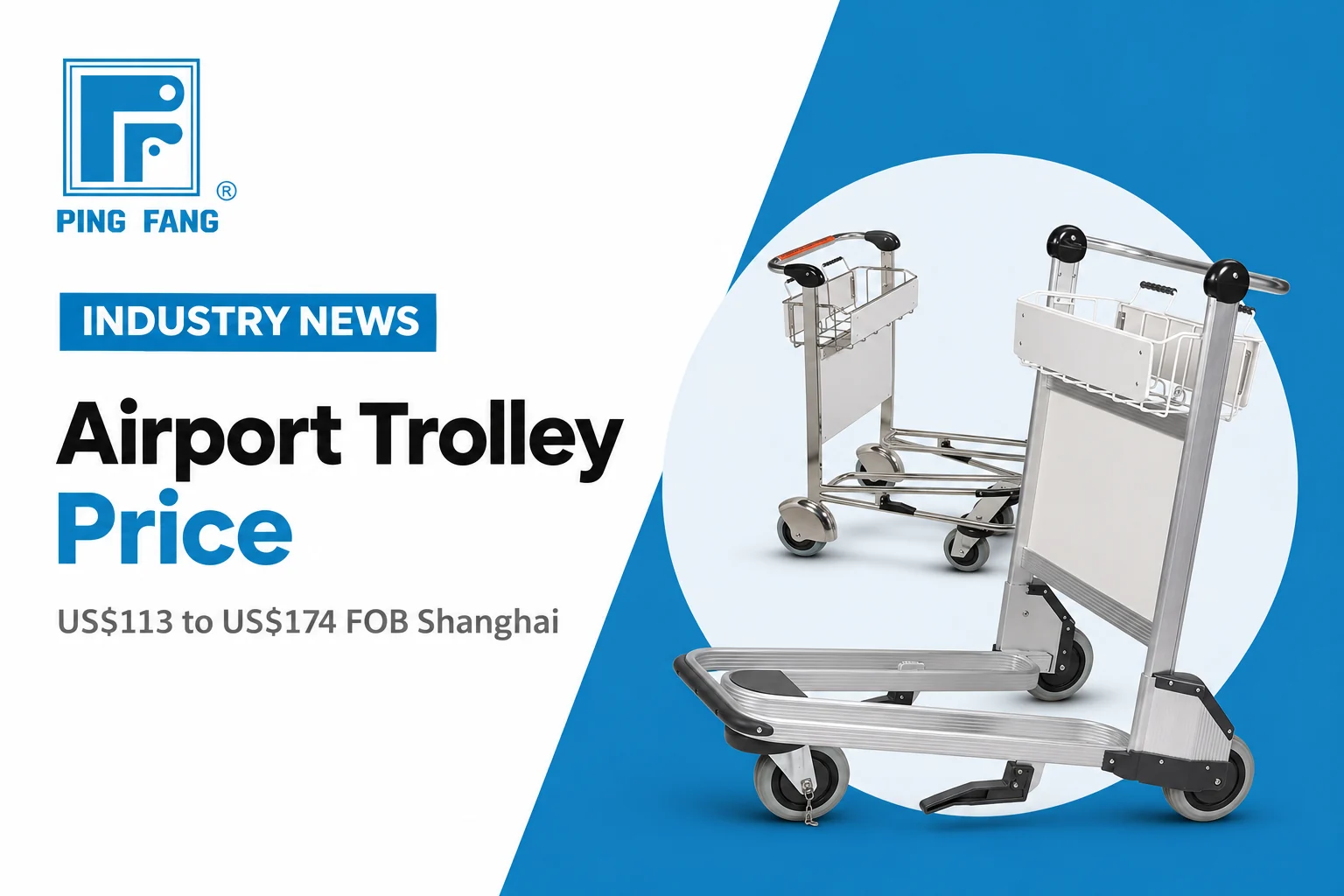
An airport trolley price depends on more than the metal. Brake, wheels, basket, advertising plate and weight all change the number, and a list of sixteen prices with no explanation is hard to use. This page puts each of our airport trolley prices next to the facts that sit behind it, taken from the model sheets, and then shows what the list says about aluminum against stainless steel, about weight and about freight. The prices are the factory's FOB Shanghai prices in US dollars per piece, based on one 40HQ container.
Airport Trolley Price at a Glance, Sixteen Models
The airport trolley price below is for one trolley when a full container is ordered, loaded at the port of Shanghai. Sea freight, duty and tax are not included. Where two models have the same size, the name of the model on the product page tells them apart.
| Model | Load | Weight | Per 40HQ | FOB Shanghai |
|---|---|---|---|---|
| Aluminum 790 × 525 × 1020 | 90 kg | 13 kg | 408 | US$113.30 |
| Stainless 710 × 510 × 1000 | 90 kg | 13 kg | 408 | US$113.30 |
| Aluminum 980 × 670 × 1040 | 250 kg | 18 kg | 252 | US$117.00 |
| Aluminum 1030 × 670 × 1040 | 250 kg | 18 kg | 252 | US$119.50 |
| Aluminum 1030 × 670 × 1070 | 250 kg | 20 kg | 252 | US$128.00 |
| Aluminum 980 × 675 × 1050 | 250 kg | 19 kg | 252 | US$135.20 |
| Aluminum 980 × 675 × 1050, 160 and 180 mm wheels | 250 kg | 19 kg | 252 | US$139.50 |
| Steel 940 × 570 × 980 | 100 kg | 18.5 kg | 410 | US$140.00 |
| Aluminum 950 × 670 × 1040, 150 L basket | 100 kg | 22.6 kg | 204 | US$145.00 |
| Stainless 1090 × 670 × 1030 | 250 kg | 22 kg | 252 | US$145.30 |
| Stainless 1000 × 670 × 1000 | 250 kg | 21 kg | 252 | US$149.50 |
| Stainless 1020 × 620 × 1040, 430 mm plate | 250 kg | 21 kg | 252 | US$152.50 |
| Stainless 1250 × 670 × 1050 | 250 kg | 23 kg | 240 | US$155.50 |
| Stainless 1070 × 620 × 1030, TPU wheels | 250 kg | 22 kg | 246 | US$164.00 |
| Stainless 1020 × 620 × 1040, 330 mm plate | 250 kg | 23.5 kg | 252 | US$169.80 |
| Stainless 1070 × 620 × 1030 | 250 kg | 24.5 kg | 252 | US$174.00 |
Aluminum Against Stainless Steel
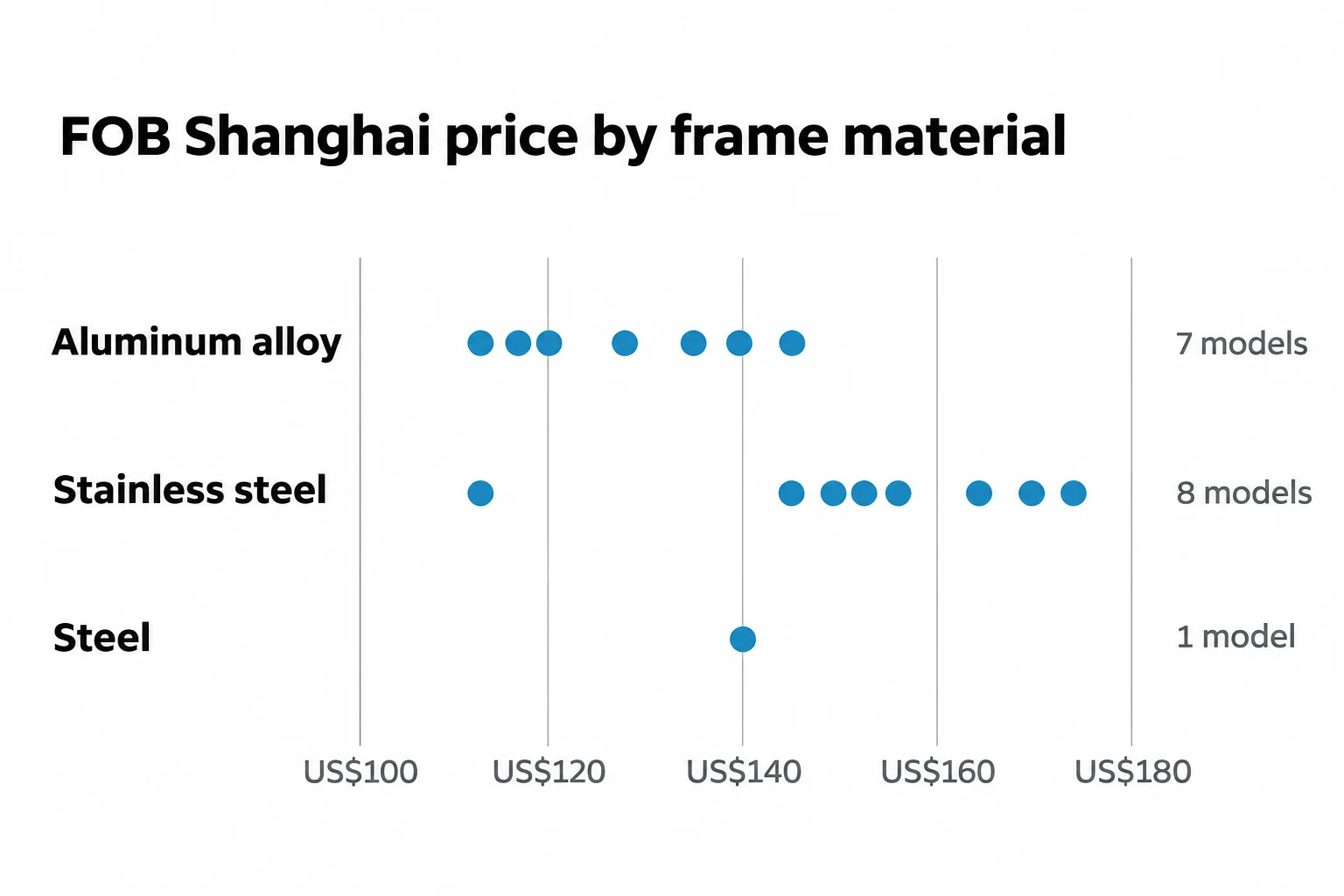
The airport trolley price question buyers ask first is how much more stainless steel costs. Among the 250 kg models the answer is clear in the list. The five aluminum alloy trolleys cost US$117.00 to US$139.50, with an average of about US$128. The seven stainless steel trolleys cost US$145.30 to US$174.00, with an average of about US$159. Stainless steel runs about a quarter higher on average, and the cheapest stainless trolley still costs more than the dearest aluminum one.
The price gap is the price of a different material for a different place. Aluminum alloy suits a clean terminal where weight matters, and stainless steel suits places where trolleys are washed or kept outdoors. Our guide to the airport luggage trolley goes through the choice of metal in more detail.
Airport Trolley Price Follows the Weight
The most useful pattern in the list appears when you divide each price by the weight of the trolley. The result is the cost of each kilogram of trolley, and it is a calculation from the table, not a test result.
| Model, 250 kg | Weight | FOB Shanghai | Per kg of trolley |
|---|---|---|---|
| Aluminum 1030 × 670 × 1070 | 20 kg | US$128.00 | US$6.40 |
| Aluminum 980 × 670 × 1040 | 18 kg | US$117.00 | US$6.50 |
| Stainless 1090 × 670 × 1030 | 22 kg | US$145.30 | US$6.60 |
| Aluminum 1030 × 670 × 1040 | 18 kg | US$119.50 | US$6.64 |
| Stainless 1250 × 670 × 1050 | 23 kg | US$155.50 | US$6.76 |
| Stainless 1070 × 620 × 1030 | 24.5 kg | US$174.00 | US$7.10 |
| Aluminum 980 × 675 × 1050 | 19 kg | US$135.20 | US$7.12 |
| Stainless 1000 × 670 × 1000 | 21 kg | US$149.50 | US$7.12 |
| Stainless 1020 × 620 × 1040, 330 mm plate | 23.5 kg | US$169.80 | US$7.23 |
| Stainless 1020 × 620 × 1040, 430 mm plate | 21 kg | US$152.50 | US$7.26 |
| Aluminum 980 × 675 × 1050, 160 and 180 mm wheels | 19 kg | US$139.50 | US$7.34 |
| Stainless 1070 × 620 × 1030, TPU wheels | 22 kg | US$164.00 | US$7.45 |
All twelve 250 kg trolleys fall between US$6.40 and US$7.45 per kilogram, aluminum and stainless alike. That says the price of an airport trolley follows the amount of metal and the parts on it, and not the name of the material. A trolley that is 2 kg heavier costs roughly US$13 to US$15 more. The pattern also explains why two stainless trolleys of the same size can cost different amounts, since they weigh different amounts and the heavier one is dearer. If you want a cheaper trolley of the same kind, the lighter model in the same size is the place to look.
Airport Trolley Price of the 90 kg and 100 kg Models
Four models are rated below 250 kg. The two 90 kg trolleys, an aluminum 790 × 525 × 1020 mm and a stainless steel 710 × 510 × 1000 mm, share the lowest price of US$113.30. Both weigh 13 kg and run on 125 mm TPU swivel wheels, and 408 fit in a container. The steel model at 940 × 570 × 980 mm is rated 100 kg, costs US$140.00 and fits 410 per container with 5 inch PU wheels on double axles. The aluminum model with a 150 L basket is rated 100 kg, weighs 22.6 kg, has an automatic brake and 5 inch PU front wheels, and costs US$145.00 with 204 to a container.
On airport trolley price alone the light models are the cheapest in dollars and not in dollars per kilogram, which is about US$8.70 for a 90 kg model against about US$6.50 for a 250 kg aluminum one. A small trolley needs the same wheels, the same handle and the same assembly as a large one. If the job is light, the small models are the right buy, and if you are unsure, the 250 kg models give more rated load for each dollar.
Brake, Wheels and Plate in the Airport Trolley Price
Most 250 kg models have an automatic brake and 180 mm natural rubber wheels, and the list shows which ones differ. The two stainless models without a brake, the 1090 × 670 × 1030 mm and the 1000 × 670 × 1000 mm, are the two cheapest 250 kg stainless trolleys at US$145.30 and US$149.50, and they also have smaller baskets of 455 and 470 mm. Two trolleys carry TPU wheels together with rubber wheels, the stainless 1070 × 620 × 1030 mm with TPU wheels at US$164.00 and the stainless 1090 × 670 × 1030 mm at US$145.30. The aluminum 980 × 675 × 1050 mm model comes in two versions, with 180 mm wheels at US$135.20 and with 160 and 180 mm wheels at US$139.50.
The advertising plate also varies. Two stainless trolleys of the same 1020 × 620 × 1040 mm size carry a 430 mm and a 330 mm plate, at US$152.50 and US$169.80, and the weights are 21 kg and 23.5 kg. The sheet gives no reason for the difference beyond the weight, so check what is included before you compare two quotes for trolleys that look alike.
What the Container Count Does to the Real Price
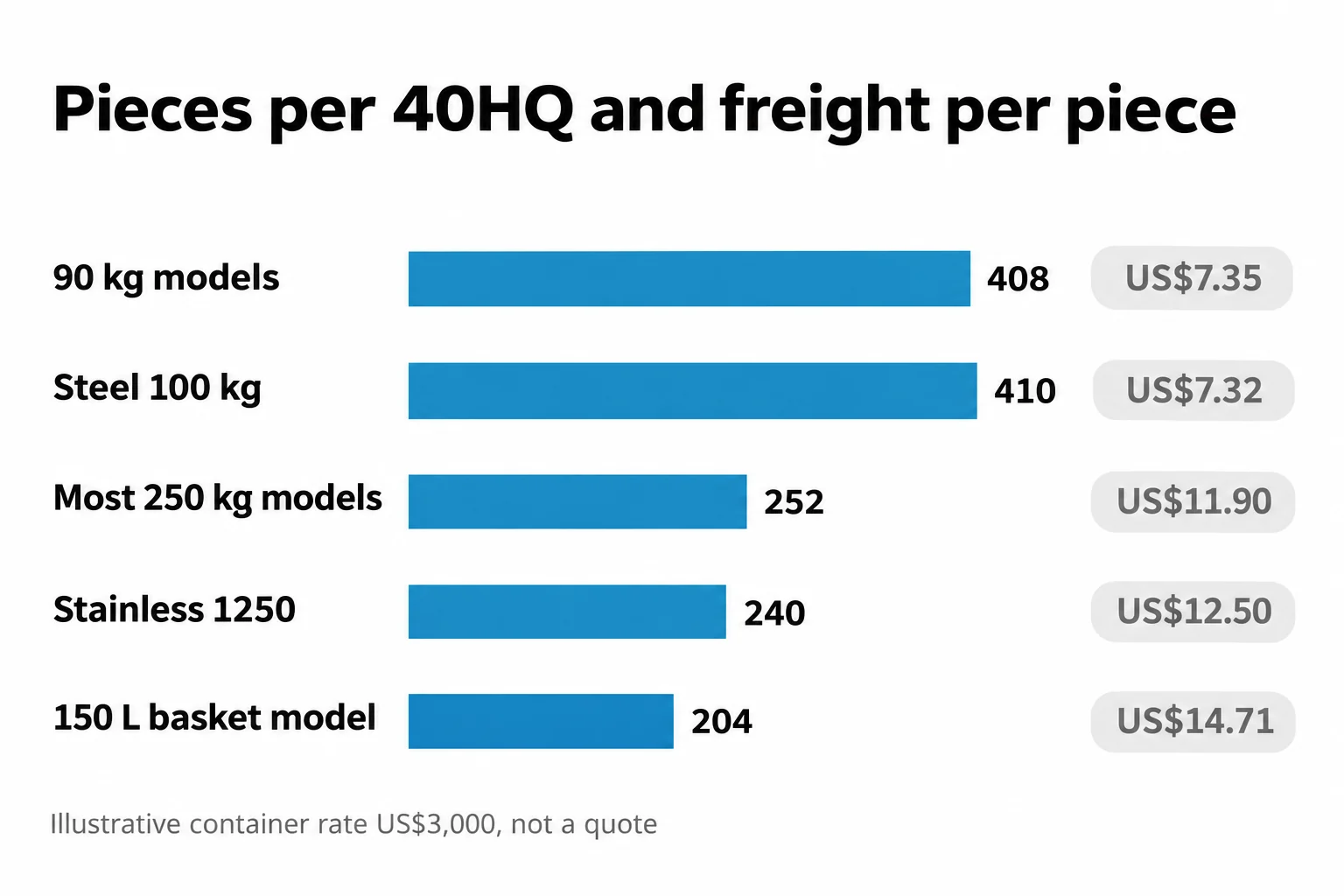
Airport trolleys are bulky, with 204 to 410 in a 40HQ container against more than 1,000 for a folding platform trolley, so freight is a larger part of the cost. The table uses an illustrative container rate of US$3,000 to show the effect, and it is not a quote. Your real rate depends on the port, the season and the forwarder.
| Group | Per 40HQ | Freight per piece at US$3,000 | Share of a typical price |
|---|---|---|---|
| 90 kg aluminum and stainless | 408 | US$7.35 | About 6.5% |
| Steel, 100 kg | 410 | US$7.32 | About 5.2% |
| Most 250 kg models | 252 | US$11.90 | About 8 to 10% |
| Stainless 1250 × 670 × 1050 | 240 | US$12.50 | About 8% |
| Aluminum with 150 L basket | 204 | US$14.71 | About 10% |
At that rate freight adds about 5 to 10% to the price, so a trolley that costs US$5 less but packs worse can end up dearer. Ask for the loading plan of the exact model, and compare landed cost.
What One Container Order Costs
Because the airport trolley price is based on a full container, one order is a considerable sum. A container of the 117.00 dollar aluminum model holds 252 trolleys and costs US$29,484 FOB Shanghai. A container of the 174.00 dollar stainless model holds 252 and costs US$43,848. A container of the 113.30 dollar 90 kg model holds 408 and costs US$46,226. If you want a smaller trial order or a mixed container, say so in the inquiry, and the price for that quantity is confirmed in the quotation and is not the price in the table.
Comparing Airport Luggage Trolley Price Quotes
When you collect quotes from several suppliers, put the same facts side by side.
- The trade term and the quantity the price is based on.
- The material and, for stainless steel, the grade.
- The rated load and the empty weight.
- Whether there is an automatic brake, and what the wheels are.
- The basket and the advertising plate, with their sizes.
- The number of pieces in a 40HQ container and how each is packed. Ours are packed one to a bubble bag.
A supplier who cannot give these facts is quoting a trolley you cannot compare.
Frames, Baskets and Handles as Listed
The material list on each sheet is the second place to look after the weight, since two trolleys of one size can be built from different parts.
| Frame | Basket | Handle | Models |
|---|---|---|---|
| Aluminum alloy | Powder coated steel | Aluminum alloy | 980 × 670 × 1040, 980 × 675 × 1050 (both versions), 950 × 670 × 1040 with 150 L basket |
| Aluminum alloy | Powder coated steel | PVC | 1030 × 670 × 1040, 1030 × 670 × 1070 |
| Aluminum alloy | Stainless steel | PVC | 790 × 525 × 1020, 90 kg |
| Stainless steel | Stainless steel | PVC | 1020 × 620 × 1040 (both plates), 1070 × 620 × 1030 (both versions) |
| Stainless steel | Stainless steel | Stainless steel | 1250 × 670 × 1050 |
| Steel | Not listed | Not listed | 940 × 570 × 980, zinc with powder coating |
The steel model is finished in zinc with a powder coat, and the aluminum 790 × 525 × 1020 mm model is listed with a light oxidation finish. For the choice between zinc and a powder coat on the steel parts, see our article on galvanized vs powder coated.
Wheels, Listed Model by Model
Wheels are the other large item on the sheet. Most 250 kg models roll on 180 mm natural rubber wheels. The two 90 kg models use 125 mm TPU swivel wheels. The steel model has 5 inch PU wheels on double axles, and the 150 L model has 5 inch PU swivel front wheels with 180 mm rubber wheels at the back. Three models mix sizes or materials, and these are the stainless 1070 × 620 × 1030 mm and 1090 × 670 × 1030 mm with 125 mm TPU and 180 mm rubber wheels, and the aluminum 980 × 675 × 1050 mm with 160 and 180 mm wheels.
Wheel size and material change how a trolley rolls over joints and thresholds, and a larger wheel generally copes better with a rough floor. Tell the supplier about the floor and the length of the route before you choose, because the wheel is the part that decides how the trolley feels to push.
Weight, Handling and Packing
The trolleys weigh 13 to 24.5 kg, and each is packed in its own bubble bag, one piece per bag. The weight matters in two places. It sets the freight, because a container carries a fixed number of trolleys and not a fixed weight. It also sets how easy the trolley is to handle when a staff member has to lift one into a store or a van. The 13 kg models are the lightest, and the 24.5 kg stainless steel model is the heaviest.
A trolley that needs to be lifted often favors the lighter models. Match the model to the way the trolley will be used, and the price will follow.
What the Price Does Not Change
Several things are the same across the list. Every 250 kg model is rated at 250 kg, and most carry a 180 mm rubber wheel, an advertising plate and a basket of 525 × 220 × 150 mm, with the plate sizes listed on each sheet. The 150 L model is listed without a baby seat. If you want a plate printed with your logo, a different color or a baby seat, those are changes from the standard model and are quoted separately.
How to Think About the Right Trolley Before the Price
Start with the number of trolleys you will need, then the load, the floor and the climate. A terminal that washes its trolleys and keeps them in a damp place may prefer stainless steel. A terminal that keeps them indoors and wants light ones to push may prefer aluminum alloy. Only then compare the prices of the models that fit, and compare them as landed cost.
The price list answers what a model costs and the sheet answers what a model is. The quotation joins them with your quantity, your port and your terms.
A Budget Example
To work out how the numbers add up, take three container orders of 250 kg models, each priced at the 40HQ quantity of 252. The freight line again uses the illustrative US$3,000 container rate, and duty and tax are left out because they depend on the country.
| Order | FOB Shanghai | Freight at US$3,000 | Before duty and tax | Per trolley |
|---|---|---|---|---|
| 252 aluminum 980 × 670 × 1040 | US$29,484 | US$3,000 | US$32,484 | US$128.90 |
| 252 stainless 1020 × 620 × 1040, 430 mm plate | US$38,430 | US$3,000 | US$41,430 | US$164.40 |
| 252 stainless 1070 × 620 × 1030 | US$43,848 | US$3,000 | US$46,848 | US$185.90 |
The same count of trolleys can cost US$32,000 or US$47,000 depending on the model, and the freight is the same amount in each case. The freight share is largest for the cheapest model, at about 9%, and smallest for the dearest, at about 6%. That is why a price list alone does not tell you the budget, and why the number per container matters.
Mistakes When Comparing Airport Trolley Prices
- Comparing two prices with different trade terms or quantity bases.
- Ignoring the weight. Two trolleys of the same size can differ by 2 kg and by US$13 to US$15.
- Treating aluminum and stainless steel as the same product at different prices. They suit different places.
- Leaving out the brake, the plate or the basket when you list what you need.
- Forgetting freight on a bulky item, where it can add 5 to 10% to the price.
Quality Behind the Price
An airport trolley price tells you what you pay, and the quality system tells you what you get. Every order passes four inspection checkpoints, covering incoming materials, in-process self-inspection with QC patrol, inspection before surface treatment and final inspection before shipment, and a quality inspection report comes with the shipment. The quality system is ISO 9001 certified, and frames are welded on robot welding machines so that every joint is made the same way. A sample is built on the same stations as a bulk order when a project needs one, and you confirm it before mass production starts. Our guide on how stillages are made describes the factory route in detail, and airport trolleys run down the same stations.
When the Cheapest Airport Trolley Is the Wrong One
The lowest airport trolley price in the list belongs to the two US$113.30 models are the cheapest in the list, and they are rated 90 kg. A trolley carrying a passenger's heavy luggage regularly needs the rating of a 250 kg model, and a trolley sized for light bags will not suit that job however low the price. In the same way, a trolley without an automatic brake is a poor choice where the floor slopes. Choose the rating, the brake and the wheel for the real use, and then pick the lowest price among the models that meet them.
Aluminum or Stainless Steel, Decided by the Place
The material choice follows the setting more than the budget. Aluminum alloy is lighter and costs less in this list, which suits a covered terminal with regular cleaning. Stainless steel costs more and suits places where trolleys are washed often, left in damp areas or used for years in a harsh setting. The two groups overlap in the 90 kg class, where the aluminum and stainless steel models cost the same US$113.30, so the material can be chosen freely there. If you have trolleys in service already, ask how they have aged, and let that settle the question.
Questions for Any Airport Trolley Manufacturer
When you compare us with other makers, ask each of them the same short list. Ask whether the price is FOB and for how many pieces. Ask for the weight, the rated load and the container count of the exact model. Ask what the wheels and the brake are, and what the frame and basket are made of. Ask whether the advertising plate is included and what size it is. Ask how the trolleys are packed and what inspection and report come with the order. Ask whether a sample is possible and how long the lead time is. A manufacturer who answers every line in writing is a manufacturer you can plan around.
What the List Leaves Out
The price list gives one figure per model, and several details sit outside it. The grade of the stainless steel is not stated on the sheets, so ask for it if your specification names one. The finish of the aluminum alloy frames is not part of the price list either, apart from the light oxidation listed on the 790 × 525 × 1020 mm model. Spare wheels, brake parts and replacement baskets are not priced here, and a buyer who runs a large fleet should ask for them with the order. Delivery time, which depends on the quantity and on the sample stage for any custom work, is confirmed with the quotation. None of this changes the reference price, and all of it belongs in the quotation, so put it on your list when you write to us. A short list in the first message saves a round of emails, and our technical sales team replies within 24 hours on working days with the loading plan and a per-unit freight estimate for the models you name.
Buying From the Factory
Buyers who search for an airport trolley for sale, a luggage trolley for sale or an airport trolley manufacturer find distributors and factories on the same page, and importers who buy luggage trolley fleets in volume save a step by asking the factory. A factory price is a price per piece for a container, and the importing is yours to arrange. Bulk orders usually run on a 30% deposit with the balance against a copy of the bill of lading, T/T is preferred and L/C is accepted. We send a loading plan and a per-unit freight estimate within 24 hours on working days once we have the quantity and the destination port. The airport luggage trolley category lists every model with its table, and our guide to warehouse trolley types shows how airport trolleys relate to the other families.
What to Send for an Exact Quote
- The model or models and the quantity of each.
- The destination port and the trade term, FOB, CIF or another.
- Any advertising plate you need, and its size.
- Any change from the standard model, such as a color, a logo or a different wheel.
If none of our sixteen models fits, our OEM service builds to your drawings or samples, starting with solution drawings, then tested samples and mass production once you confirm them.
 Related Questions